Key findings:
- Documents obtained by TTP shed light on OpenAI’s push for education customers and how schools are trying to justify their investment in premium ChatGPT amid shrinking budgets and faculty pushback.
- The California State University (CSU) system said it “paid the lowest price possible” for ChatGPT, but documents show it awarded OpenAI a sole-source contract without holding a competitive bidding process.
- Tech staff at CSU saw working with OpenAI as a “huge” branding opportunity but suggested it could deplete the university system’s “entire AI budget,” according to an internal presentation reviewed by TTP.
- OpenAI informed one customer, the University of California, that it was unable to meet requirements to keep student data in the U.S., a violation of school policy, a university official told colleagues.
- As part of its sales pitch, OpenAI has dangled perks to educators, such as membership in an exclusive AI forum featuring “dinner-mixers” at OpenAI and access to a Nobel laureate and other award winners.
When OpenAI and the California State University system announced a deal to supply more than half a million students and faculty with a version of ChatGPT customized for schools, CSU Chancellor Mildred Garcia hailed it as a way to “ensure that our diverse students from across California and staff are ‘AI-empowered’ to thrive as our world evolves.”
But behind the scenes, the CSU administration was sweating about how to defend the $17 million ChatGPT contract in the midst of looming budget cuts, according to internal documents obtained by the Tech Transparency Project through public records requests.
CSU should say it “paid the lowest price possible” which is “less than current and planned expenditures for these technologies,” according to talking points prepared for Garcia’s office. But the memo also noted that CSU awarded OpenAI a sole source contract without a competitive bidding process. If asked about this, the school should defend the decision by saying that OpenAI is the “current industry-leading provider” of AI and that students would benefit by having access to “the most utilized platform in the market,” the memo advised.
The decision to award a sole source contract to OpenAI raises questions about whether CSU paid the “lowest price possible” for AI, a talking point that university officials repeated in media interviews. In another internal document, CSU technology staff described working with OpenAI as a “huge branding” opportunity but suggested it ran the risk of depleting the university system’s “entire AI budget.”
These communications are part of a collection of documents obtained from OpenAI customers in the education field. They show how schools that have partnered with the company have at times struggled to justify their investment in the paid version of ChatGPT, ensure it meets student data security requirements, and overcome teacher concerns about AI’s impact on learning and academic integrity.
Some school officials have grappled with how to protect student data when working with OpenAI, TTP found. For example, an IT director at the University of California, another of OpenAI’s education customers, warned colleagues that OpenAI was unable to meet requirements to host sensitive data like education and health records in the U.S. He said OpenAI requested a contract revision to allow it to host the data offshore, a violation of the school’s security policies that created “significant” privacy risks.
The documents obtained by TTP also pull back the curtain on OpenAI’s aggressive courting of school administrators. The company has been bulking up its education sales team and conducting a nationwide roadshow to promote its product. In a sales pitch to one K-12 school district, OpenAI offered membership in an exclusive AI club featuring “dinner-mixers” at OpenAI and access to a Nobel laureate and other award winners.
OpenAI’s push to sign up schools for its premium ChatGPT product reflects the vast revenue possibilities of the education field—and the potential to hook generations of students on its tools. The company is going head to head against Google, Microsoft, and other firms to capture a global AI education market that, by one estimate, is expected to grow from $6 billion in 2024 to $32 billion by 2030.
**OpenAI & CSU comment/no comment
A critical deal
In May 2024, OpenAI debuted ChatGPT Edu, a paid version of its chatbot designed for universities. The product offers similar benefits to OpenAI’s business offering, ChatGPT Enterprise, such as higher message limits, data analytics, and the ability to build custom AI assistants. It also promises never to use student data and conversations to train OpenAI models—a selling point for schools required to safeguard the privacy of students.
At the time, many school districts that initially banned ChatGPT over fears of cheating and data privacy had begun cautiously allowing it back into the classroom, a nod to the fact that AI was becoming ubiquitous and the bans had proven largely ineffective.
The February 2025 deal with the California State University system represented a huge get for OpenAI as it ramped up its sales effort. Covering more than 520,000 students, faculty and staff across 23 campuses, the deal represented the “largest implementation of ChatGPT by any single organization or company anywhere in the world,” OpenAI boasted in an official announcement. Since then, the company has prominently featured the CSU rollout in its marketing.
CSU has also touted the ChatGPT deal, framing it as part of a broader collaboration with the AI industry. But records obtained by TTP show that the CSU administration grappled behind the scenes with how to justify the ChatGPT deal.
The talking points prepared for Chancellor Garcia’s office focused in large part on what CSU paid for ChatGPT—a sensitive issue given proposed budget cuts to the university system. At the time, Gov. Gavin Newsom’s state budget proposal included a $375 million or 8% reduction to the school system’s general fund, raising the specter of faculty layoffs and cuts to academic programs. Sonoma State, which is part of the CSU system, had already floated plans for staff reductions and elimination of academic and athletic programs.
The memo says CSU should acknowledge that “the timing of this investment is difficult” but reframe it as savings rather than an expenditure. “Due to our size, we have leveraged economies of scale to ensure that CSU paid the lowest price possible,” the memo suggests as a talking point. It goes on to say that $17 million is “less than current and planned expenditures for this technology” and thus “represents a significant savings rather than a new investment.” University officials used some of these talking points in media interviews.
But the memo also notes that CSU awarded a sole-source contract to OpenAI, raising questions about whether it secured the most cost-effective deal in the AI market. Sole-source contracts, which are issued without a competitive bidding process, are typically reserved for situations in which only a single business can fulfill the contract requirements.
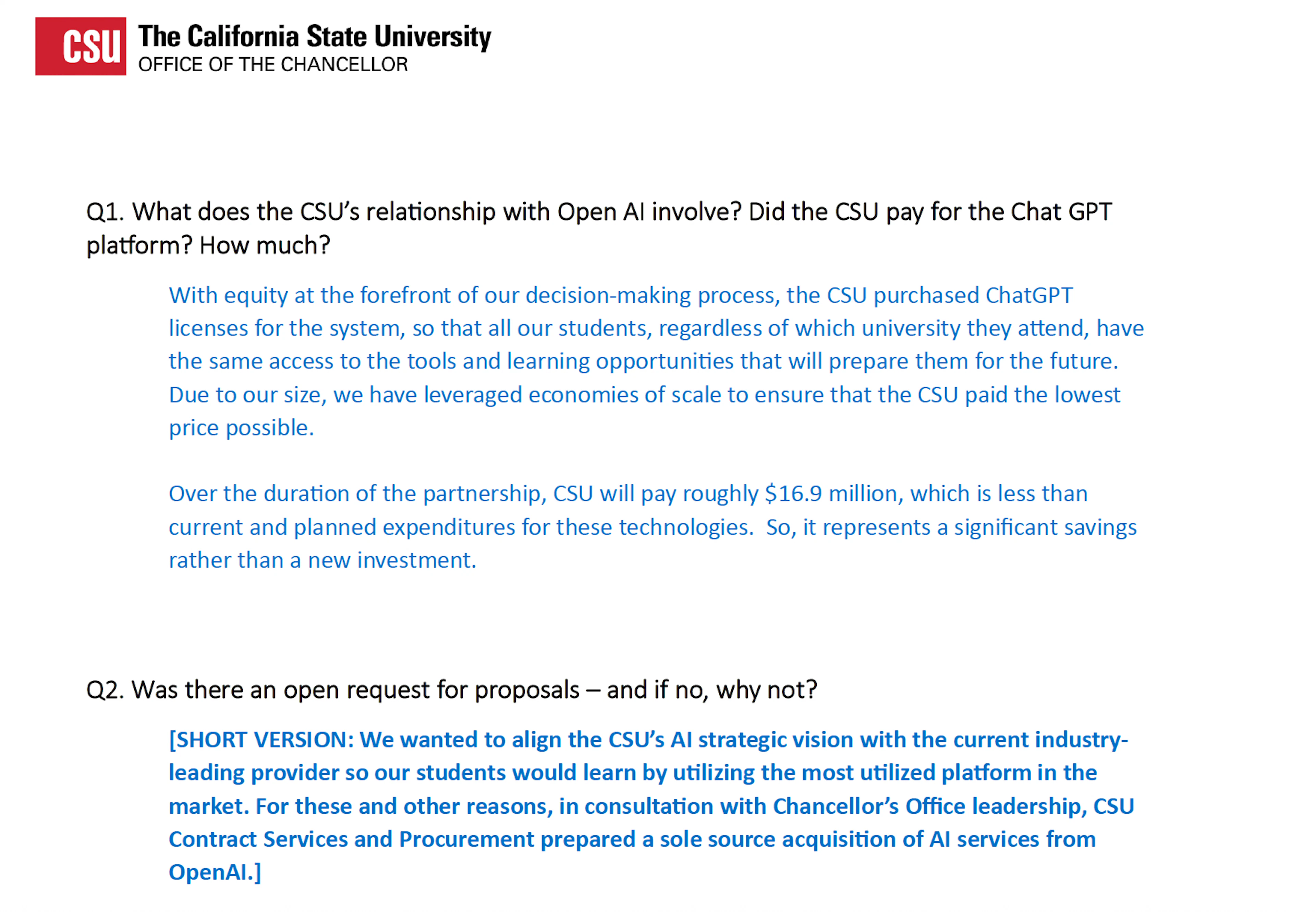
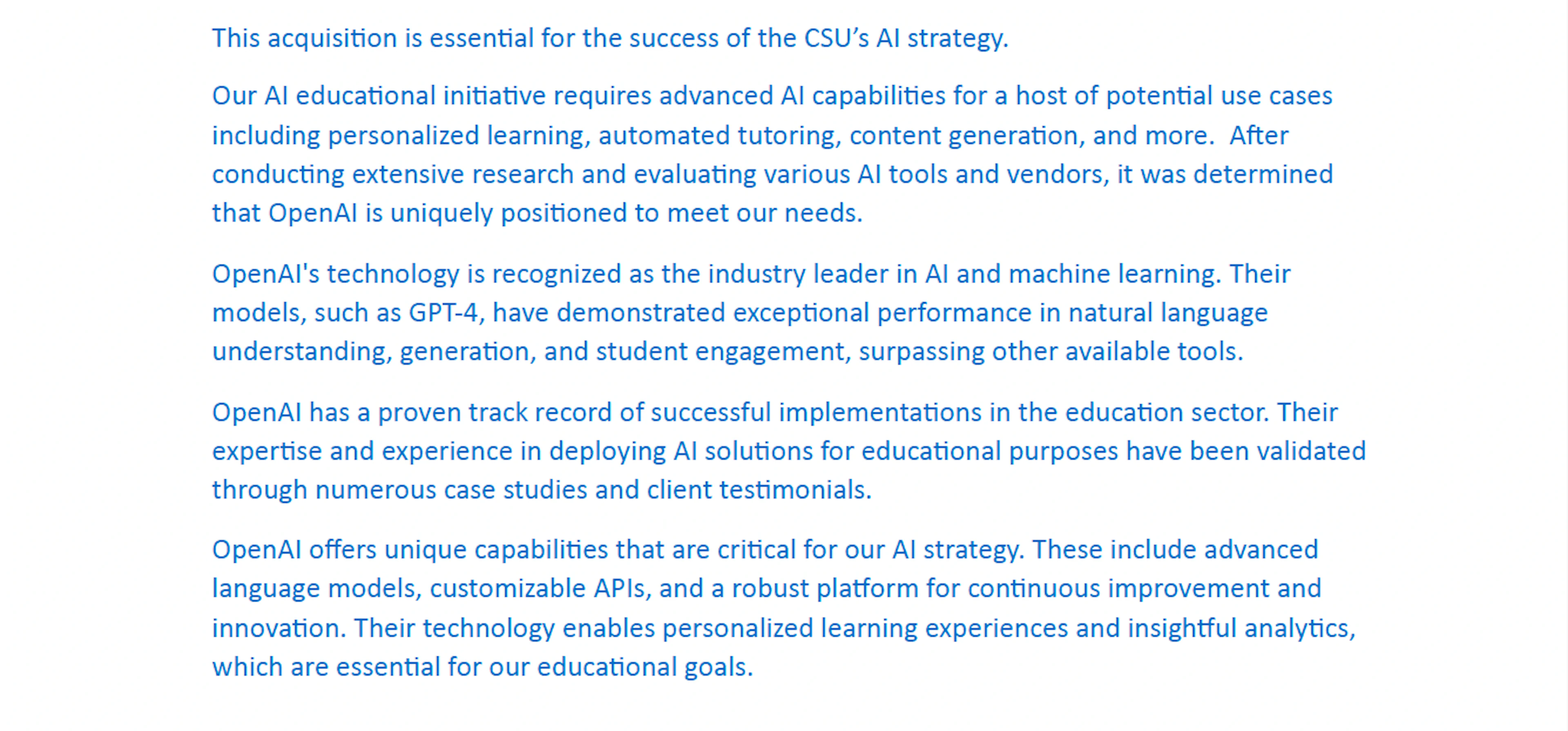
Talking points prepared for California State University chancellor's office said the university system "paid the lowest price possible" for ChatGPT but also noted that it awarded OpenAI a sole source contract without a competitive bidding process.
Talking points prepared for California State University chancellor's office said the university system "paid the lowest price possible" for ChatGPT but also noted that it awarded OpenAI a sole source contract without a competitive bidding process.
According to CSU’s contracts policy, requests for sole source procurement must “demonstrate that the supplier holds a unique (no other sources have it) set of skills or expertise that make it impossible for anyone else to do the work or that the goods are not available from another source.”
But CSU’s written justification for the sole source contract, which was obtained by TTP, attributes a number of “unique” features to OpenAI that are available from other AI companies.
For example, it says OpenAI is uniquely capable of providing advanced language models specifically tuned for education, something that is also offered by Google Gemini. It says OpenAI can provide personalized learning, which is offered by Gemini and Microsoft Copilot. It also says OpenAI has unique enterprise security features which meet CSU’s institutional requirements. TTP was not able to evaluate the requirements, but both Gemini and Copilot offer enterprise security for education.
The justification lists other unique features of OpenAI as “industry leader in generative AI” and “proven track record” in education—which are generalized descriptions rather than specific criteria.
CSU officials state in the justification that they reviewed Google’s LaMDA and Copilot but found they “did not meet the scope, scale and functionality important to CSU.” The officials say OpenAI offered “significant cost savings” compared with other providers, but it was unclear how this determination was reached without a competitive bidding process. (Individual CSU campuses can get licenses for Gemini, Copilot, and other AI services, but the CSU deal with OpenAI covers the entire university system of 23 campuses.)
**CSU comment/no comment on above points.
Another document obtained by TTP raise questions about CSU’s contention that it paid the “lowest price possible” for ChatGPT.
In December 2024 slide presentation, just weeks before the OpenAI deal was announced, CSU technology staff described working with OpenAI as a “huge branding opp” but said possible risks include that it “depletes entire AI budget.” The presentation, which weighed the pros and cons of various AI options for the school system, estimated the cost of ChatGPT to be between $10 million to $15 million per year. It said the AI options under consideration ranged from $12.5 on the low end and $17.5 million on the high end. CSU ultimately paid nearly $17 million for an 18-month contract for ChatGPT.
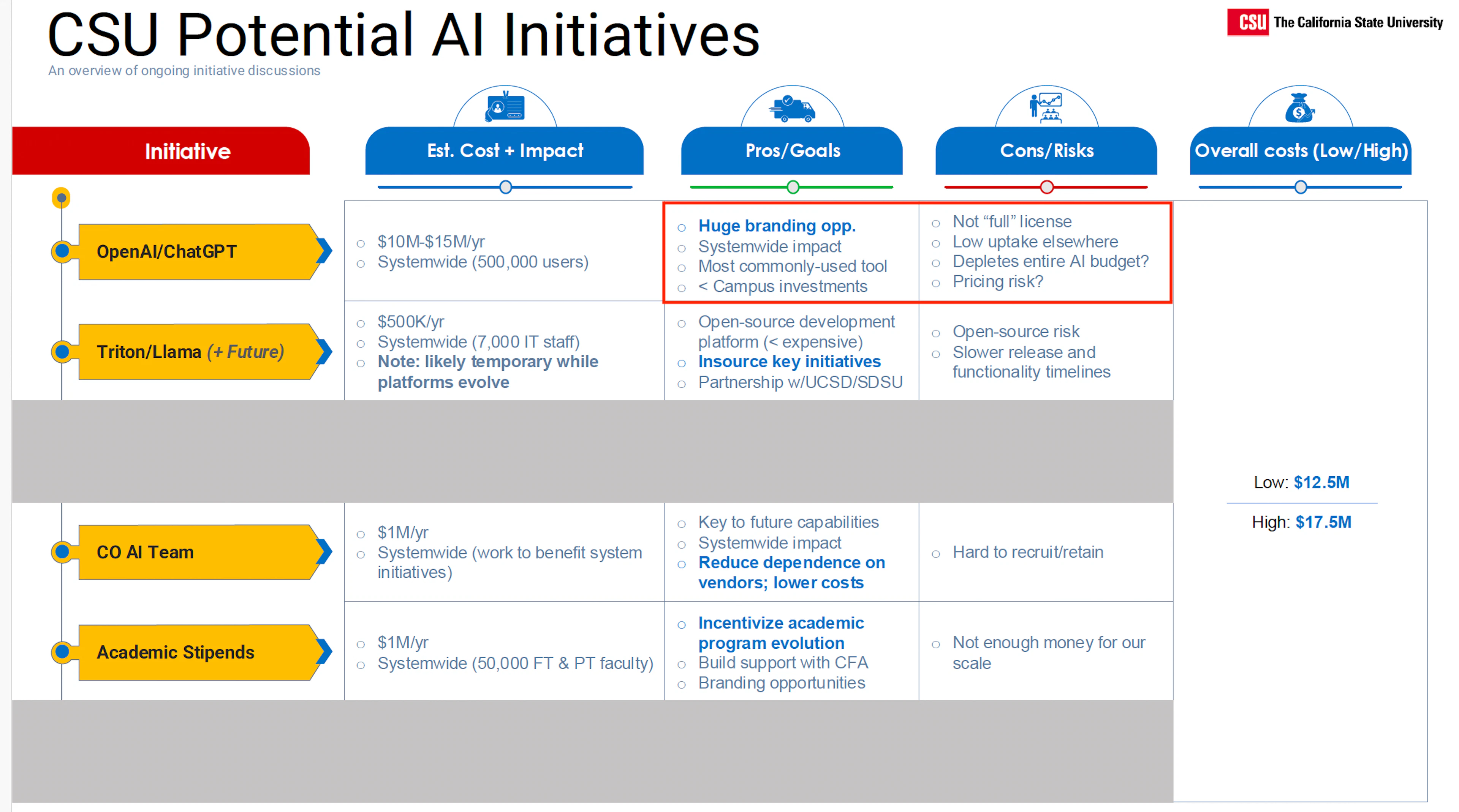
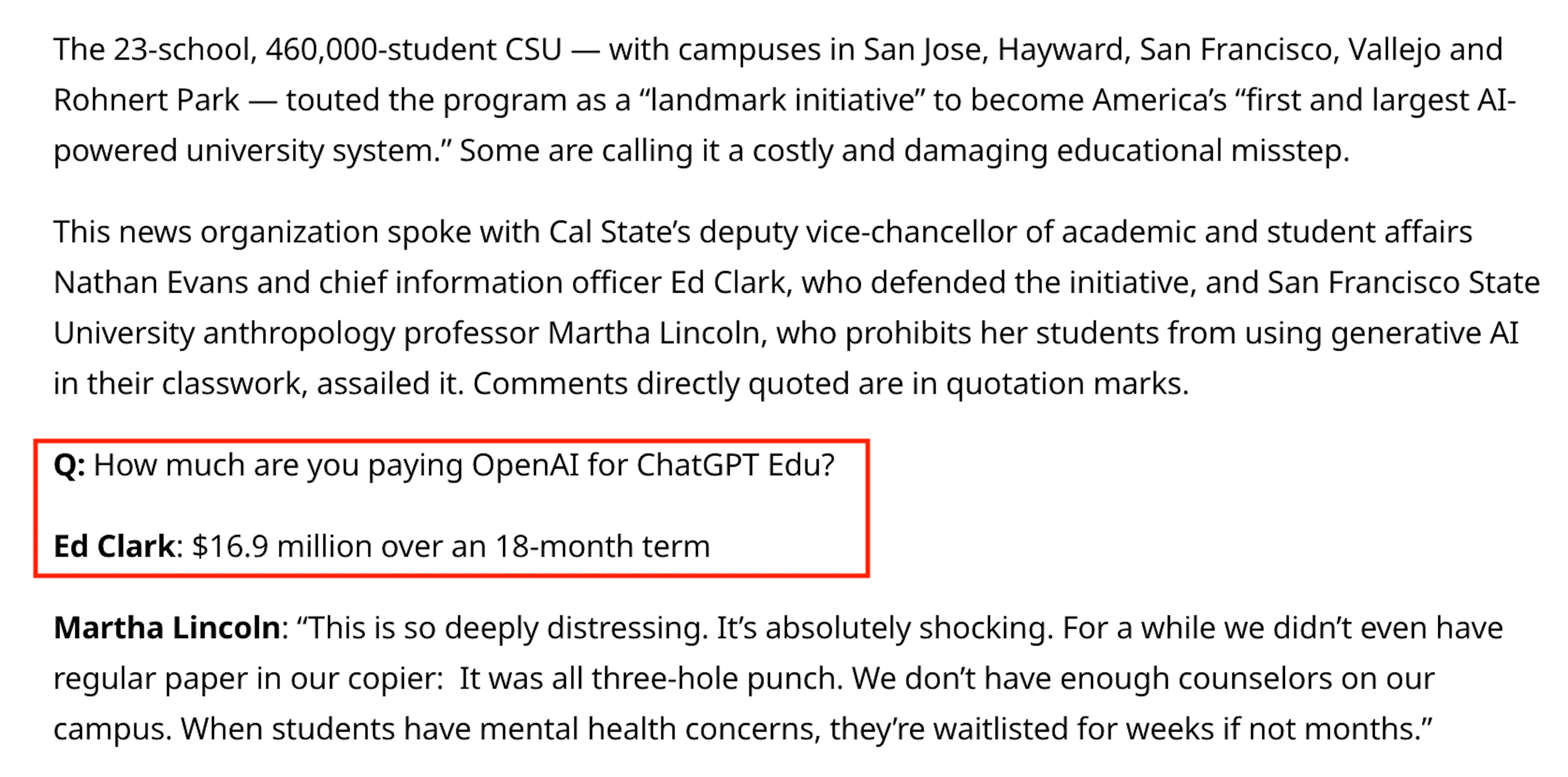
CSU tech staff described working with OpenAI as a “huge branding opp” but said possible risks include that it “depletes entire AI budget.”
CSU tech staff described working with OpenAI as a “huge branding opp” but said possible risks include that it “depletes entire AI budget.”
**CSU comment/no comment on above points.
The memo prepared for the CSU chancellor’s office also anticipates criticism from professors opposed to bringing AI into the classroom. The suggested responses to skeptical faculty include “AI is not going away” and “This is an opportunity to lead in educational innovation.”
In the weeks following the announcement, professors raised concern that CSU lacked an official policy on student use of AI in classrooms and warned that generative AI threatens to undermine students’ critical thinking and take away faculty jobs. In April, the California Faculty Association, a union representing 29,000 CSU staff, filed a labor charge against the university system, saying it had partnered with private organizations on the AI initiative without addressing staff concerns about ethics, data use, and environmental costs.
The memo further indicates that CSU was girding for blowback over working with tech companies that are cozying up to the Trump administration. It says questions about the ChatGPT deal could include, “How does the CSU address concerns about the ethics of supporting Silicon Valley companies with specific political affiliations?” That appears to be a reference to OpenAI CEO Sam Altman, who has cultivated a close relationship with Trump.
The memo’s suggested responses to such questions include “Investing in companies doesn’t mean endorsing their politics” and “It is important to consider how withholding investment could harm the CSU community by limiting access to critical innovations.”
“Investing in companies doesn’t mean endorsing their politics.”
CSU officials have said the contract with OpenAI is for 18 months and they have hired a firm to assess the school system’s return on investment from ChatGPT. But CSU appears to be heavily invested in portraying its AI initiative as a success, making plans to circulate positive testimonies about how students are “benefiting from AI training and partnerships,” according to a media plan prepared for the chancellor’s office.
OpenAI, meanwhile, has recruited students to serve as “campus ambassadors” evangelizing ChatGPT across the CSU system.
Data security concerns
At the University of California, another one of OpenAI’s education customers, staff raised concerns about the company’s storage of sensitive student data.
In December 2024, a university IT director said Open AI had informed the school it was unable to meet requirements to keep student data in the U.S. and had requested “broad discretion to offshore data to jurisdictions not subject to sanctions,” according to the minutes of an Academic Senate committee meeting. The IT director said allowing the company to process sensitive data like educational records and protected health information in unknown locations would be in direct conflict with the university’s security policies. He said UC has systemwide licenses for both ChatGPT Edu and ChatGPT Enterprise.
The IT director warned that “given the significant risks,” university leadership “must be consulted prior to any further engagement with OpenAI.” He added that UC campuses have other options for AI licenses, including Copilot, Gemini, and “Vertex Enterprise” (an apparent reference to Google’s Vertex AI), which comply with the school’s policies.
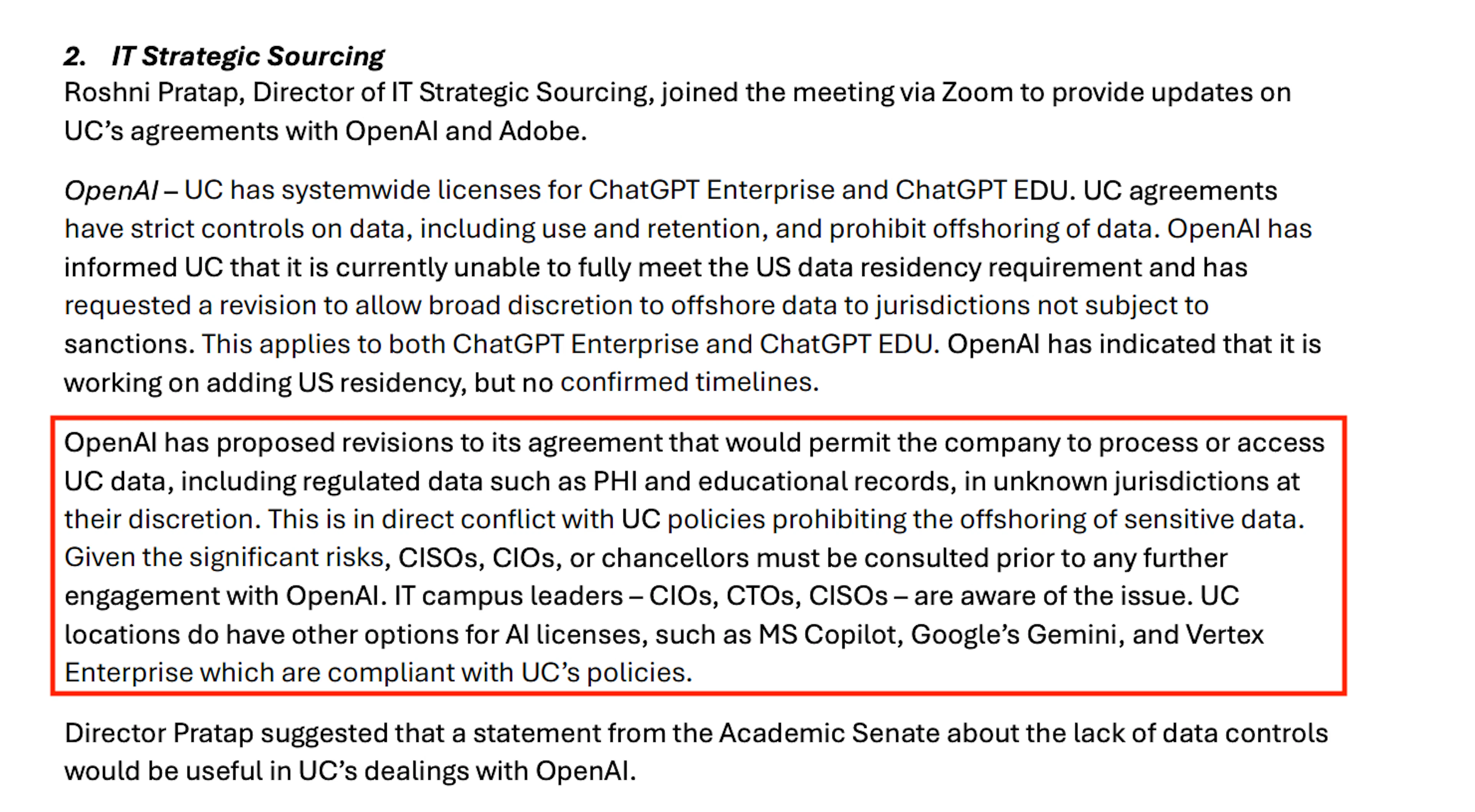
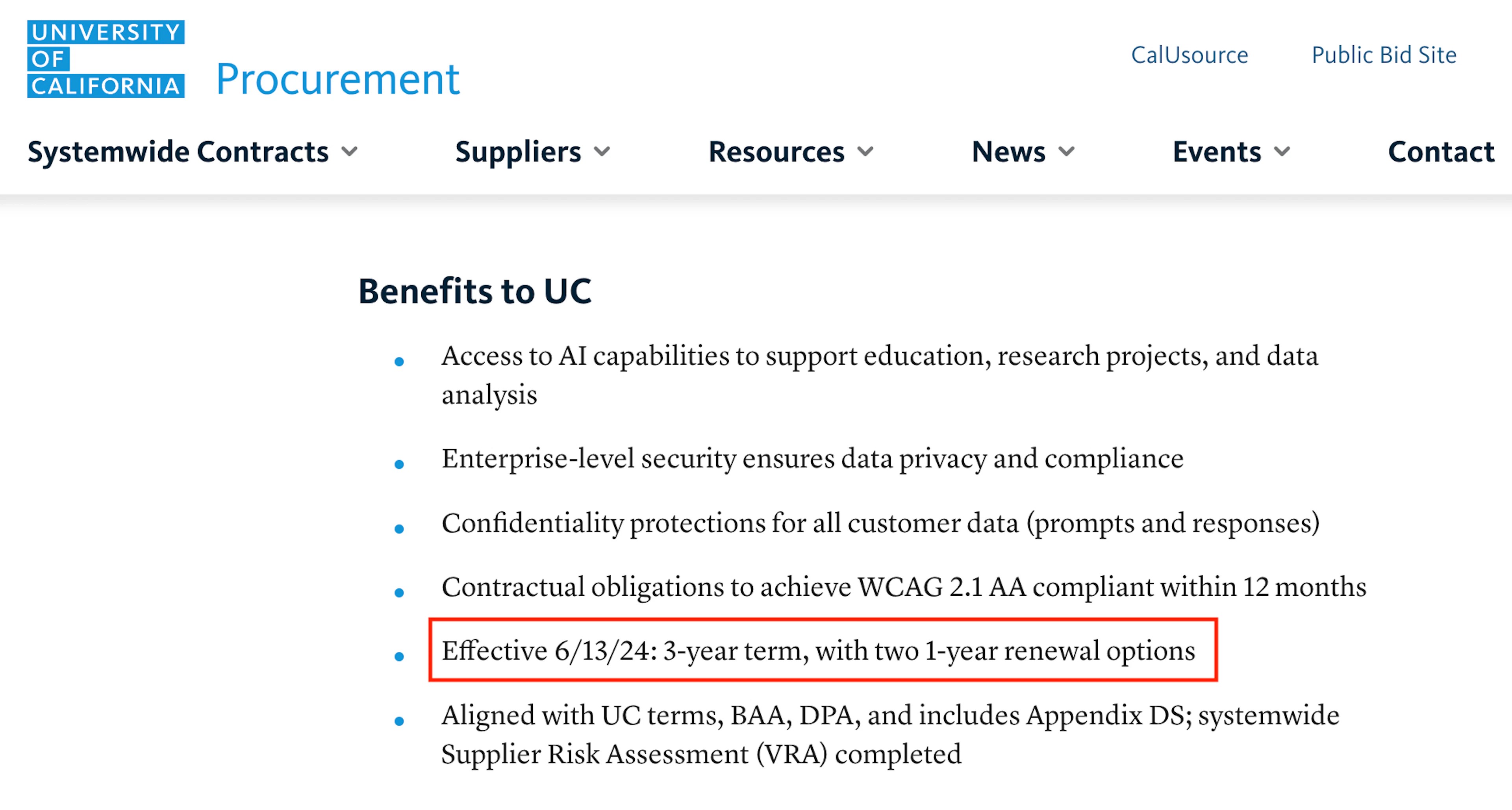
In December 2024, an IT director at the University of California said Open AI had informed the school it was unable to meet requirements to keep school data on U.S.-based servers and had requested a contract revision to host it offshore.
In December 2024, an IT director at the University of California said Open AI had informed the school it was unable to meet requirements to keep school data on U.S.-based servers and had requested a contract revision to host it offshore.
TTP found no further references to the data dispute in publicly available UC records and was unable to determine how the issue was ultimately resolved. **The University of California & OpenAI comment/no comment on above points.
OpenAI has marketed ChatGPT Edu as privacy-protective, saying school data and conversations will not be used to train the company’s AI models. But a TTP review of several ChatGPT Edu contracts, including some obtained via public records requests, reveals that the contract language at times gives OpenAI significant leeway in this area.
ChatGPT Edu contracts with four customers—the Laguna Beach and San Bernardino City school districts in California, the Riverside County Office of Education in California, and the Iowa City Community School District—show that OpenAI reserves the right to create, share, store, and own “de-identified” data. This is defined as data where “all personally identifiable information has been removed or obscured” in a way that what remains “does not reasonably identify a specific individual.”
It's not clear how OpenAI squares this carveout for “de-identified” data with its pledge to not to use school data and conversations to train its AI models. While the contracts do not give specifics of how OpenAI proposes to de-identify the data, the practice is not always considered a silver bullet for protecting privacy. Multiple studies have shown researchers are increasingly able to match anonymized data with public information to reveal people’s identities.
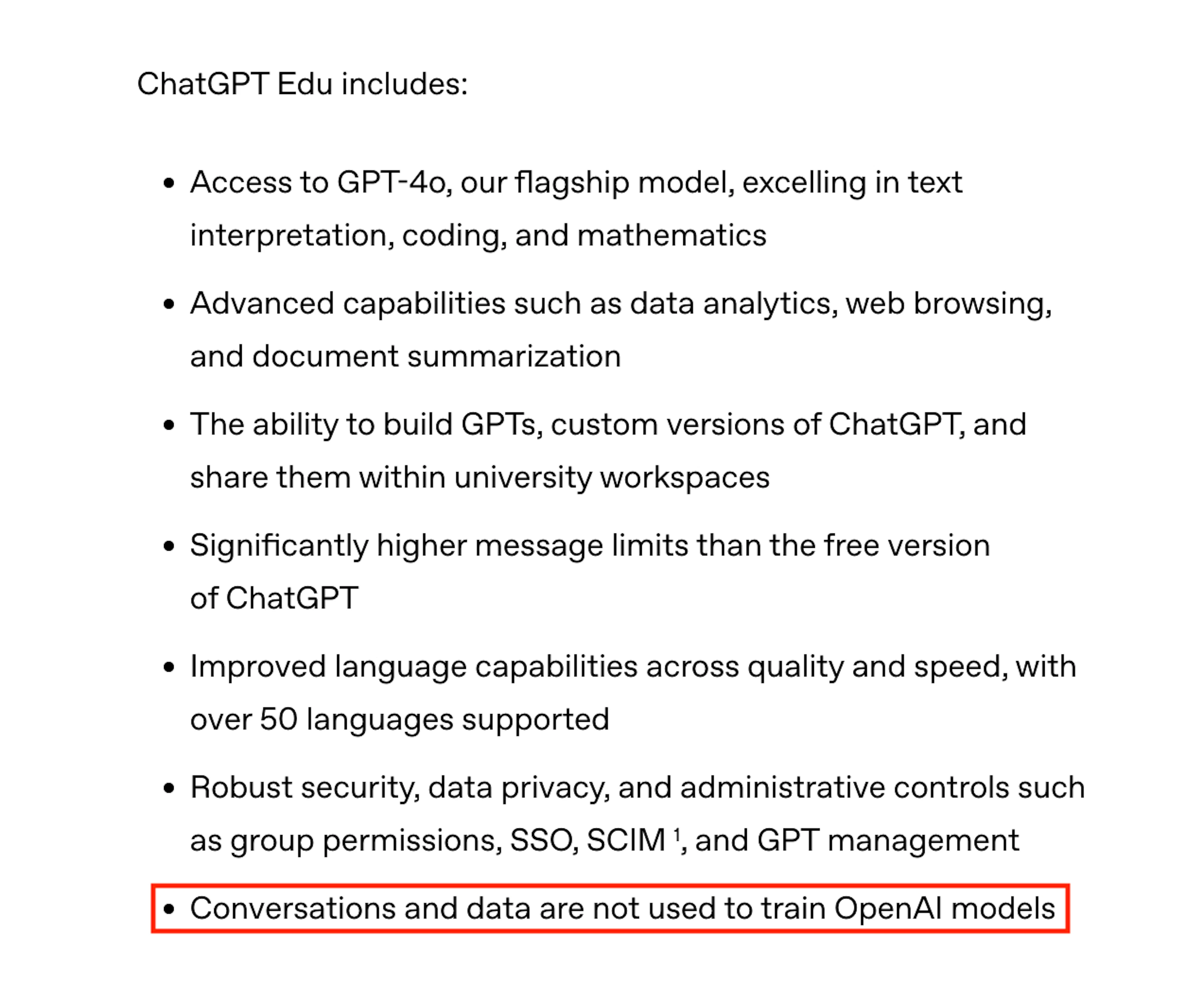
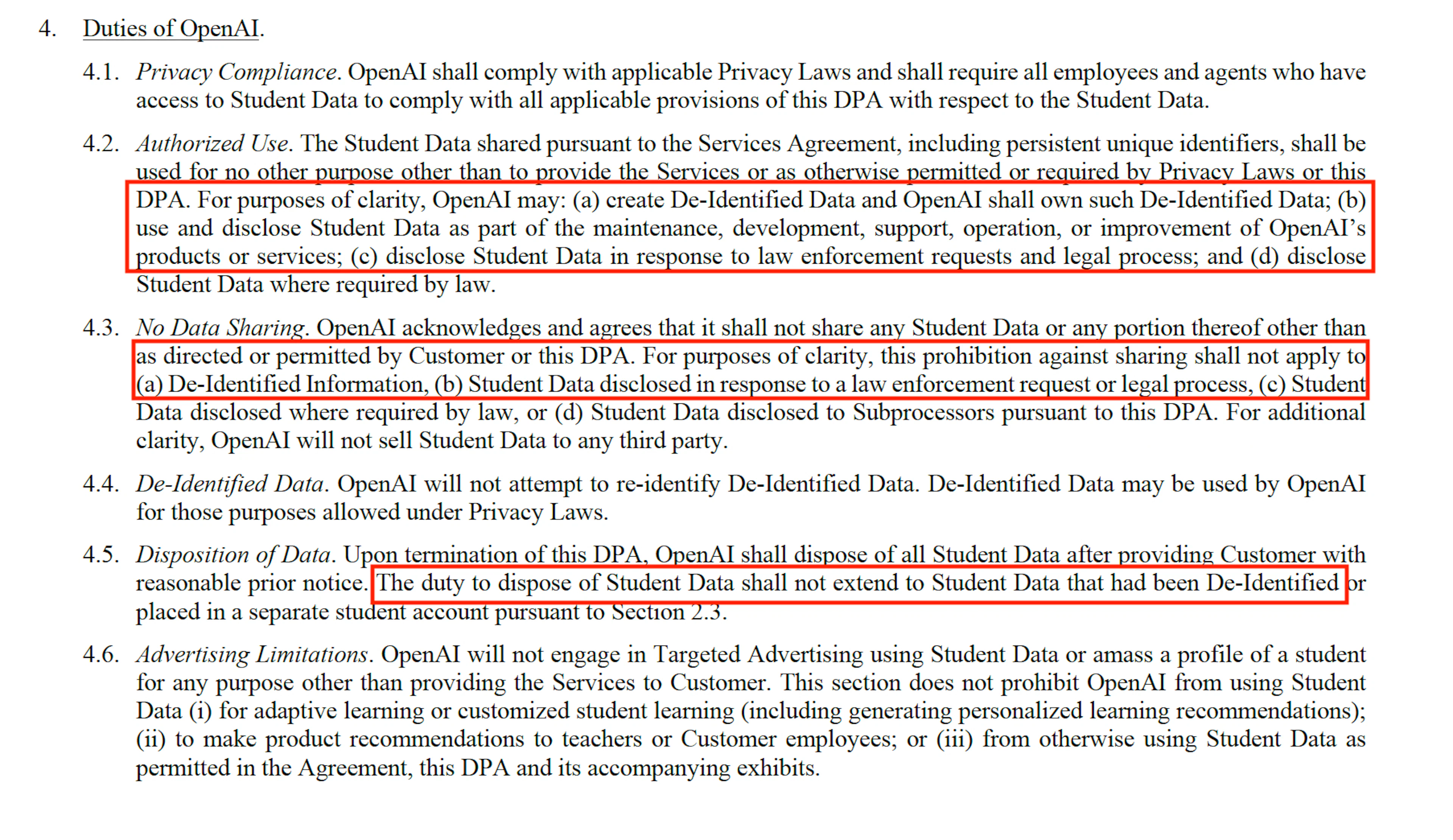
When OpenAI introduced ChatGPT Edu in May 2024, it said school conversations and data would not be used to train its models.
When OpenAI introduced ChatGPT Edu in May 2024, it said school conversations and data would not be used to train its models.
The contracts examined by TTP also state that OpenAI can use student data in general for “the maintenance, development, support, operation, or improvement of OpenAI’s products or services.” It was not clear what OpenAI deems allowable use of student data under that language.
**OpenAI comment/no comment on above points. Schools comment/no comment.
K-12 focus
Leading OpenAI’s education push is Leah Belsky, a former executive at online class platform Coursera. The company has hired roughly two dozen staff for this team over the past year, including several veterans of the edtech market, according to LinkedIn postings.
The hires include Kevin Mills, another former Coursera executive; Siya Raj Purohit, who served as global lead for Amazon Web Service’s education division; Austin Bates, a former education lead for Slack; and Sam Canning-Kaplan, who worked on K-12 education for Google Gemini.
The K-12 market appears to be a growing focus for OpenAI. In July, the company joined Microsoft and Anthropic in funding a new AI training academy for K-12 educators, launched by the American Federation of Teachers. Open AI’s Canning-Kaplan has been a frequent presence at K-12 schools, advisory panels, and education conferences.
One document obtained by TTP gives an inside look at the kind of perks and incentives OpenAI is dangling to school districts behind the scenes.
A “ChatGPT 101” slide show presented to the Capistrano Unified School District in Orange County, California, invited educators to apply to join an “OpenAI Forum,” described as a discussion group on the future of artificial general intelligence (AGI). The application form, which does not appear to be public, offers members access to in-person talks and roundtable discussions, “dinner-mixers at OpenAI,” and networking opportunities, including access to “experts operating at the highest expression of their field including a Nobel laureate, Fields medalist, and a Turing recipient.”
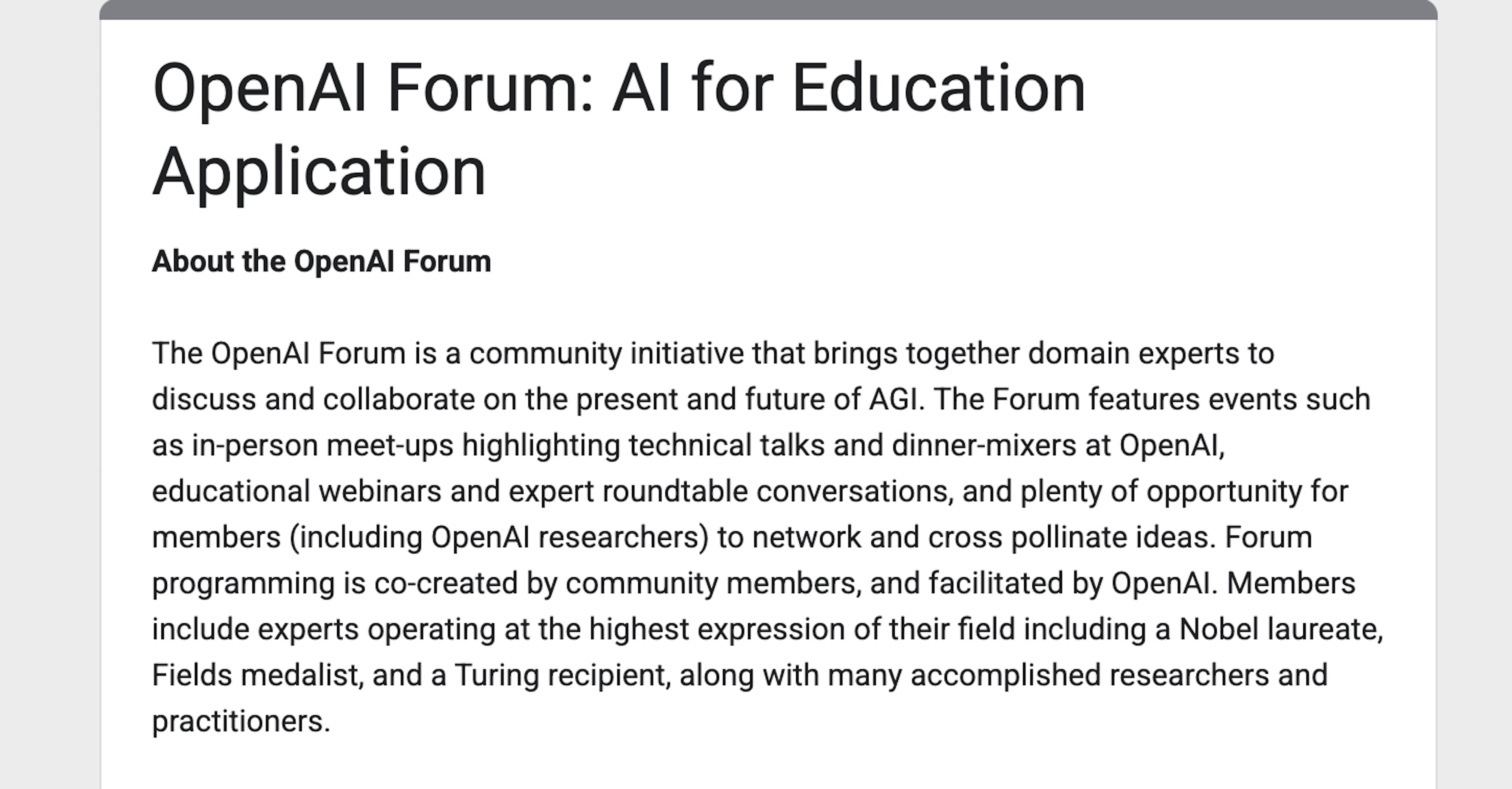
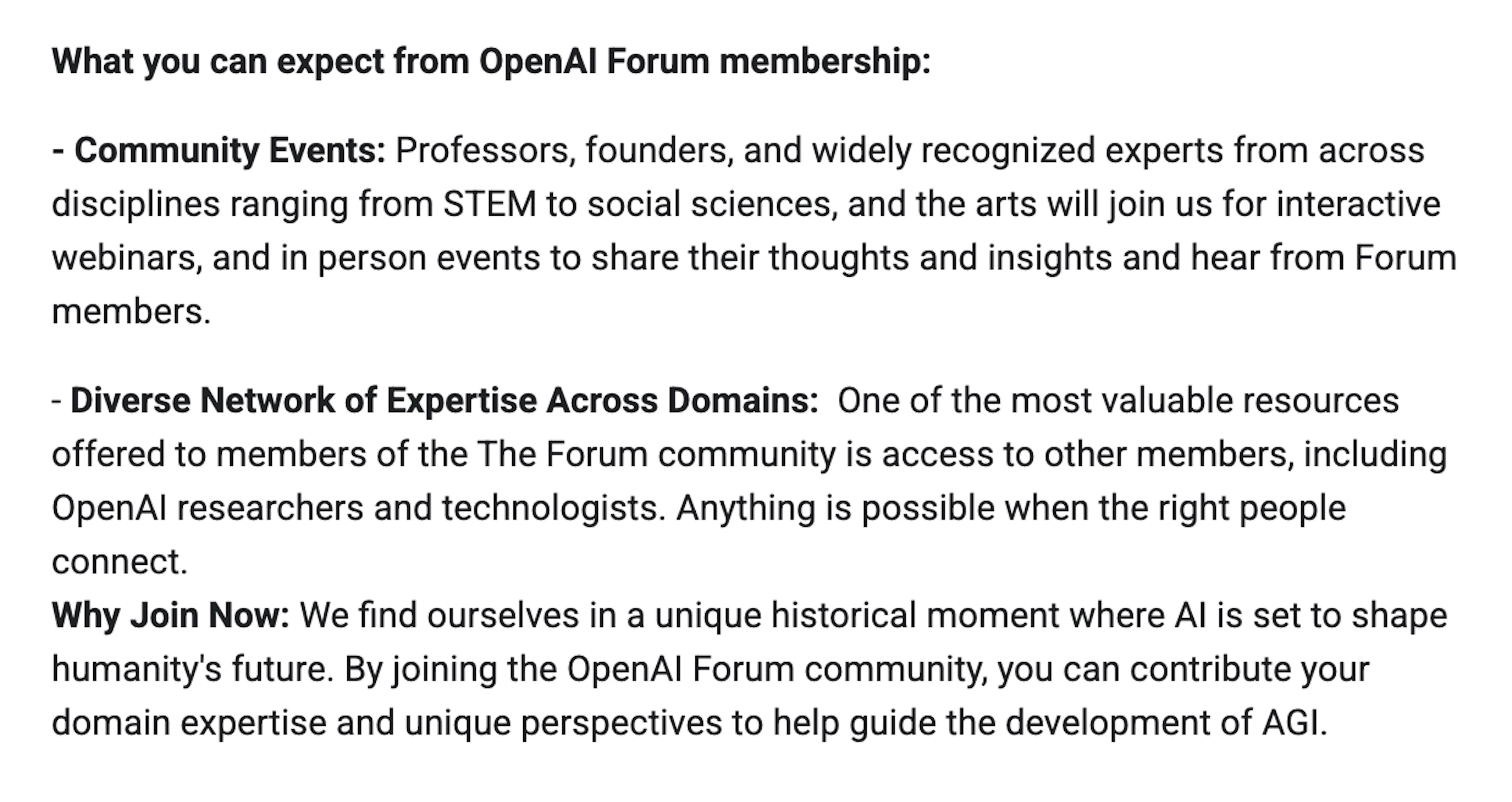
In a presentation to one California school district, OpenAI invited educators to apply to join a special AI forum giving them access to "dinner-mixers at OpenAI," networking opportunities, and the chance to hobnob with a Nobel laureate.
In a presentation to one California school district, OpenAI invited educators to apply to join a special AI forum giving them access to "dinner-mixers at OpenAI," networking opportunities, and the chance to hobnob with a Nobel laureate.
Another set of documents sheds light on OpenAI’s role in shaping a May 2025 K-12 AI summit hosted by the Riverside County Office of Education. In the run-up to the event, OpenAI paid the county office $10,000 to cover food and swag for attendees but also sought to revise marketing materials to downplay the company’s role in organizing it, according to emails obtained by TTP. (“This needs to be presented as a Riverside K-12 event, not an OpenAI event,” Canning-Kaplan wrote.)
In a slide show prepared for the summit, OpenAI invited attendees to join something called OpenAI Academy, giving K-12 educators “early access to specialized programming led by our team and our community partners, including office hours, roundtables, product demos, and more.” At the time, the academy did not appear to be public. (It was announced in a press release several months later.)
**OpenAI comment/no comment on above points.
TTP also examined documents from U-46, a school district serving parts of the Chicago metro area that considered buying ChatGPT Edu for staff. An internal memo shows that a number of district employees questioned the benefit of paid ChatGPT.
“$400k is a lot of money to spend on a service that many currently use for free. I am not 100% clear on what this fee covers,” one staffer asked in a written Q&A. Another asked “how we are ensuring that the information we are pulling to use in classrooms meets our guidelines.” A third staffer wondered if ChatGPT was “actually detracting from critical thought and variety in our classrooms.” In response to the cost question, the district said it had “successfully negotiated a discounted price” for ChatGPT, whittling down the standard monthly rate of $12 per user per month. (A separate email indicates the negotiated rate was $9 per user.)
“$400k is a lot of money to spend on a service that many currently use for free. I am not 100% clear on what this fee covers.”
Other documents show U-46 grappled with concerns about how a deal with OpenAI would affect student data privacy. For example, a December 2024 presentation about a pilot program comparing ChatGPT and Google Gemini observed that “OpenAI faced privacy concerns as a company.” A slide show prepared for the district’s AI task force in February 2025 noted that OpenAI’s policies did not specifically address key privacy laws including the Student Online Personal Protection Act (SOPPA), the Family Educational Rights and Privacy Act (FERPA), and the Illinois School Student Records Act (ISSRA).
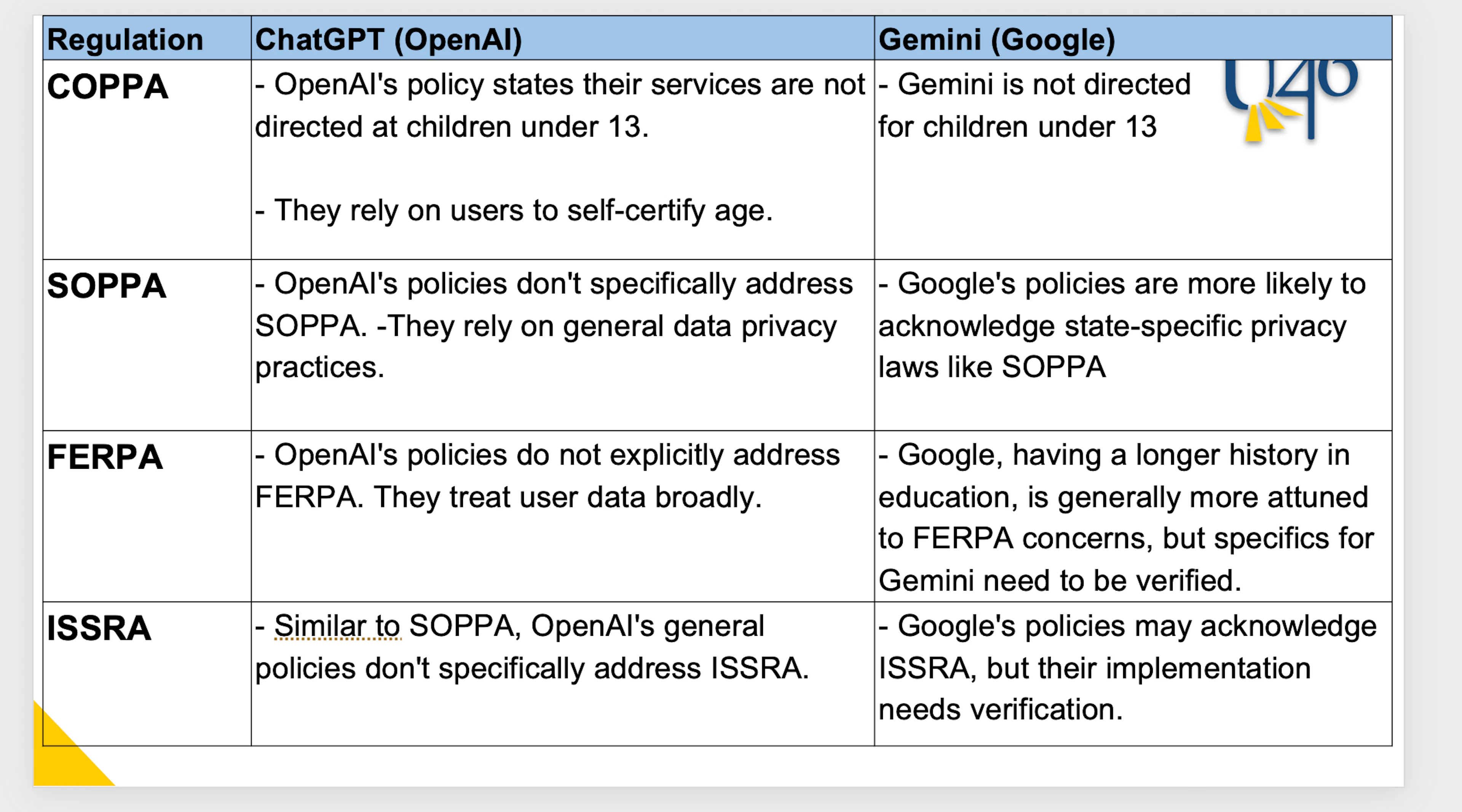
U-46, a school district serving parts of the Chicago metro area, has weighed the pros and cons of ChatGPT and other AI products.
U-46, a school district serving parts of the Chicago metro area, has weighed the pros and cons of ChatGPT and other AI products.
Another spreadsheet from the district comparing AI options rated ChatGPT Edu as “not compliant” with four privacy laws for pre-kindergarten through 12th grade students.
**U-46 comment/no comment on above points. OpenAI comment/no comment.
Conclusion
OpenAI is making an aggressive push to sign up universities and K-12 school districts for its paid ChatGPT product, drawn by the revenue potential of the education market. But schools that have partnered with OpenAI are grappling behind the scenes with how to justify their ChatGPT investment in the face of strained budgets, faculty skepticism, and concerns about the privacy of student data. These tensions are likely to persist as OpenAI continues its sales pitch in the education space.