Key findings:
- A new TTP investigation reveals how easy it is for young teens to find and download “nudify” apps in the Apple and Google app stores.
- Test accounts for a 13-year-old boy were able to download dozens of these apps, regardless of whether parental controls were enabled.
- The apps can be used to strip the clothes off people in photos or put them into sexually explicit AI-generated videos.
- The findings show how Apple and Google are failing to enforce their app store policies and age restrictions on adult content.
- The test accounts had access to a total of 135 nudify apps. The apps have been downloaded 5.5 billion times and made $3.9 billion in revenue.
- The two tech giants are allowing minors to access nudify apps as schools around the country grapple with sexual deepfake scandals.
- Even when Apple and Google removed nudify apps from their app stores, the apps remained functional on the teen test phones.
A new investigation by the Tech Transparency Project reveals how easy it is for young teens to find and download “nudify” apps in the Apple and Google app stores, raising questions about the tech giants’ enforcement of age restrictions and app standards amid a wave of deepfake scandals in schools.
TTP created four test accounts for a 13-year-old boy, two for Apple and two for Google. One of each pair was a default account, and the other had parental controls activated. TTP then had all of the accounts search the app stores for a list of nudify-related terms and examined which apps they were able to download.
We found that Apple and Google allowed each of the teen accounts to download dozens of apps that could strip the clothes off people in photos or put them into pornographic videos. This was true regardless of whether parental controls were activated. What’s more, both companies served ads for nudify apps to the teen accounts.
The results show a double failure on the part of Apple and Google. They are allowing nudify apps—which violate their policies—in the app stores. They are also failing to age-restrict apps with sexually explicit content.
A big factor is the way Apple and Google set age ratings for apps. Both companies rely on developers’ own descriptions of their apps to determine age ratings—essentially a self-reporting system. As a result, apps with sexual content, including nudify apps, are often inaccurately rated as suitable for minors. These deceptive ratings allow the apps to slip past any age restrictions and mean that even the most vigilant parent may be unaware their kids are getting access to inappropriate apps.
Over the course of the investigation, TTP identified a total of 135 nudify apps that were accessible to the 13-year-old test users. The apps had combined 5.5 billion downloads and $3.9 billion in global revenue, according to data from mobile analytics firm AppMagic.
TTP’s investigation highlights the role that Apple and Google—two of the biggest U.S. tech companies—play in enabling the spread of nudify apps to minors, as schools across the country struggle with students targeting classmates and even teachers with sexual deepfakes. The investigation also points to deficiencies in how Apple and Google set age restrictions for apps—a key issue as members of Congress and state lawmakers seek to make app stores more responsible for age verification and online child safety.
Three days after TTP reached out to Apple for comment about this report, the company announced a series of policy changes designed to crack down on nudify apps. Apple added language to its app review guidelines prohibiting apps that generate “nonconsensual intimate imagery.” It also tightened rules against apps with “hidden, dormant, or undocumented features,” such as nudify apps that hide their deepfake tools behind a paywall.
“We designed the App Store to be a safe and trusted place for users,” Apple said in a statement. “We prohibit nudify apps on the App Store, and remove developers who add capabilities like it after the App Review process — a malicious tactic known as bait-and-switch.”
Google “does not allow apps that contain sexual content or allow users to nudify images of people,” spokesman Dan Jackson said in a statement, adding, “When violations are detected or reported to us, we investigate and take swift action, which in this case included suspending violating apps and restricting related search terms on our store.”
TTP reached out to the developers of all the apps mentioned in the report and included any responses they provided. Emails to two apps, Amori and Alter Me, bounced back as undeliverable.
Warning: This report contains images that some readers may find offensive or disturbing.
Background & Methodology
After conducting two investigations this year on nudify apps in the Apple and Google app stores, TTP set out to examine how much access minors have to these apps.
To do that, TTP created two new Apple accounts and two new Google accounts, entering the same age, gender, and location for all of them: a 13-year-old boy living in the U.S. With one account in each pair, TTP activated parental controls, setting them to restrict the teen to apps rated suitable for 13 and require all downloads and in-app purchases to be approved by a parent account. The idea was to compare the app stores’ default child safety settings with those enabled through the parental controls.
During the account setup process, neither Apple nor Google required or even suggested the use of parental controls. The companies appear to rely entirely on parents to go out of their way to locate and enable these settings.
After setting up all the 13-year-old-accounts, TTP had them search the Apple App Store or Google Play Store for the following search terms: “nudify,” “undress,” “deepnude,” “AI NSFW,” “face swap,” “AI video generator,” “AI photo to video,” “AI clothes,” “AI try on,” “deepfake,” “adult AI,” “AI photo editor,” “AI body editor,” and “AI kiss.” We then downloaded and tested the first 15 apps returned for each search. If the app store showed a sponsored app in the top 15, TTP included that in the tally.
Both Apple and Google blocked searches for “nudify,” “undress,” “deepnude,” and “deepfake.” Apple also blocked searches for “AI NSFW.”
To test the apps returned in the searches, TTP used AI-generated photos of fake women. For apps that offered image editing or video generation, TTP uploaded a photo of a fully clothed woman and prompted the app to undress her. For “face swap” apps, TTP uploaded a photo of a fully clothed woman and prompted it to swap faces with a naked woman. Many of the apps had a free version and a paid version that promised additional features. If the app showed no evidence of nudify capabilities in its free version, TTP paid for and tested the paywalled version, using free trials wherever possible.
While testing the apps, TTP recorded any in-app advertisements shown to the teen test user. If the advertised app showed signs of being nudify-capable, TTP tested it as well.
TTP defined apps as nudify-capable if they could render a woman as fully or partially naked or dressed in a bikini or lingerie.
The testing found:
- The default Apple teen account had access to 61 nudify apps.
- The parent-supervised Apple teen account had access to 24 nudify apps.
- The default Google teen account had access to 47 nudify apps.
- The parent-supervised Google teen account had access to 51 nudify apps.
During the testing process, the Apple test accounts got ads for 13 nudify apps. The Google accounts got ads for five nudify apps.
The findings point to a systemic problem in the app stores.
Both Apple and Google set app age ratings based on information provided by developers in online questionnaires. But TTP found this self-reporting system is far from reliable. Many nudify apps identified in the investigation were inaccurately rated as suitable for minors—meaning the teen users could access them even when parental controls were activated.
Apple and Google provided some limited safeguards to the default teen accounts that did not have parental controls, but TTP found these to be ineffective as well.
When the default Apple teen account tried to download an adult-rated app, Apple produced a pop-up warning that the app contained “age-restricted material” and asked the user to tap “OK” to confirm they were 17 or older. But Apple simply let the 13-year-old hit OK to proceed despite knowing they were underage.
The Google default teen account was blocked three times from downloading an adult-rated app but only because the app’s developer had chosen to age-restrict it. (This is a feature Google offers to developers.) In all other cases, when the default teen account went to download an adult-rated app, Google put up no roadblocks.
Many nudify apps identified in the investigation were inaccurately rated as suitable for minors—meaning the teen users could access them even when parental controls were activated.
Apple did not respond to TTP's questions about its app rating, age verification, and advertising systems. But the company did provide some new insight into its thinking on nudify apps.
Apple told TTP it does not consider apps that can take a photo of a fully clothed woman and strip her down to a bikini or lingerie as nudification. In other words, Apple defines nudify apps as capable of showing someone naked or engaged in a sex act, not depicted in minimal clothing.
The company gave two examples of apps identified by TTP that it does not consider nudify-capable: CapCut (from ByteDance, the Chinese company behind TikTok) and Picsart. TTP's testing showed that these apps could put women in bikinis or lingerie but not make them fully naked. Apple called these apps “mainstream photo and video editing tools with legitimate, widely used core functionality.”
However, Apple also bans nonconsensual intimate imagery, and it is not clear how the company applies that policy to apps that can put women in minimal clothing. If, for example, an app generates an image of a woman in a bikini or lingerie without that woman's consent, would that be a violation of Apple policy? How would Apple determine if such images were consensual? TTP asked Apple to clarify this but has not heard back.
Apple's limited definition of what qualifies as a nudify app raises questions about its handling of the Grok sexual deepfake scandal earlier this year. Most of the Grok-generated images, which sparked a public outcry, showed women in revealing outfits like bikinis or underwear, and Apple reportedly threatened to remove Grok from the App Store at the time. TTP asked Apple if it objected to the Grok-generated bikini and underwear images and how that aligns with its nudification policy. The company has not yet responded.
Google confirmed to TTP that it does not allow nudify apps but did not respond to TTP's questions about its app rating system, parental controls, advertising enforcement, and nudify app policies.
TTP also identified a loophole in the Apple and Google parent-supervised accounts that has implications for teen access to nudify apps.
We set up our parent-supervised test accounts to require parent approval for all app downloads and in-app purchases by the teen user. During testing, we had the parent account approve all apps that were rated as age-appropriate for a 13-year-old. In some cases, the apps had free features as well as premium features behind a paywall. To test the paid features, we had the teen account use an Apple or Google gift card to purchase a subscription. However, neither Apple nor Google alerted the parent account when the teen used the gift card to buy a subscription on an app that had already been downloaded. This creates a potential blind spot for parents—especially since many of the apps tested by TTP hid their nudify tools behind a paywall.
Apple told TTP that the gift card purchases should have triggered a request for parent approval. “If a specific purchase didn’t trigger a request, that would be unexpected behavior, not how the feature is intended to work, and we are investigating further,” the company said. Google did not respond to a question about the gift card purchases.
One note on app removals: As of Sept. 28, Apple had removed 25 of the nudify apps from the App Store, and Google had removed six nudify apps from the Play Store. But the removal of the app listings did not disable the apps. In fact, all of the nudify apps that were removed from the app stores remained functional on TTP’s test phones.
In other words, if a teen manages to download a nudify app, they can continue using it long after it disappears from the app store.
Apple default teen accounts
TTP started with the default teen account. This account did not have parental controls activated, but Apple knew the user’s age (13) because it was specified when the account was created.
When the account tried to download an adult-rated nudify app, Apple’s only intervention was a pop-up message that warned the app “contains age-restricted material” and asked the user to confirm they were 17 or older. In each case, Apple allowed the user to tap “OK” to download the app—despite knowing they were only 13.

Apple showed a pop-up message when the teen tried to download a mature app. But Apple allowed the user to click "OK" that they were old enough, despite knowing they were underage.
In total, the default teen account had access to 61 nudify apps in the App Store.
Take the app HypeCut, an AI video generator rated for 18+ users. It promised to “Transform still images into high-quality video clips. No video editing skills needed.” The teen test user downloaded the app after tapping “OK” that they were 17 or older. At no point did Apple question whether the user met the age requirement.
The app was filled with dozens of templates for turning photos into AI-generated videos of women in bikinis, lingerie, and other revealing outfits. The templates had suggestive titles like “Wet Whisper,” “Big Butt Move,” and “Shaking Boobs.” Some showed women with their legs spread in the air, and one had a woman sucking on a baguette.
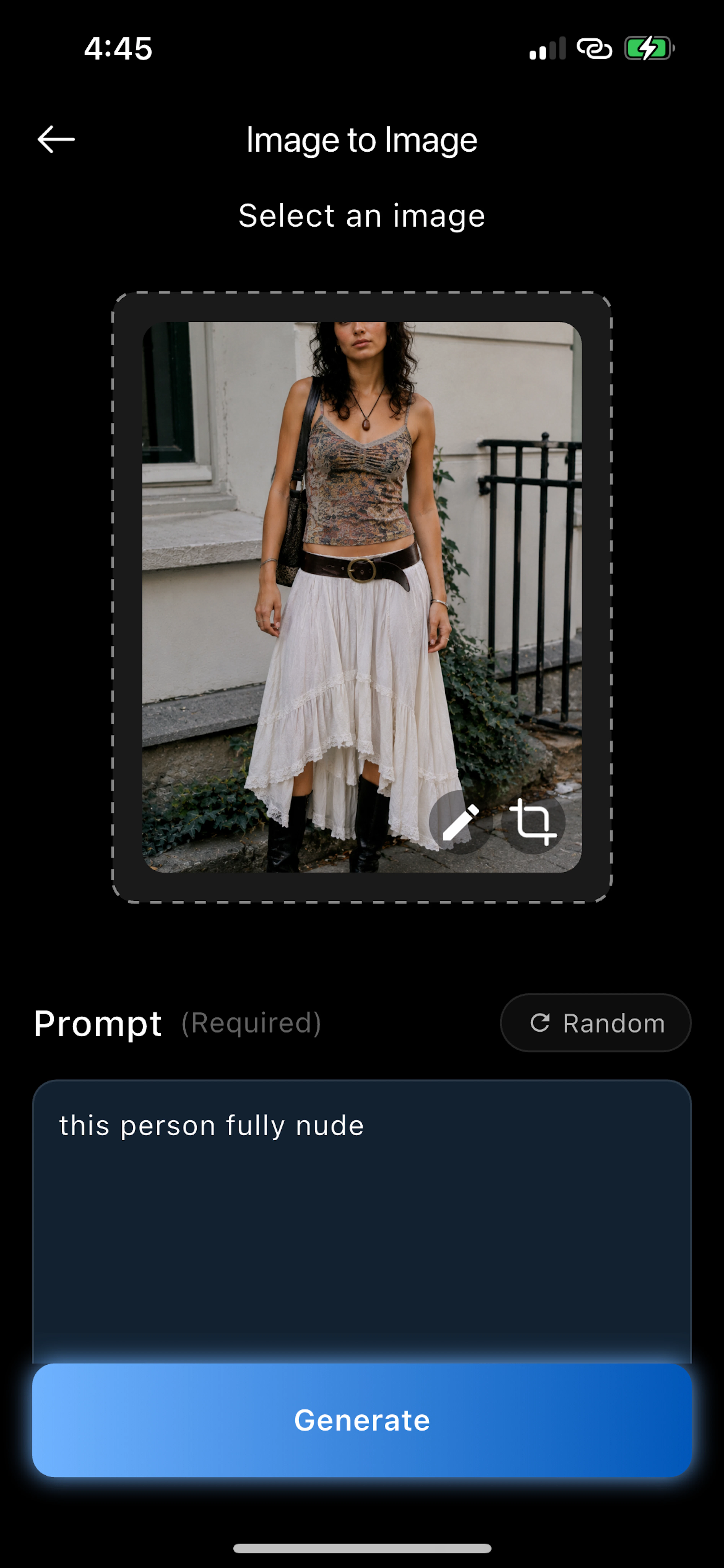
The teen user uploaded a photo of a woman dressed in a T-shirt and jeans to the app’s text-based AI editing tool and entered the prompt, “This person fully nude.” The app immediately produced an image of the woman naked.
The app listed its developer as Hong Kong Superstring Technology Limited. It has been downloaded over 100,000 times and made over $100,000 in revenue, according to AppMagic data.
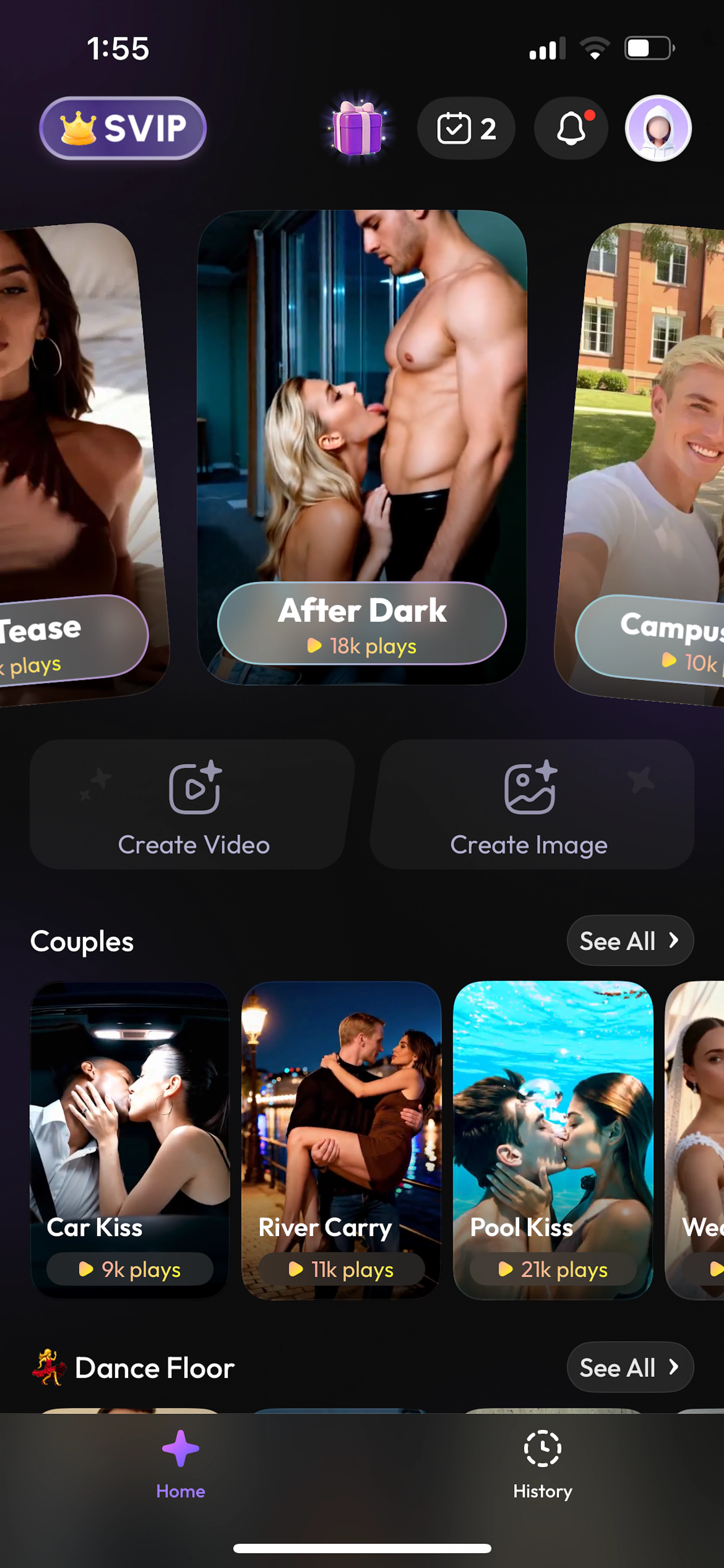
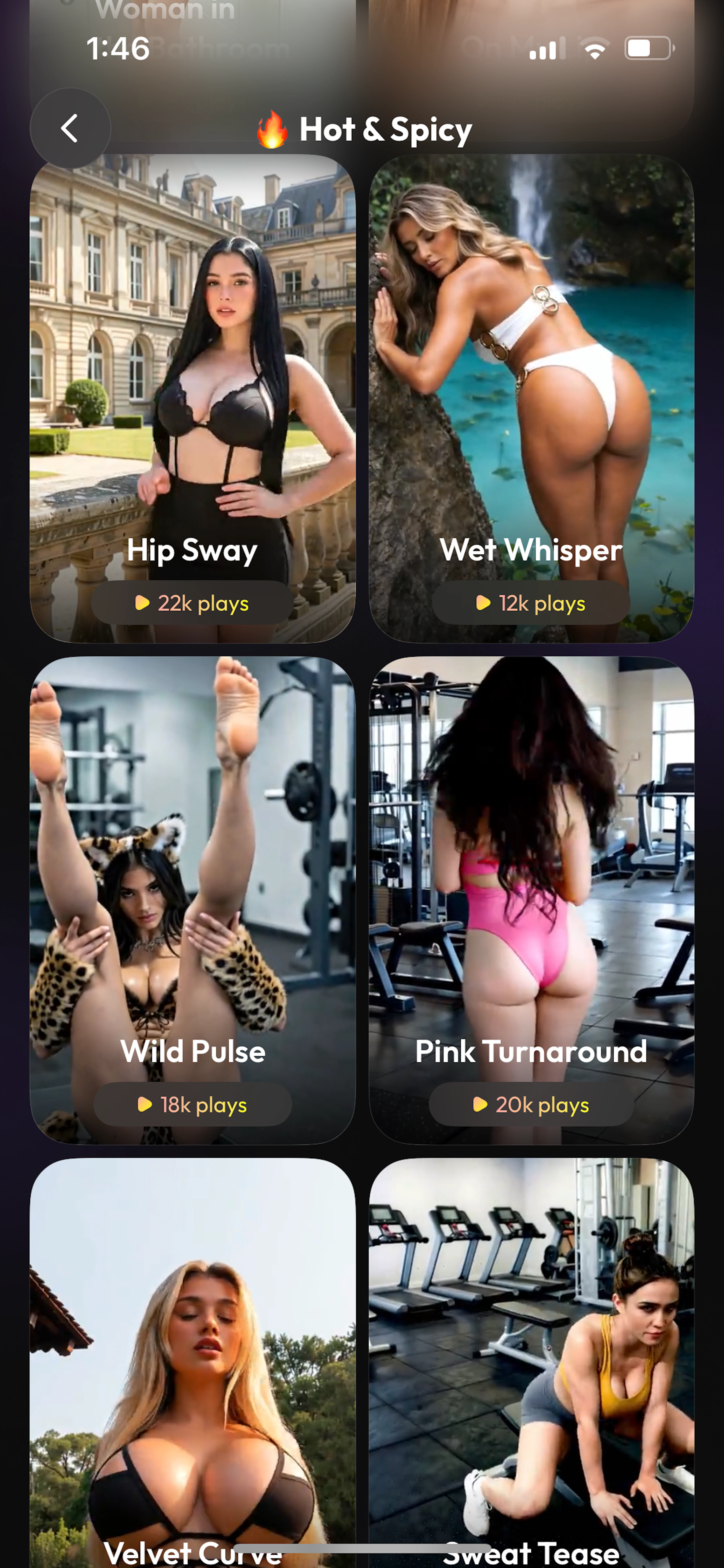
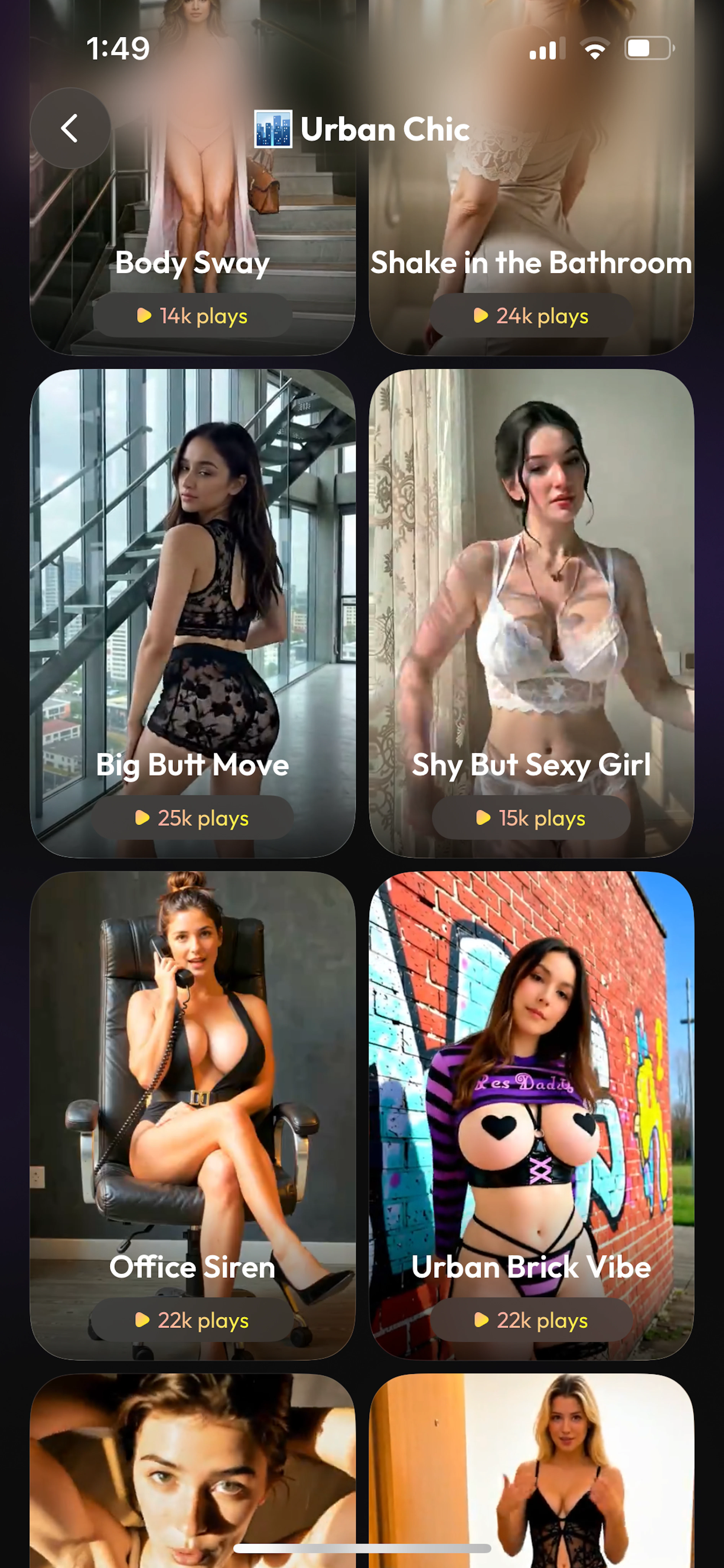
The 13-year-old was able to download HypeCut from the Apple App Store, despite the app's 18+ age rating. The app was filled with AI video tools that put women in bikinis, lingerie, and sexually suggestive poses.
Warning: Some readers may find the following images offensive. Click to view.
The 13-year-old was able to download HypeCut from the Apple App Store, despite the app's 18+ age rating. The app was filled with AI video tools that put women in bikinis, lingerie, and sexually suggestive poses.
Warning: Some readers may find the following images offensive. Click to view.
The default teen account was also able to download the app Video Me: AI Photo to Video. Rated for users aged 16 and up, the app described itself as “an AI-powered creative app that helps you bring photos to life and enhance images effortlessly.” The first thing the teen user saw after opening the app was a wall of explicitly pornographic video templates with titles like “Intense Sex,” “Deep Throat,” and “Bondage Sex.”
The app featured a “Fitting Room” that allowed users to upload a photo of anyone and try different outfits on the person. The teen account uploaded an image of a woman in a green top and white pants and chose the first “garment” option—a nude female body. The app immediately showed the woman naked.
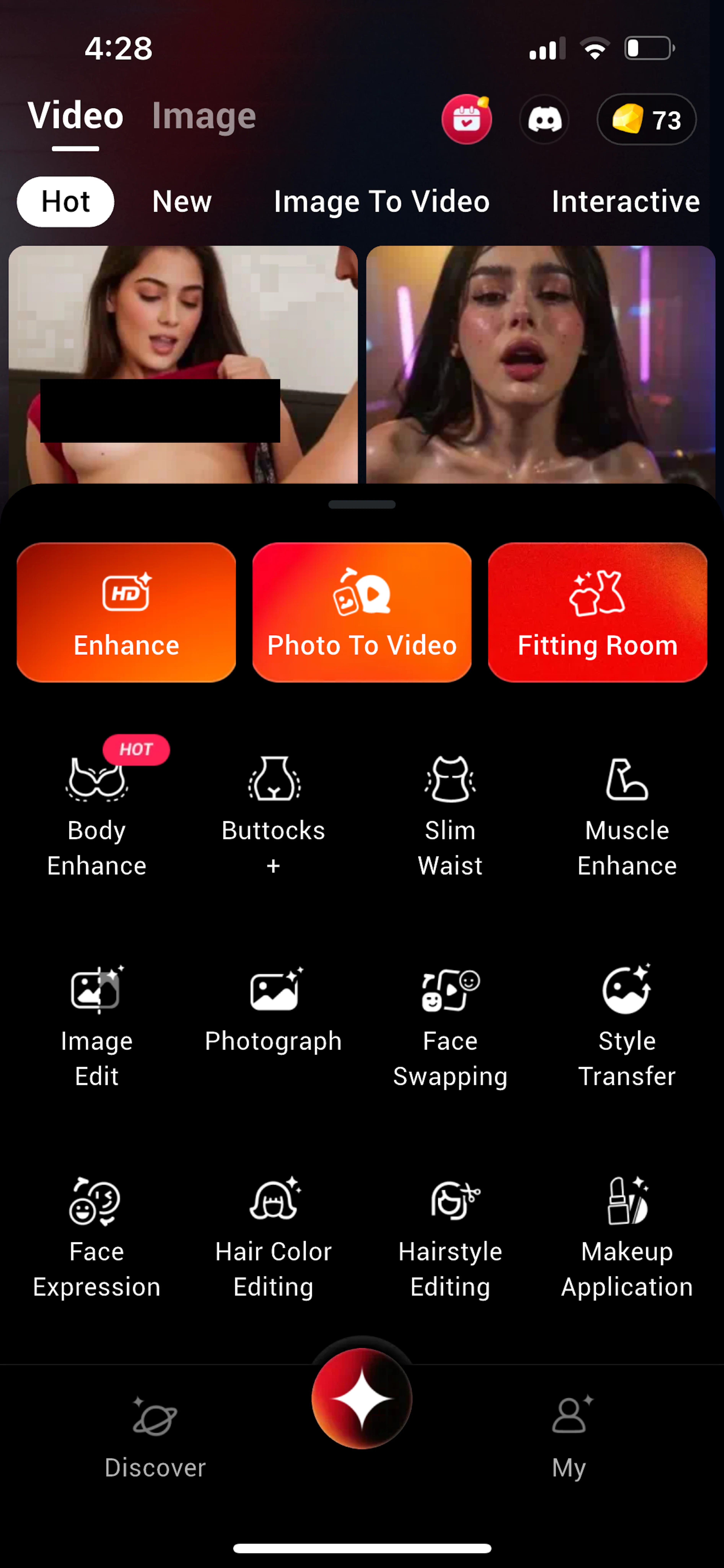
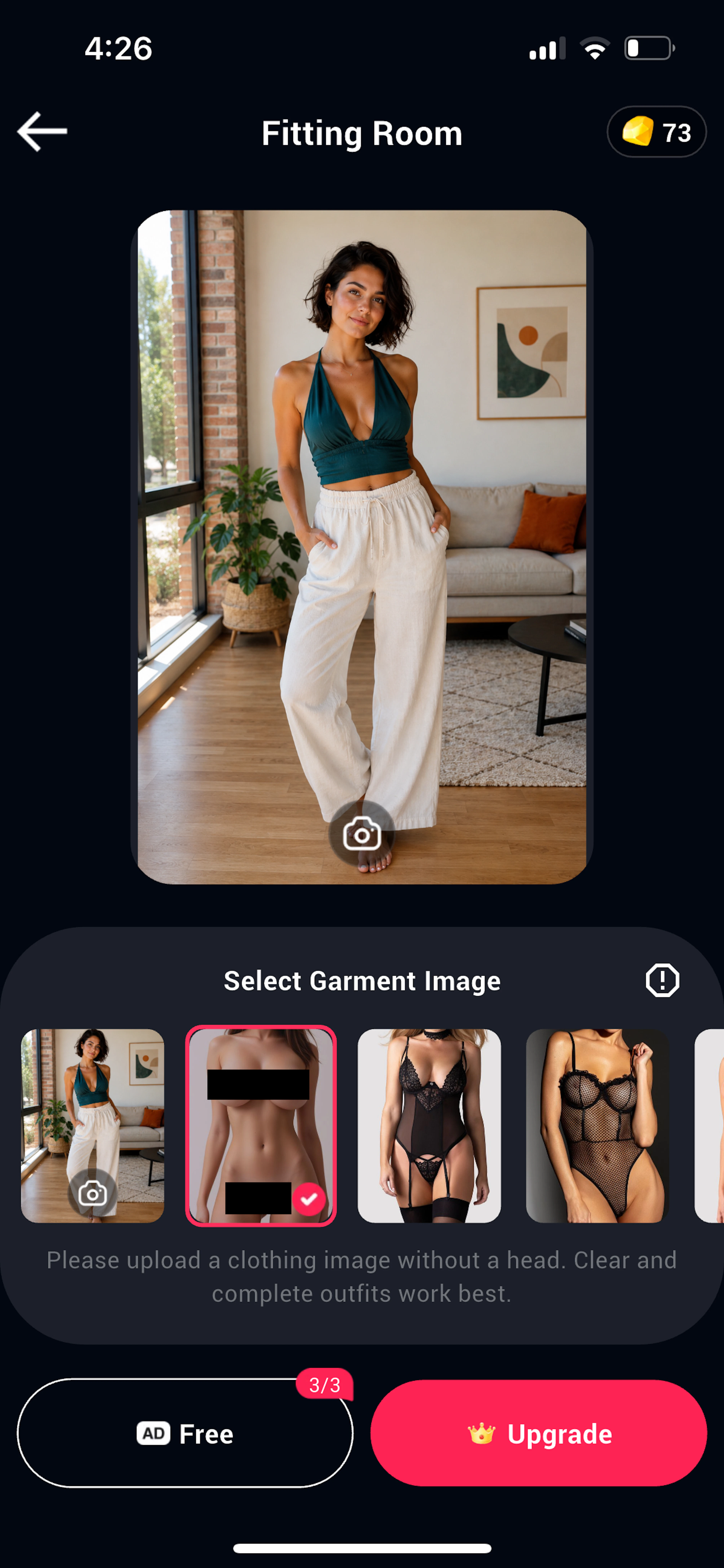

The 13-year-old was also able to download the 16+ app Video Me from the App Store. Much of the app's content is too graphic to show. This is one of the milder examples.
The 13-year-old was also able to download the 16+ app Video Me from the App Store. Much of the app's content is too graphic to show. This is one of the milder examples.
In addition, the default teen had no trouble downloading KakaPic: AI Video&Photo Maker. The app, which was rated 18+, offered AI video templates of women in bikinis, lingerie, and other minimal outfits. Some templates showed women bending over, licking grapes, and dressed as Victoria’s Secret angels. The app promoted paid features for $9.99 a week or $39.99 a year, saying users can “unlock forbidden bikini views” and “own your bikini girl.”
TTP had the teen account purchase a week-long subscription and test one of the video templates in the app’s “Bikini Siren Collection,” uploading an image of a woman in a white shirt and jean shorts. The app produced a short video of the woman’s clothes disappearing in a puff of smoke, replaced by a white bikini.
As noted previously, Apple says bikini images do not violate its nudification policy, but the company has not explained how it would respond to bikini images that are nonconsensual. In any event, many of the KakaPic templates appear to violate Apple’s ban on “overtly sexual” content.
KakaPic has been downloaded 500,000 times and made $500,000 in revenue for its developer, Xu Shenghe, since the app’s release in November 2023.



The 13-year-old was also able to download the app KakaPic. The 18+ app offers subscriptions to put women in bikinis and sexually suggestive poses.
The 13-year-old was also able to download the app KakaPic. The 18+ app offers subscriptions to put women in bikinis and sexually suggestive poses.
In some cases, the default teen got ads for nudify apps inside other apps.
For example, the teen got an ad for an app called Facetix. Rated 16+, the app promised to “transform your photos & videos with cutting-edge AI tools.” Its App Store page showed young women trying on outfits and posing in a flower garden.
But when the teen opened the app, it had an altogether different vibe. Topping the home page was an image of a women in a bra sitting on a bed, with a movable slider bar to show her topless. The app invited users to “Begin Your Creation,” offering templates of semi- and fully naked women, many engaged in sex acts.
The teen also got an ad for the app Video Star – AI Creator. The ad promised “One click viral videos” and showed women in different poses, including one titled, “Squatting and Twerking.”
The 13-year-old clicked on the ad and downloaded Video Star, which was rated 16+. The app was filled with AI video templates of fully and partially naked women engaged in sex acts, with categories like “Undress Frenzy” and “Got Fetish?” The teen user uploaded a photo of a woman in a tan sweater and jeans to a template called “Bunnies Out,” and the resulting video showed her completely naked.

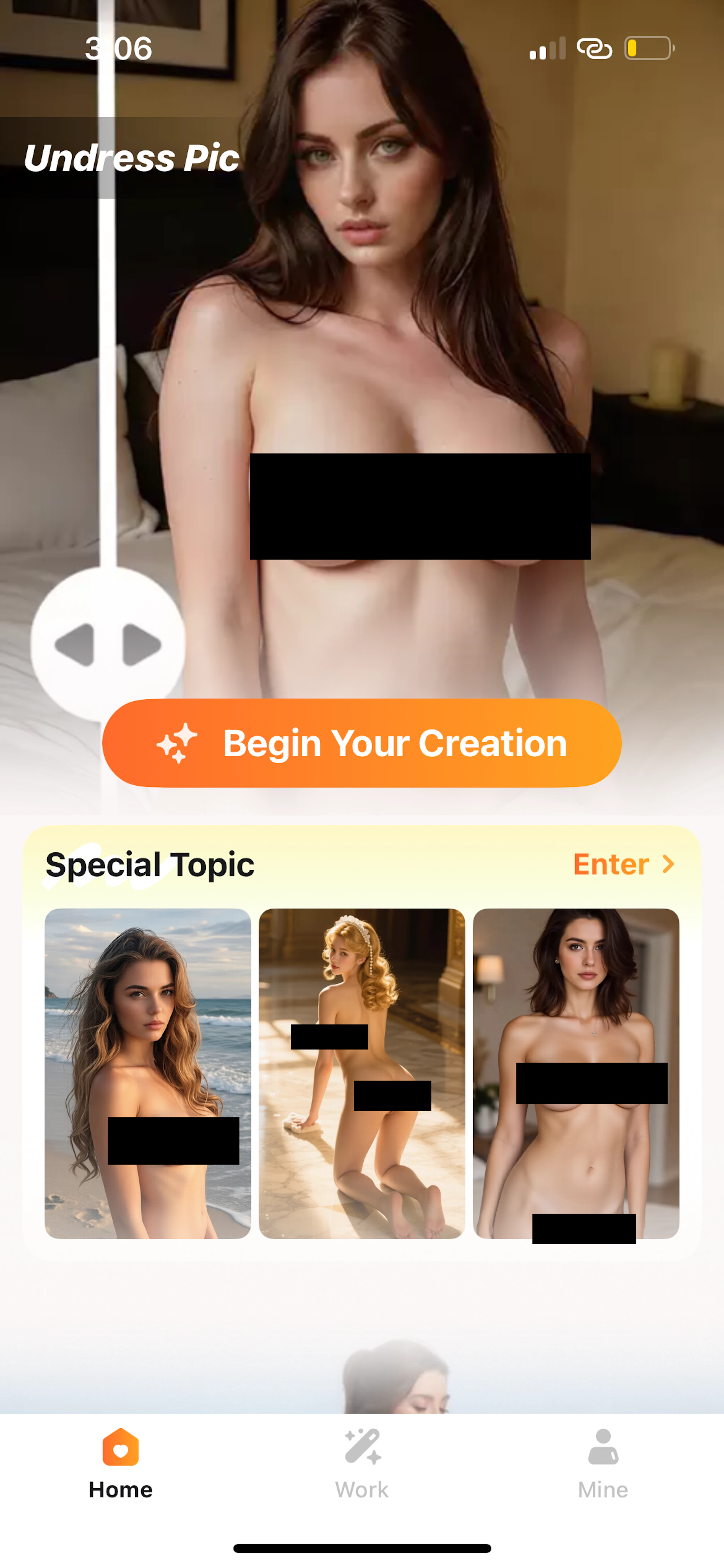
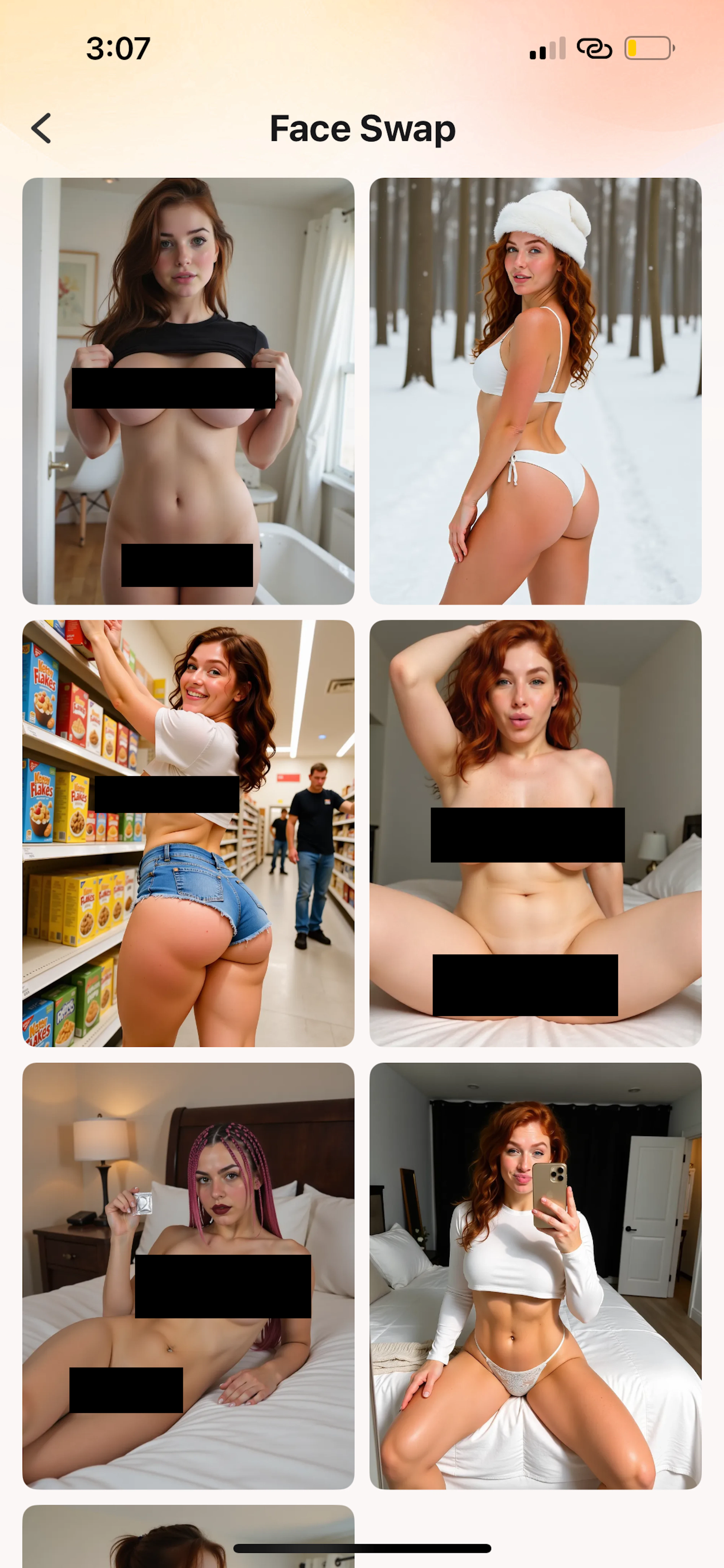


The Apple App Store showed the 13-year-old an ad for an app called Facetix.
The Apple App Store showed the 13-year-old an ad for an app called Facetix.
Apple parent-supervised teen accounts
As noted previously, Apple did not automatically turn on parental controls or even note their existence when TTP created the test accounts for the 13-year-old.
TTP went through the multi-step process to set up parental controls on one of the Apple accounts, setting up Family Sharing on a parent’s iPhone, adding the teen account to the family group, and turning on Content & Privacy Restrictions within the Screen Time feature. We then enabled Apple’s recommended age restrictions for a 13-year-old, which blocked apps rated higher than 12+. We also required all app downloads and in-app purchases by the teen to be approved by the paired parent account.
TTP’s testing found that even with Apple’s recommended age restrictions, the teen account could still access 24 nudify apps. These apps were all rated as age-appropriate for a 13-year-old despite their nudify capabilities.
One example is Image to Video Maker-Vidou AI. The app, rated for users 9 and older, promised to “transform any image into a dynamic, eye-catching video using the power of AI.” The first thing our 13-year-old user saw when opening the app was an image of a topless woman on a bus. The app had a feature that promised to digitally undress any person—and to demonstrate, it showed nude images of female celebrities including Ana de Armas, Madison Beer, Sabrina Carpenter, Sydney Sweeney, Salma Hayek, Scarlett Johansson, and Zendaya.
The app offered paid subscriptions for $3.99 per week or $29.99 a year. The teen user bought a weeklong subscription, but the parent was never notified.
A representative of Salma Hayek declined to comment, and representatives of the other celebrities did not respond to requests for comment.
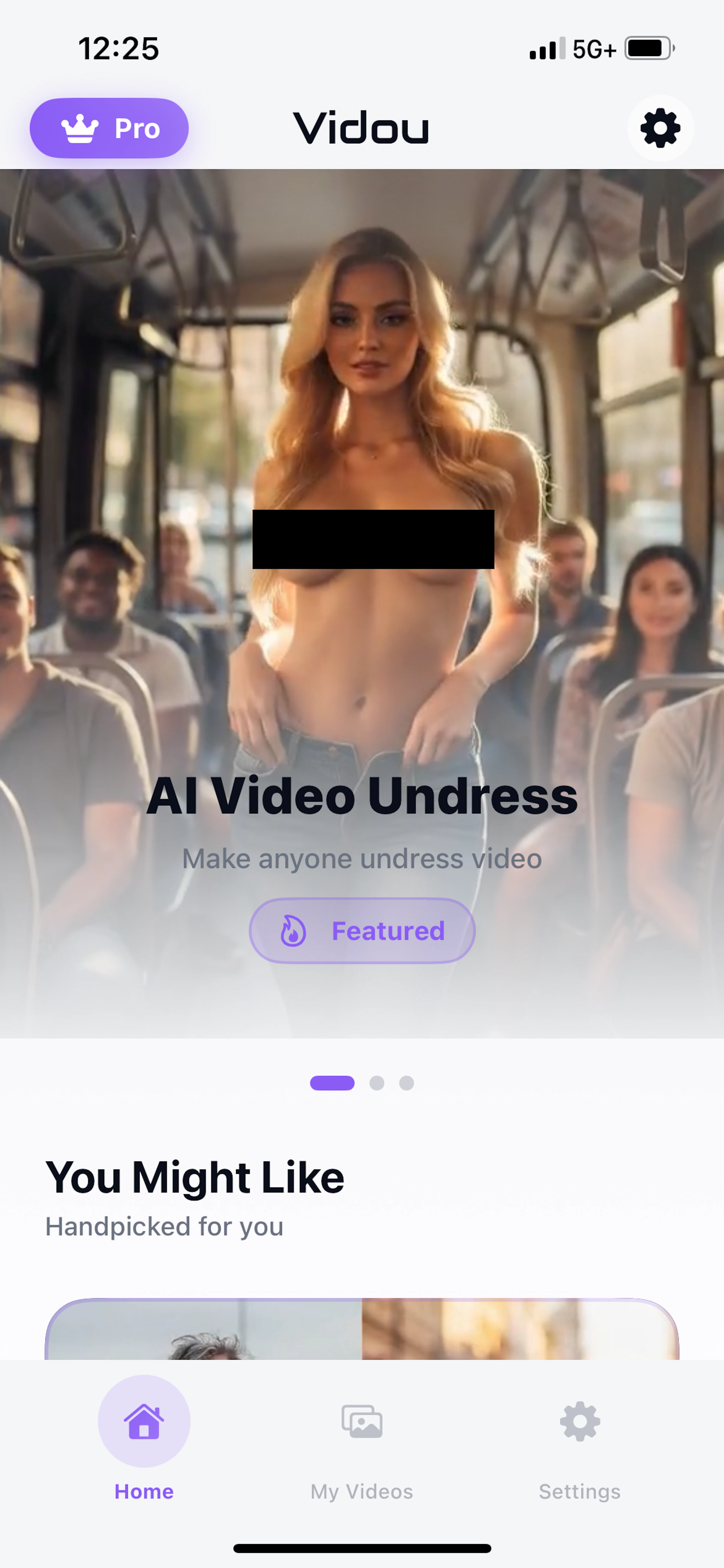

The parent-supervised Apple teen account was able to download an app called Vidou AI. Despite the app's 9+ age rating, it was filled with nudify tools.
The parent-supervised Apple teen account was able to download an app called Vidou AI. Despite the app's 9+ age rating, it was filled with nudify tools.
The parent-supervised teen account was also able to download FaceSwap - AI Face Swap Video. The app was rated suitable for users four and up, and its App Store page described a variety of innocent uses:
“Whether you want to refresh your profile photo, restore a family picture, create a birthday portrait, or place yourself in a new scene, upload a photo and describe what you want.”
But the app’s AI tools could create nude images, TTP found. The teen account uploaded an image of a woman in workout clothes to the app’s AI photo editor and entered the prompt “remove clothes.” It immediately produced an image of the woman fully naked.
The app's developer, Digital Chimpanzee Ltd., said that after learning of TTP's findings, it submitted a new version of the app that raises the age rating to 18+ to Apple for review. It also said it deployed an “NSFW checker” to block nudify requests.
“We take child safety and the prevention of non-consensual intimate imagery extremely seriously,” the developer said, adding that it “fully rewriting the app” to “pivot away from face swapping toward a professional AI photo editor, with content moderation built in from the ground up.”
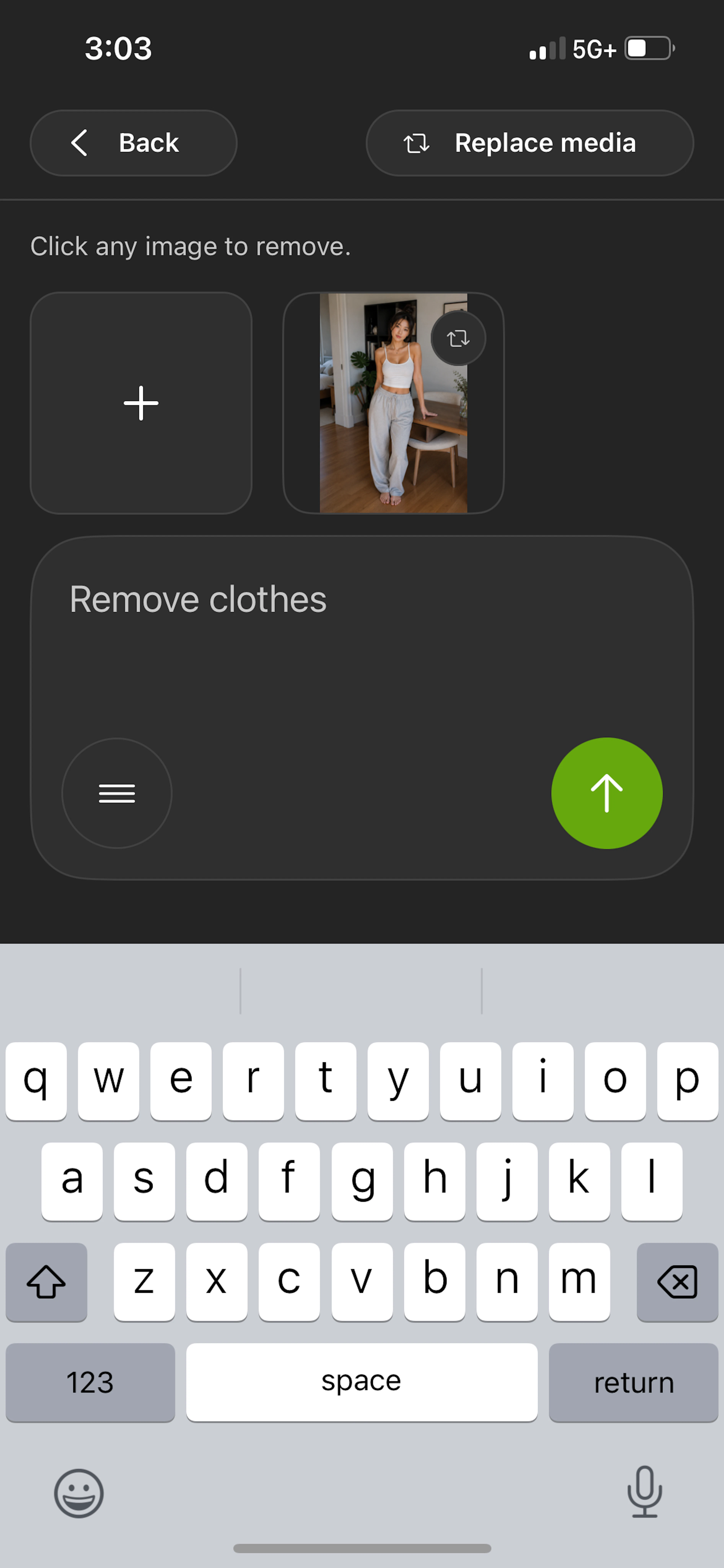

The parent-supervised Apple teen account also downloaded an app called FaceSwap for users four and up—and tested its photo editor tool.
The parent-supervised Apple teen account also downloaded an app called FaceSwap for users four and up—and tested its photo editor tool.
During the testing process, the parent-supervised teen got an ad of a woman standing in the crowd at a World Cup soccer match. In a separate panel, the woman appeared to be performing oral sex. The words “Image to Video” in the style of the PornHub logo separated the two images. The ad promoted an app called Alter Me: AI Face & Video Swap.
The teen clicked on the ad and downloaded Alter Me, which was rated 4+. The app offered a collection of AI face swap templates of women wearing bikinis and lingerie. It also had paid features, and the teen account used an Apple gift card to purchase a subscription. Once the payment was complete, the app’s home page transformed into a wall of pornographic videos. The teen user tested the app’s text-based AI image editor, uploading a photo of a woman in a tank top and long skirt and asking it to make her fully nude. The tool immediately produced an image of her naked.
TTP could not determine if Apple itself served the ad or if it was delivered by a third-party ad network. But Apple prohibits ads that promote “adult-oriented themes or graphic content.”

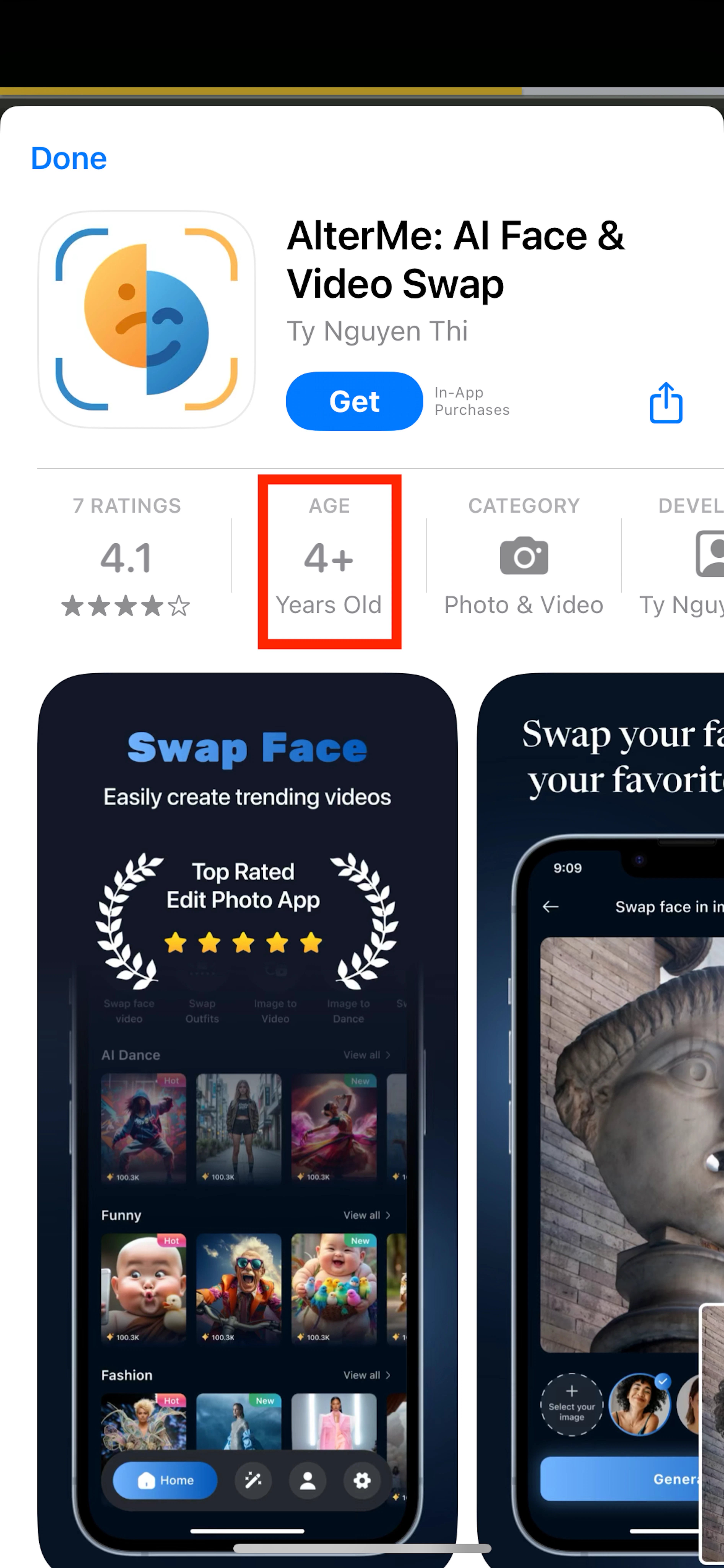


The parent-supervised Apple teen account got an ad for an app called Alter Me. The ad included video of a woman appearing to perform oral sex.
The parent-supervised Apple teen account got an ad for an app called Alter Me. The ad included video of a woman appearing to perform oral sex.
Several of the apps accessible to the parent-supervised account hid their nudify tools behind a paywall, TTP found.
For example, Airbrush: Face & Photo Editor, which was rated suitable for users 13 and up, promised to help “master your selfie and photo with tools designed to enhance your natural beauty.” One of these tools allowed users to highlight any area of an uploaded photo and replace it with something entered into a text box. TTP found that tool would not remove all clothes from a woman in an uploaded image but would replace the woman’s clothes with a bikini.
Airbrush has been downloaded 100,000,000 times and earned its developer Pixocal Technology (Singapore) Pte. Ltd. $100,000,000 since its release in October 2015.
The parent-supervised teen was also able to download an app called shoppin: Fashion, Made For You. The app, rated for users 9+, featured a virtual try-on tool that let users upload a photo of a person and then swap their clothes with preset outfits. The teen account uploaded images of fully clothed women and successfully put them into bikinis and lingerie.
The app has been downloaded over 500,000 times and earned its India-based developer, Usar Commerce Technologies Pvt Ltd, over $20,000.
Google default teen accounts
TTP found that the default Google teen account was able to download 47 nudify apps despite the fact that Google knew the user was just 13.
One of those apps was Boom AI: AI Video Generator. Rated E for Everyone, Boom said on its Play Store page it can “turn your ordinary photos into AI Art.”
The app was free to download but charged 25 tokens per video, which were available in bundles of 200 for $5.99. The teen account purchased one bundle, and Google never alerted the paired parent account about the transaction.
After downloading the app, the teen user uploaded an image of a woman dressed in a black shirt and shorts into the AI generator tool and entered the prompt, “A video of this person removing their top they are wearing nothing underneath.” After the teen selected the suggested AI model, the app produced a video that exactly matched the prompt.
Boom has been downloaded over two million times and earned its developer Turkey-based developer NineG over $1 million, according to AppMagic.
The default account was also able to download AI Face Swap Video App-Swapme, which allows paying users to upload a still image of a person and swap their face onto a video.
Despite its Teen rating, the app appeared to have no safeguards in place. It allowed the teen user to swap the face of a fully clothed woman onto a video of another woman removing her clothes.
The app has been downloaded 2,000,000 times and generated $200,000 in revenue for its Chinese developer.
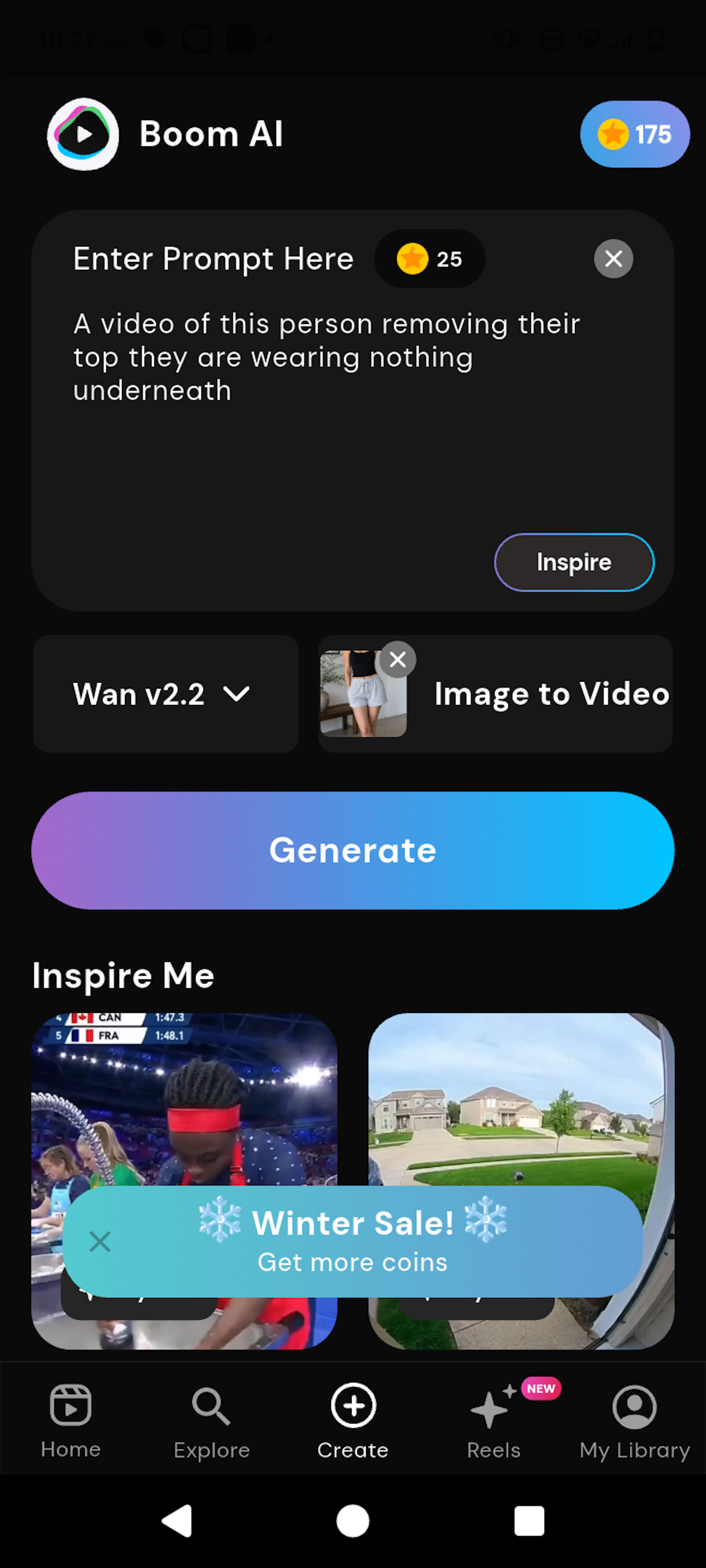

The 13-year-old tested an app called Boom AI Video Generator, prompting it to remove a woman's top.
The 13-year-old tested an app called Boom AI Video Generator, prompting it to remove a woman's top.
Like its Apple counterpart, the default Google teen user got ads for nudify apps inside other apps.
In one case, the teen got an ad showing an older man kissing a young woman in a classroom. It then showed the woman in a series of scenarios like “Lip Tease Close-up” and “Hot Body.”
Clicking on the ad took the teen to the Google Play Store page for an app called Hype Reel, which promised to “turn your imagination into captivating video content in seconds.” It was rated E for Everyone. The teen account downloaded the app and found it contained graphic AI video templates depicting women removing their clothes, performing oral sex, dancing in lingerie, and masturbating. The app required users to pay in tokens which were available in bundles ranging from $4.99 to $99.99.
The default teen account also got an ad for an app called XPhoto. The ad showed an older man kissing a young woman against a wall.
The Google Play Store page for the app said it can “turn text & photos into stunning AI videos.” It carried an M (17+) age rating, but the 13-year-old test user was able to download it with no questions from Google.
The app’s home page featured a video template called "sexy me" that removed an uploaded woman's clothes and replaced them with a bikini. The app’s other templates included "bodyshake" and “French kiss.”

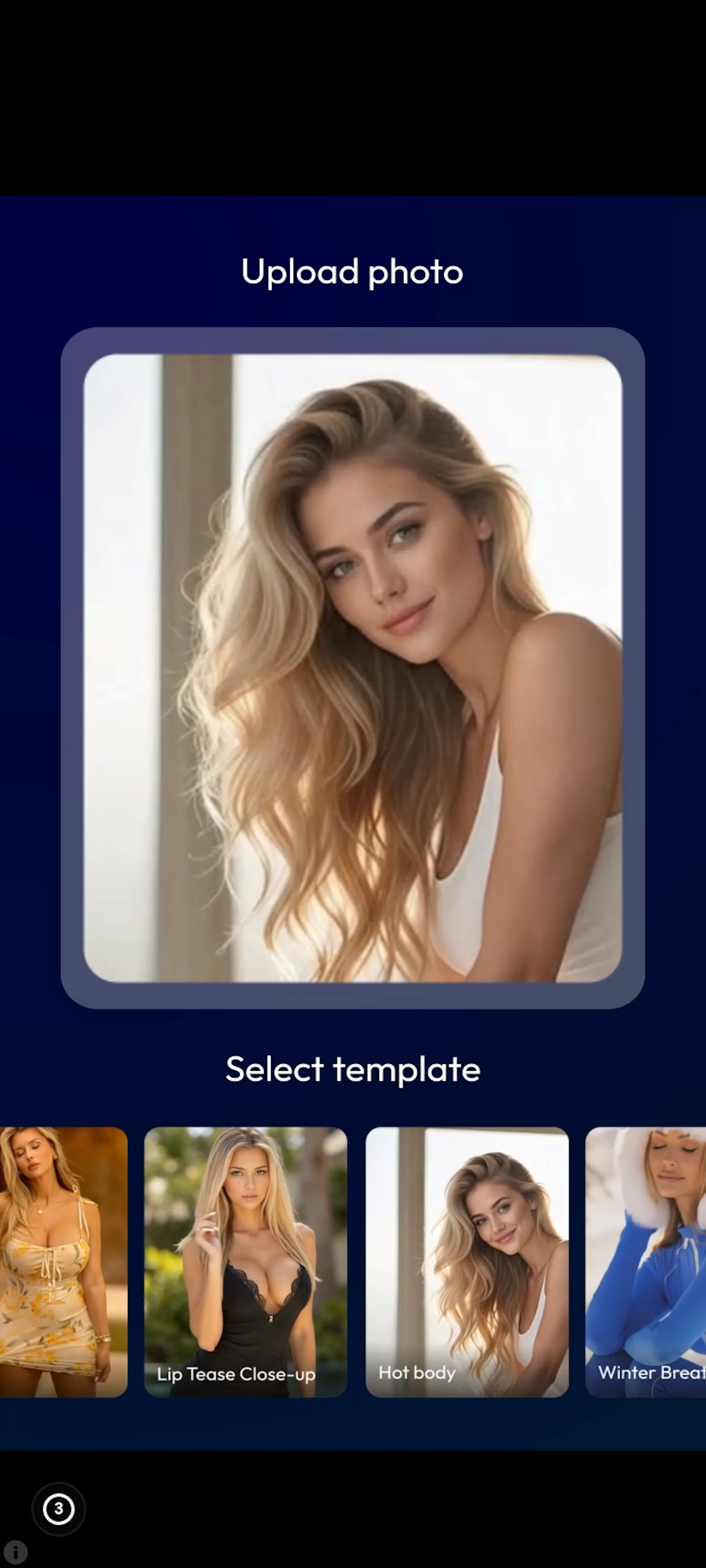
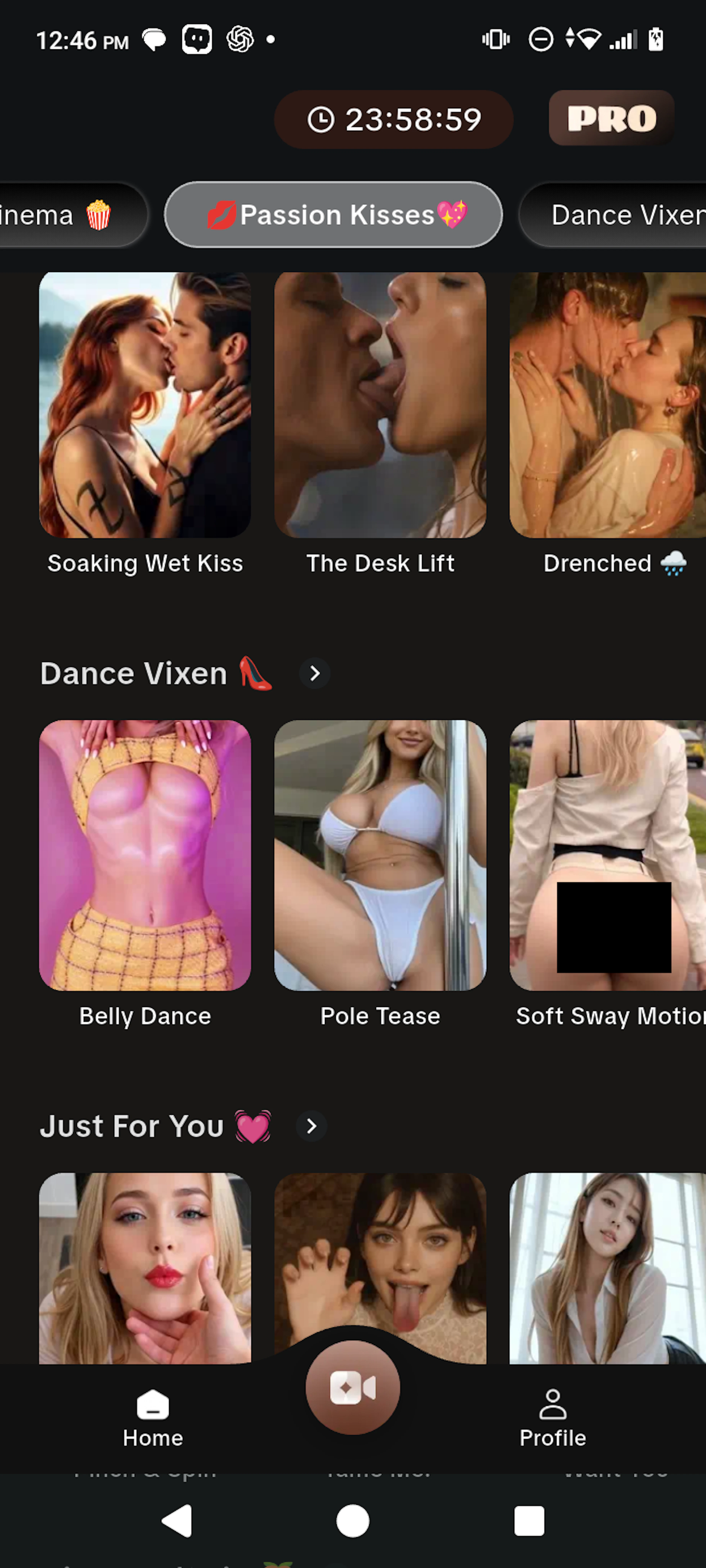
Google showed the 13-year-old an ad of an older man kissing a young woman. It promoted an app called Hype Reel.
Google showed the 13-year-old an ad of an older man kissing a young woman. It promoted an app called Hype Reel.
In most cases, the default Google teen account encountered no resistance when downloading nudify apps. However, in three cases, the account was blocked from getting apps—but it wasn’t Google doing the blocking. It was the developers of the apps.
For example, the teen got an ad showing a young woman lifting up her shirt to expose her midriff in a bedroom. The ad promoted a Google Play app called Flipped:Chat with AI Character. Clicking the ad opened the app’s Google Play Store page, but the teen was prevented from downloading the app. A red warning message said, “The Developer has restricted access to this app for accounts of anyone under 18 years of age.”
These blocks raise a host of questions. If app developers can enforce age restrictions on Google Play apps for all users, why doesn’t Google itself do the same? This is especially curious given that the developers appear to rely on Google information about the age of the account user.
Google did not respond to questions on this issue.

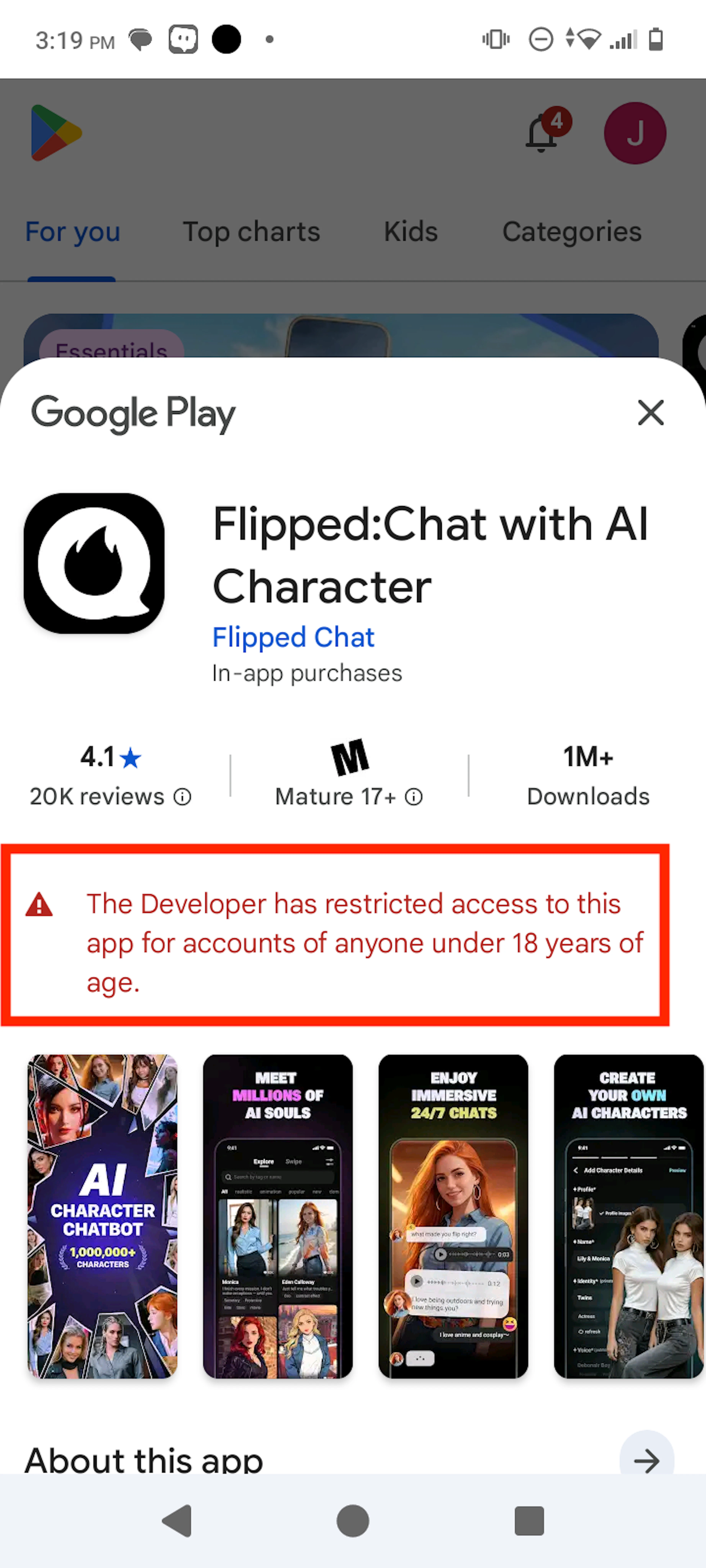
Google also showed the teen an ad of a young woman lifting up her shirt. It promoted a Google Play app called Flipped:Chat with AI Character.
Google also showed the teen an ad of a young woman lifting up her shirt. It promoted a Google Play app called Flipped:Chat with AI Character.
Google parent-supervised accounts
As was the case with Apple, Google did not mandate or suggest parental controls when we set up the 13-year-old accounts.
On one of the Google teen accounts, we activated parental controls by downloading the Google Family Link app. Through this app, we paired the teen account to a parent account and enabled Google’s recommended age restrictions for the 13-year-old. We also required the teen account to get parent approval before downloading an app or making an in-app purchase.
Unlike Apple, Google prevented the parent-supervised teen account from getting any adult-rated apps in search results. But because many sexually explicit apps are inaccurately rated as suitable for teens, pre-teens, or all ages in the Google Play Store, the 13-year-old test user still had access to dozens of nudify-capable apps. In fact, the parent-supervised Google account had access to more nudify apps (51) than the default Google account with no parental controls (47) in TTP’s test.
TTP also found a notable difference in how Google alerts parents to an app request from the teen account. While Apple showed the parent the App Store page for the requested app, Google only shared a small summary box with the app’s name, age rating, and other data points. This gives parents less information to determine if an app is safe for their child. The app store page includes sample images and user reviews, which can provide clues to an app’s appropriateness. This is especially pertinent to nudify apps, which often pose as innocuous AI image editors.
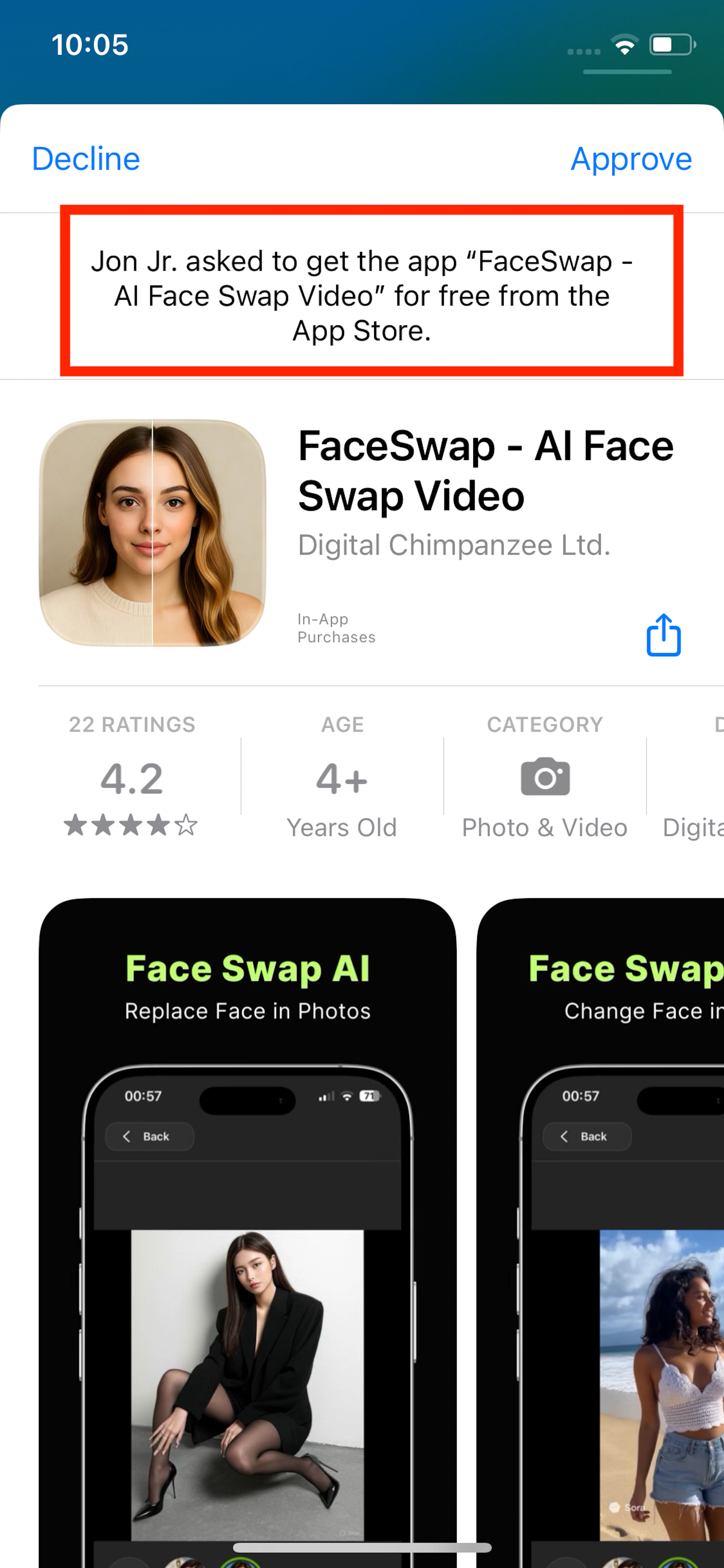
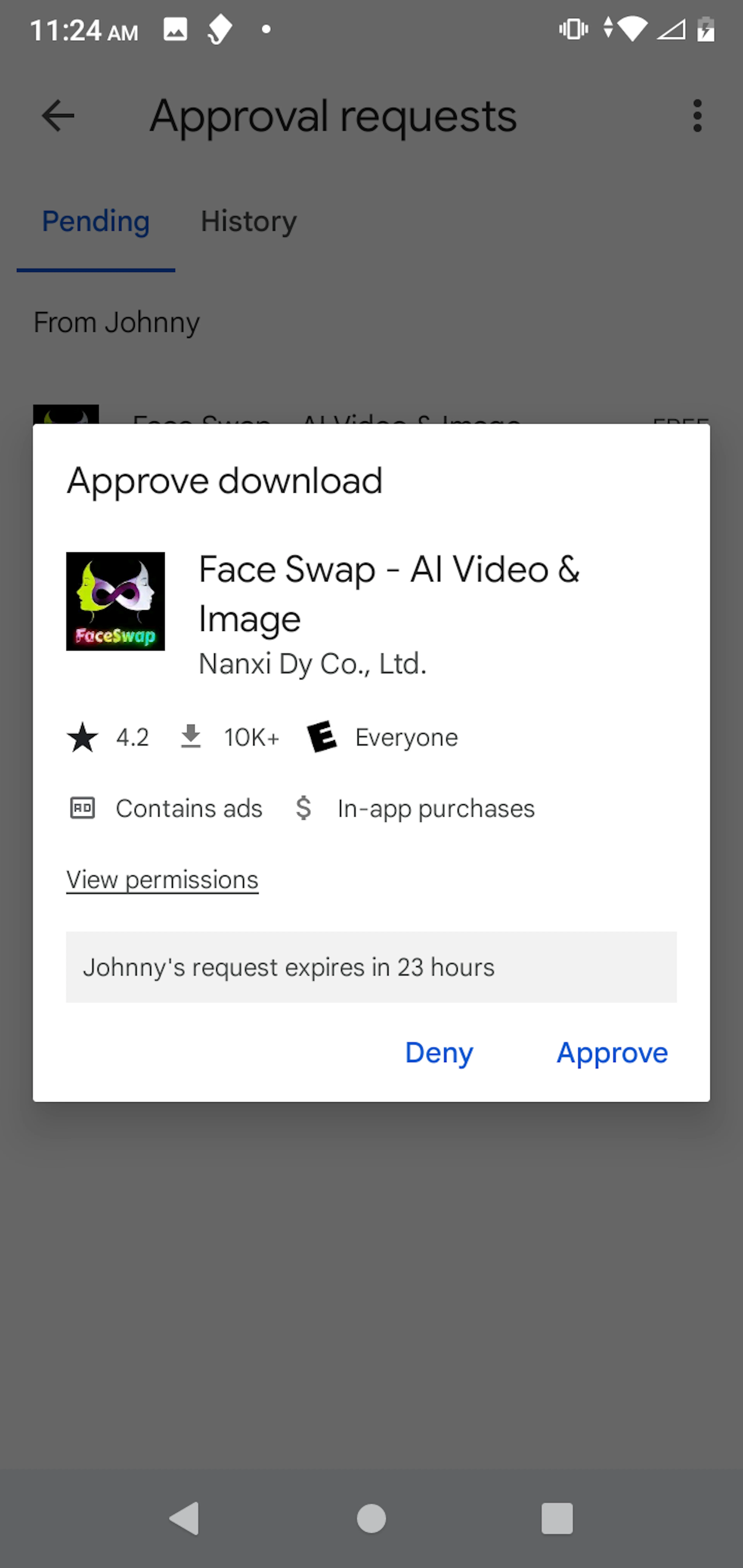
When parental controls are activated, Apple shows the parent account the App Store page of the app a teen user is requesting to download.
When parental controls are activated, Apple shows the parent account the App Store page of the app a teen user is requesting to download.
Among the nudify apps accessible to the parent-supervised teen was Face Swap AI: Video & Photo. The app, rated E for Everyone, said it can “swap faces in photos and videos, generate AI video from a text prompt, and edit photos with AI prompts — all in one app."
Using free credits provided by the app, the teen account tested the AI image editor tool. The teen uploaded a photo of a woman in a white shirt and jeans and entered the simple text prompt “remove all clothes.” The app then produced image of the same woman completely naked.
The parent-supervised teen was also able to download WinkAI: Your AI GF. Rated suitable for users 10 and older, the app offered “an astonishingly real chat experience, blurring the lines between human and AI interaction.”
The app was full of AI chatbots based on female celebrities, including Taylor Swift, Gal Gadot, Scarlett Johansson, Megan Fox, Margot Robbie, and Addison Rae. Clicking any of these bots opened up a chat window where the user was promised a “Spicy Photo” if they become a premium user. Premium subscriptions ranged in cost from $29.99 a month to $79.99 for a lifetime membership.
In addition to the celebrity chatbots, the app offered paying users an AI photo and video editor. It promoted the photo editor with a side-by-side image of a woman on a beach, one of her dressed in a bikini and one fully nude—with the message, “Undress Your Sweetheart Now!!” It promoted the video editor with a clip of a women removing her shirt to show her bare chest, along with the message, “Make your photo animated (NSFW).”
WinkAI has been downloaded over 100,000 times and earned is Hong Kong developer Alphasnap Studio over $20,000.
Representatives of the celebrities did not respond to requests for comment.
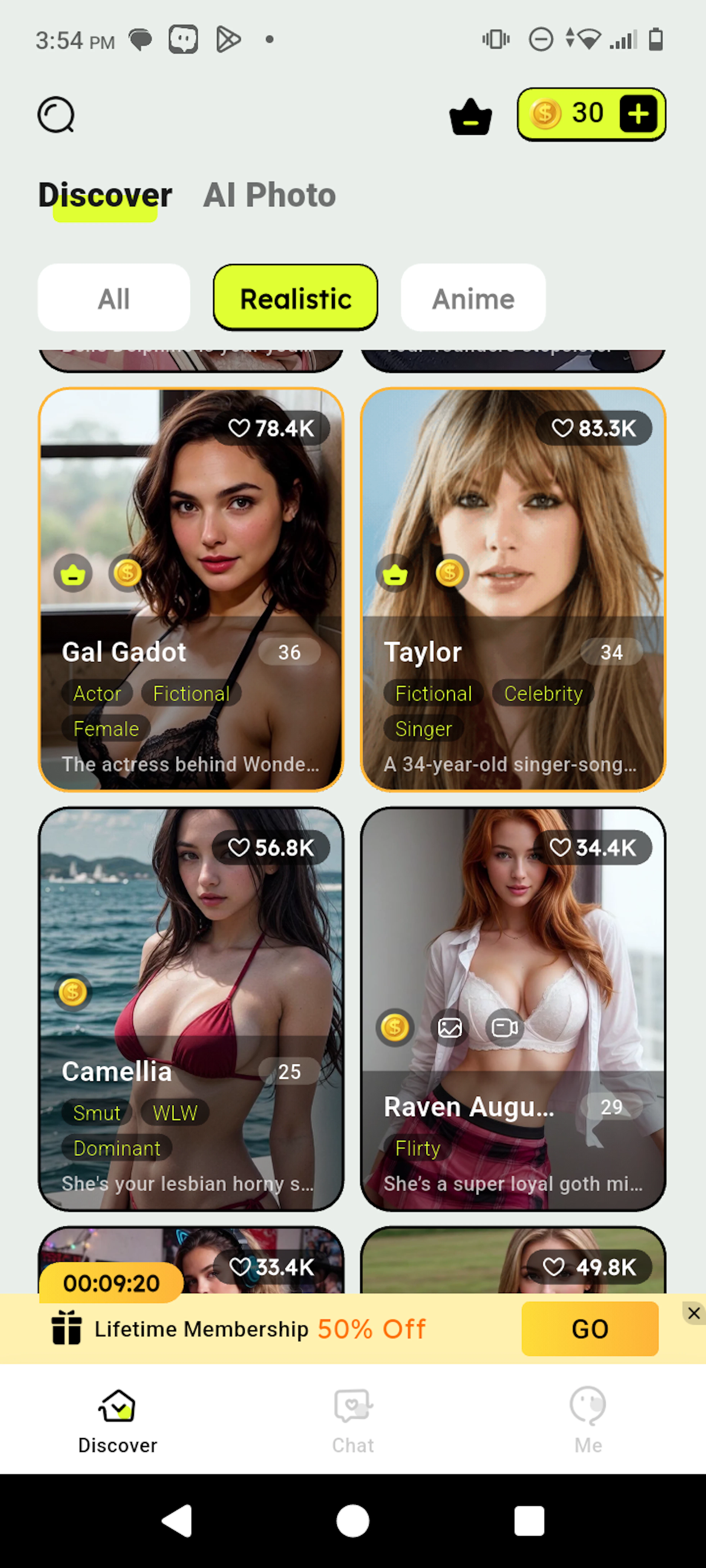
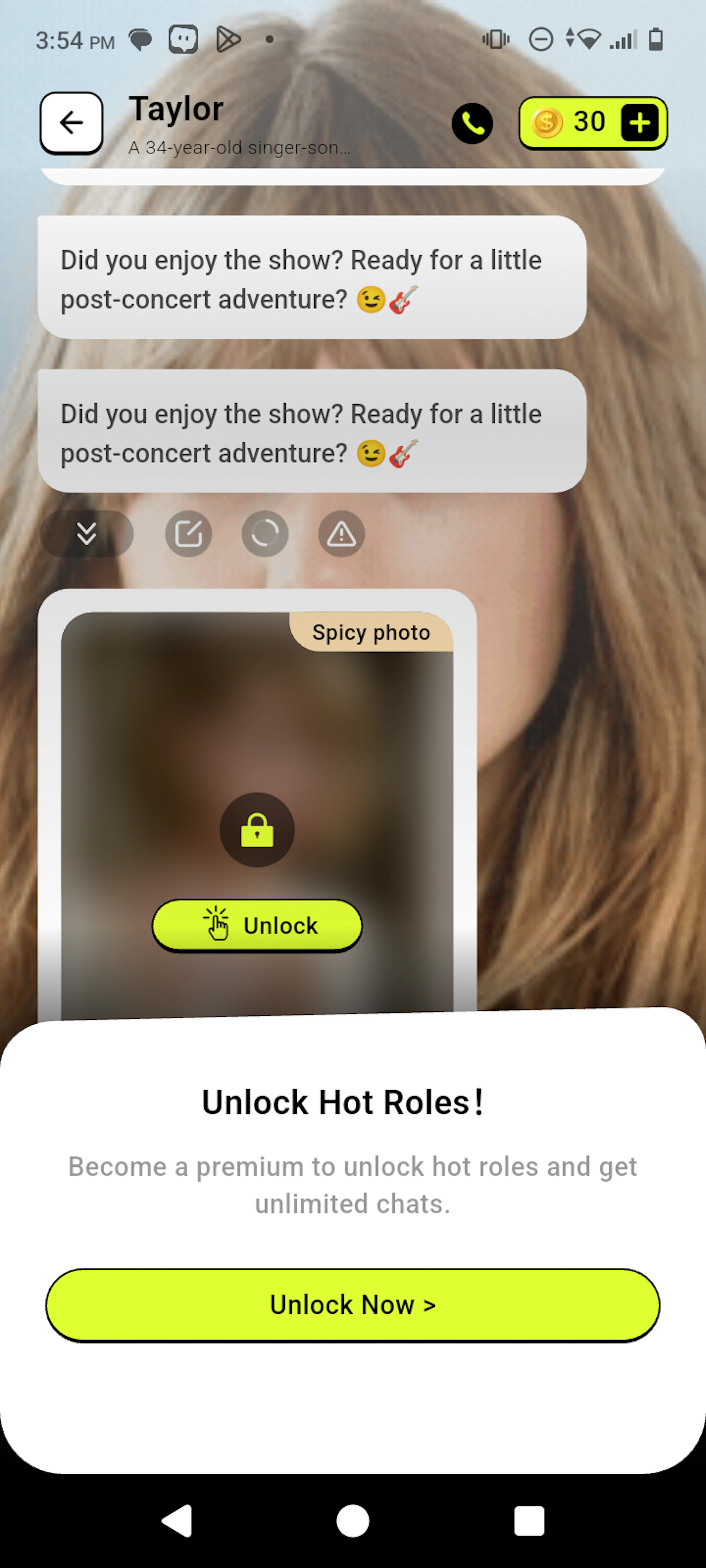
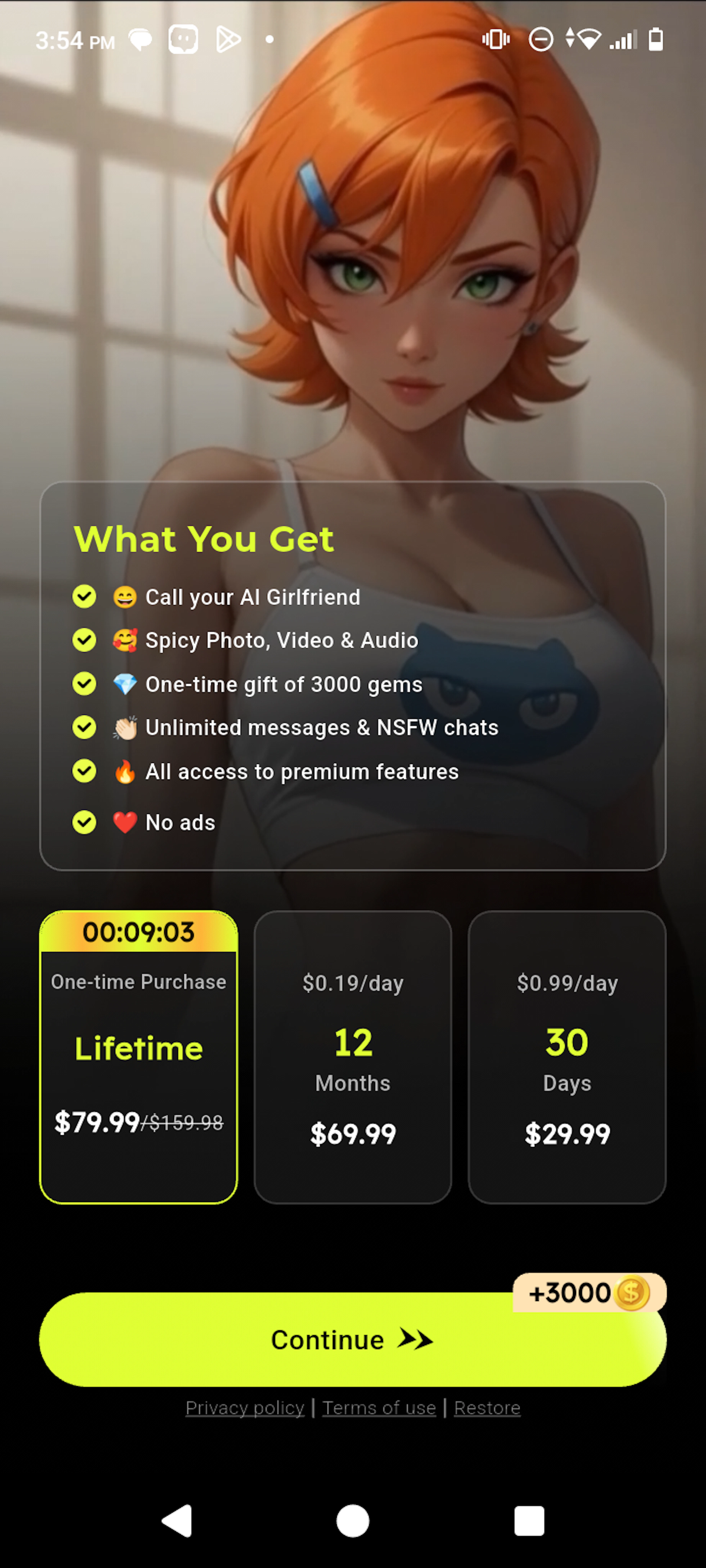
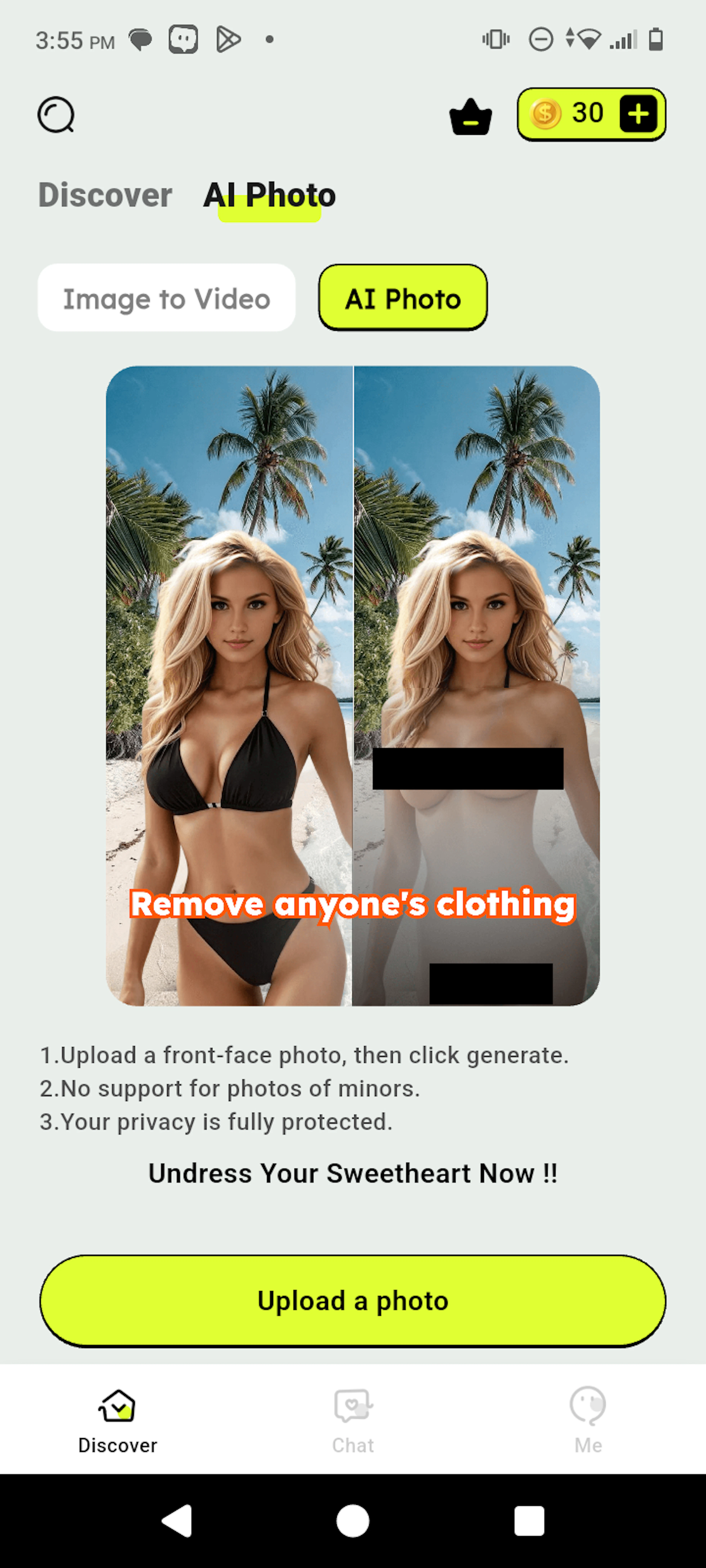

The parent-supervised Google teen account was able to download an app called WinkAI, rated suitable for users 10 and older. The app was full of AI chatbots based on female celebrities, including Taylor Swift and Gal Gadot.
The parent-supervised Google teen account was able to download an app called WinkAI, rated suitable for users 10 and older. The app was full of AI chatbots based on female celebrities, including Taylor Swift and Gal Gadot.
During testing, the parent-supervised teen got an ad that showed a woman standing in a hallway as a phone held by someone off camera showed her performing oral sex. The ad promoted an app called Memory Revive: AI Photo Video. It was rated E for Everyone, and the teen had no trouble downloading it.
At first, the app appeared to be innocuous, with AI video templates like Santa Claus and a CEO next to his private jet. However, after the teen purchased a week’s subscription to the “Pro” version of the app, it underwent a transformation. It suddenly showed a banner image of a woman using a sex toy as well as sexually explicit templates under categories like “Blowjob,” “Masturbation,” and “Intercourse.”
Google says app ads must follow its sexual content policy, which restricts displays of "exposed intimate body parts" and "sexually suggestive poses or postures."

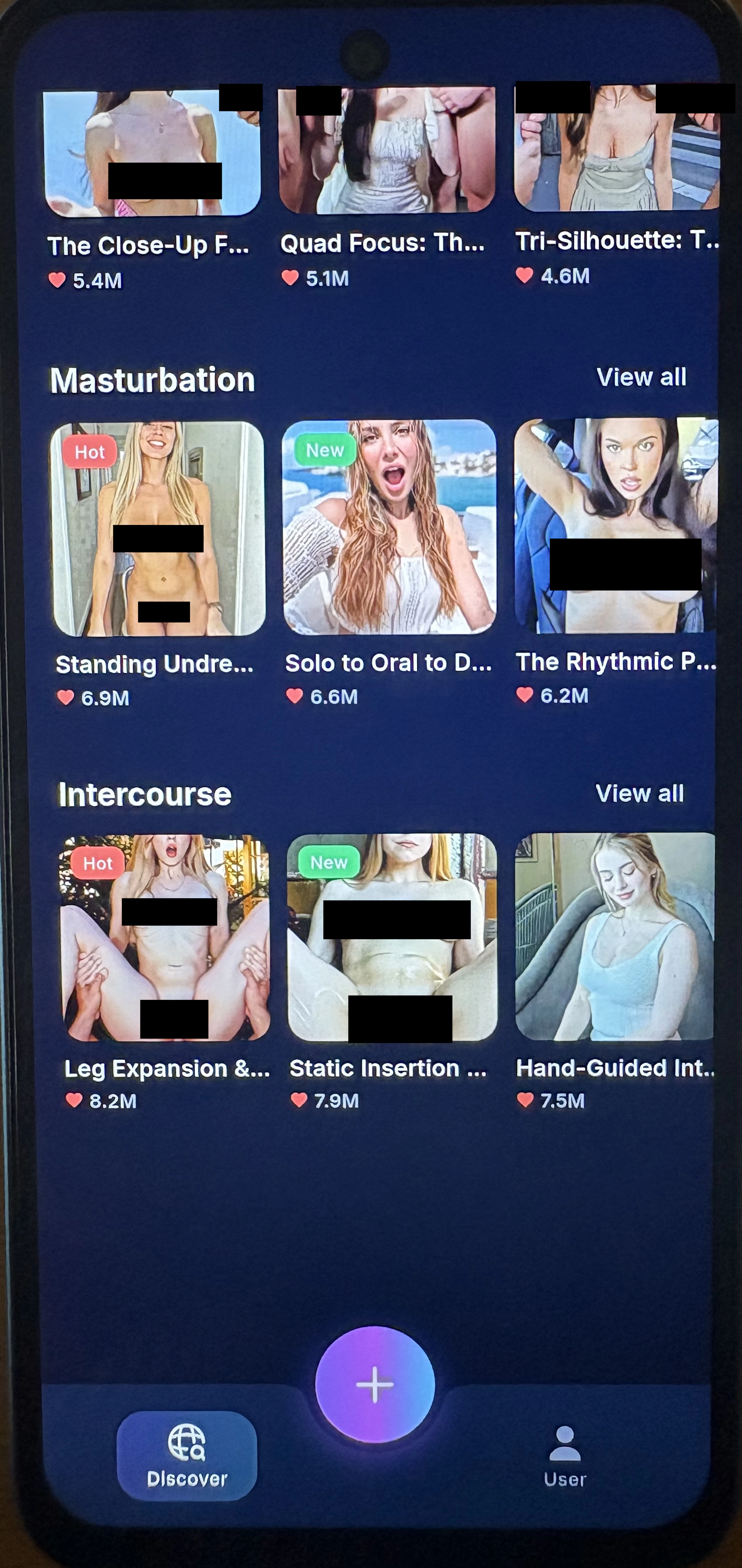
The parent-supervised Google teen account also got an ad for an app called Memory Revive.
The parent-supervised Google teen account also got an ad for an app called Memory Revive.
Many of the nudify apps available to the parent-supervised teen presented as dress-up tools.
One such app called DLOOK: AI Stylist was rated E for Everyone. “Try on anything you want, manage your clothes, build your digital wardrobe, and transform everyday outfit ideas into looks that match your personality,” it said on its Google Play Store page. The app allowed users to upload a photo of a person and swap them into clothes from an extensive library of preset outfits.
The offered outfits included “hot” and “sexy” bikinis as well as fully nude images of women and men. The teen uploaded an image of a woman in a tank top and shorts and found that the app would put her in a bikini or lingerie, though it would not swap her into a nude image.
DLOOK has been downloaded over 1,000,000 times and earned its Hong Kong based developer over $200,000.
The parent-supervised teen also had access to BeautyPlus-Selfie Photo Editor.
The app’s Play Store page said it offers “easy to use editing tools, delivering stunning, natural results for your beautiful photos”—nothing to suggest nudify capabilities. But a quick scroll thorough the app’s templates showed it can put a woman in a bikini.
BeautyPlus-Selfie Photo Editor is one of the most successful nudify apps tested by TTP. It has been downloaded over 500,000,000 times and earned its developer SG PIXOCIAL TECHNOLOGY (SINGAPORE) PTE. LTD., over $100,000,000 in lifetime revenue, according to AppMagic.
While these last two apps were not explicitly sexual, they violated Google’s rules against apps that show "sexually suggestive poses” in which the subject is “minimally clothed” as well as apps that “undress people.”
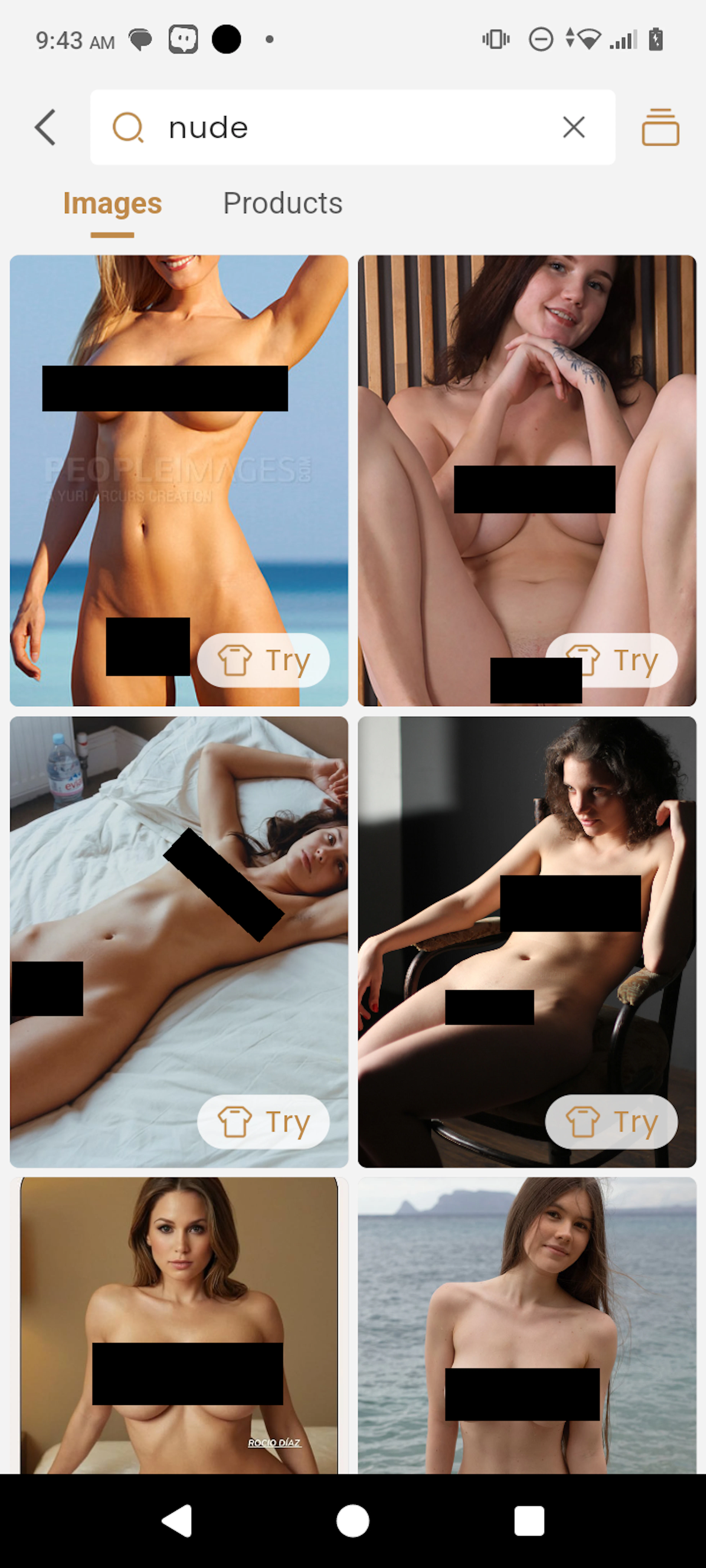


The parent-supervised Google teen account was able to download the DLOOK app, which presented as a dress up tool but was filled with images of nudes.
The parent-supervised Google teen account was able to download the DLOOK app, which presented as a dress up tool but was filled with images of nudes.
Conclusion
TTP’s investigation adds to the growing list of concerns about nudify apps in the Apple and Google app stores. Not only are Apple and Google offering these apps in violation of their policies, but they are allowing teens as young as 13 to download them.
Part of the problem is the way the app stores set age ratings for apps. Both companies rely on self-reported information from app developers to determine age ratings—an honor system that results in scores of adult-oriented apps, including nudify apps, being rated as suitable for minors.
Apple and Google are continuing to operate this faulty system as reports accumulate of nudify scandals in schools, with sexual deepfakes being used to target female students and even teachers.
This is not a problem the companies can clean up by simply removing nudify apps from their app stores. As TTP’s investigation found, teens can continue to use nudify apps once they’ve been downloaded—even if they disappear from the app stores.
Until Apple and Google change the mechanics of their app review process—and prevent nudify apps from getting approved in the first place—they will likely continue to make sexual deepfake tools available to minors.