Key findings:
- Meta is using Instagram influencer moms to soften its image on child safety amid mounting criticism and legal pressure over its impact on minors, a TTP investigation found.
- Meta invites the moms to glossy events promoting its "Teen Account" safeguards, and the influencers then repeat the company’s talking points to their thousands of followers.
- Many of the influencer posts include easy-to-miss disclosures or hashtags indicating they have a paid partnership with Meta.
- TTP also identified doctors and psychologists who are touting Instagram’s Teen Accounts and have a financial relationship with Meta.
- Despite Meta's promotion of the Teen Accounts, reports have shown that they fail to protect young users from content related to sex, drugs, and violence.
- Some influencers are also advocating for one of Meta's top policy priorities: legislation to require the Apple and Google app stores to handle user age verification.
- One medical influencer who was paid to post about the Teen Accounts said they had not been aware of child safety lawsuits against Meta and felt "manipulated" by the company.
- The influencer said Meta edited the script for their Teen Accounts post and gave it an algorithmic boost, helping it rack up millions of views.
Social media influencer Sadie Robertson Huff, known for starring in the reality TV series Duck Dynasty, typically posts about her Christian faith and family to her more than five million followers on Instagram. But in an October 2024 video post, she had a message about Instagram itself.
“They have actually rolled out these new Teen Accounts that I think is absolutely incredible,” Robertson Huff said. “The fact that Instagram is thinking about this for teens and trying to help parents have a peace of mind is amazing.”
Buried at the bottom of the glowing endorsement: a small print disclosure that she has a paid partnership with Instagram.
Robertson Huff is not an isolated case.
A new investigation by the Tech Transparency Project (TTP) reveals that Meta has deployed an army of social media influencer moms to promote its Teen Account safety features as it faces mounting criticism—and legal pressure—over its impact on the mental health of minors.
For the past several years, Meta has invited scores of “momfluencers” with large Instagram followings to glossy events around the country, where they hear about the Teen Accounts and their safety features for 13- to 17-year-olds. The influencers then turn around and deliver that same message to their followers, in Instagram Reels and Stories that reach millions of parents. Many of the moms indicate they have a paid partnership with Meta or use the hashtag #MetaPartner or #InstagramPartner.
TTP also identified multiple doctors and psychologists who have promoted the Teen Accounts and have a financial relationship with Meta. Their enthusiastic endorsements contrast with reports that the Teen Accounts fail to live up to their promised protections and can expose young users to content related to sex, alcohol, drugs, and extreme violence.
Meta's influencer strategy sheds new light on its efforts to spin the public discourse on social media and kids. Faced with an onslaught of whistleblower revelations and lawsuits alleging it knowingly harmed children, Meta has responded by heavily marketing its Instagram child safety features. Part of that strategy, TTP’s investigation shows, involves leveraging social media personalities with substantial parent followings or medical credentials to parrot Meta talking points.
TTP even found that some Meta-affiliated influencers are advocating for one of Meta’s top policy priorities: legislation that would require the Apple and Google app stores to verify the age of users and obtain parental consent for app downloads by minors. Meta has strongly backed such measures, which would push responsibility for age verification onto Apple and Google, rather than apps like Instagram. Meta is in some cases using college athletes to push these app store bills.
As TTP described in an August 2025 report, Meta had a deal with the National PTA to take part in Screen Smart events, an arrangement that gave the events a stamp of approval from the nation’s premier parent-teacher organization. The PTA announced this year it is cutting ties with Meta, citing “heightened public scrutiny and legal cases” involving the company. But Meta may continue to rely on its legion of Instagram influencers to soften its image.
Meta did not respond to TTP's request for comment and questions. But in a statement to CNN, which covered this report, Meta spokesperson Nkechi Nneji said, “We proudly work with parents and creators to spread the word about these controls and encourage people to use them."
“Our critics claim to care about safety, but attacking efforts to educate parents proves they are more interested in headlines than actually helping families," Nneji added.
Most of the influencers also declined to comment to TTP. But one medical influencer who was paid by Meta to post about the Teen Accounts said they regretted doing so.
“I was not aware of the lawsuits and the intentional harm Meta was causing to teens on their apps when I contracted to help promote increased teen restrictions,” said the influencer, who did not want to be named because they signed a nondisclosure agreement and feared retaliation from Meta. “I was paid for the content creation, but I feel manipulated by the way that I was hired and in hindsight would not have done that work.”
The influencer said they submitted a script which was edited by Meta to remove wording that was not in line with the company’s public relations strategy.
“When I originally said yes, they said I would submit a script of my choosing. So I wrote out a script and then it became a thing where they were like, ‘We’re going to edit this,’” the influencer said. “I wanted to say things in it like, ‘As parents we obviously are very concerned about the negative effects of social media on our kids,’ and that was a no.”
The influencer said they were contractually obligated to keep the Teen Accounts post up for months and were "absolutely" sure that Instagram boosted it, because it got millions more views than their typical content.
'Educational workshops'
Meta has faced a series of public relations and legal hits over its record on child safety. In 2021, whistleblower Frances Haugen, a former Facebook product manager, leaked a trove of internal Meta child safety studies. These materials, which Haugen shared with Congress, revealed that Meta was aware its products posed a risk to children yet continued to target young users.
Meta now faces a wave of litigation involving more than 1,200 individual lawsuits filed on behalf of children, families, school districts and attorneys general across the country. Juries in the first two of those cases to go to trial—a case brought by the New Mexico attorney general and a suit by a California family—ruled in March against Meta, while other social media companies settled before trial. Meta last week settled another related case brought by Kentucky schools, which was scheduled to go to trial in June. Additional cases are expected to go to trial early next year.
During this time Meta has heavily promoted its Instagram Teen Accounts through Screen Smart events across the country. Meta describes these events as “educational workshops” about parent supervision tools and screen time controls. But the company is also using them as a PR campaign to counter negative media coverage—and portray itself as dedicated to child safety.
Influencers are a key part of that effort. A review of social media posts from 2024 to the present shows that hundreds of parent influencers have promoted Meta’s Screen Smart events and Teen Accounts to millions of followers across Instagram, TikTok, and YouTube. The majority of this activity occurred on Instagram, where these posts generated 276 million views, according to social media analytics platform Zelf.
Meta has designed its Screen Smart events for maximum shareability. Its events typically feature brightly colored décor, catered food, espresso carts, art activities, customizable swag, Meta-branded photo stations, and mini studios to self-record with flattering lighting. These perks have served as an attractive backdrop for influencers hungry for content for their social media feeds.
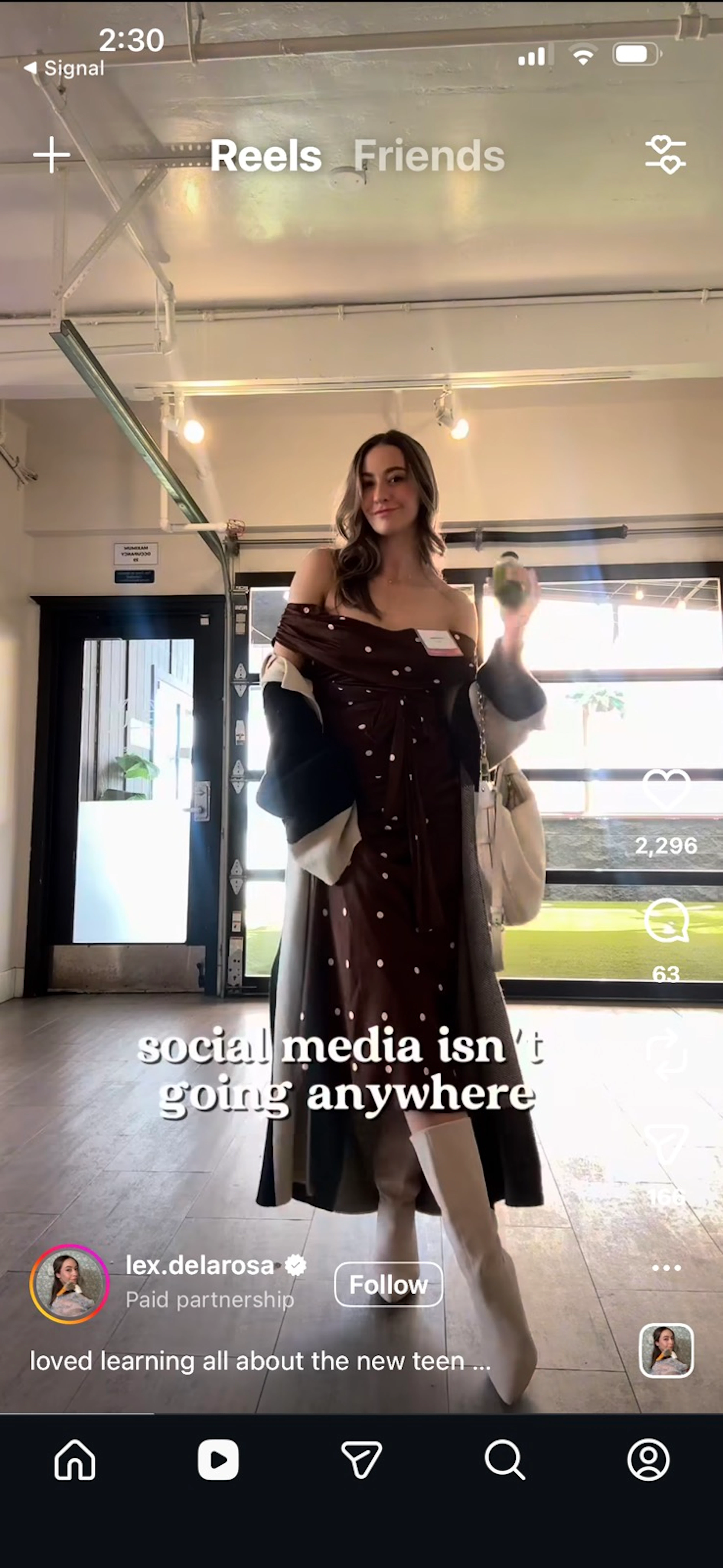
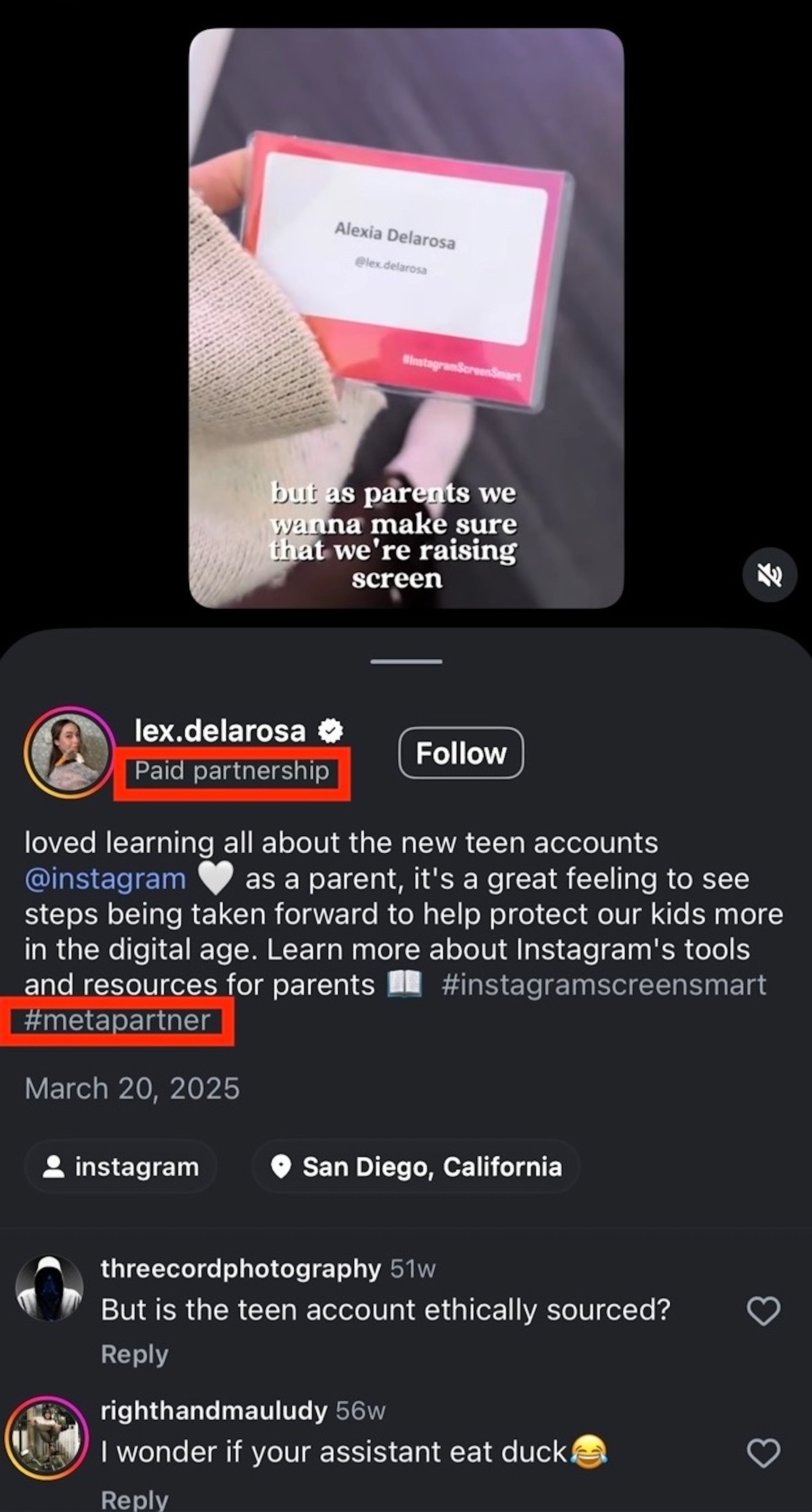
Take Alexia Delarosa, a San Diego stay-at-home mom who’s been dubbed a “viral tradwife” for sharing over-the-top homemade recipes on Instagram and TikTok. In March 2025, she veered away from her usual fare of hazelnut soup and artisanal herb butter with an Instagram Reel about a Screen Smart event she attended.
“Social media isn’t going anywhere, but as parents we want to make sure that we are raising screen smart teens,” she told her hundreds of thousands of Instagram followers. “These accounts have content control so your teen is only viewing wholesome, age appropriate content.”
The video had a “paid partnership” label and a #metapartner hashtag, indicating Delarosa was compensated by Meta.
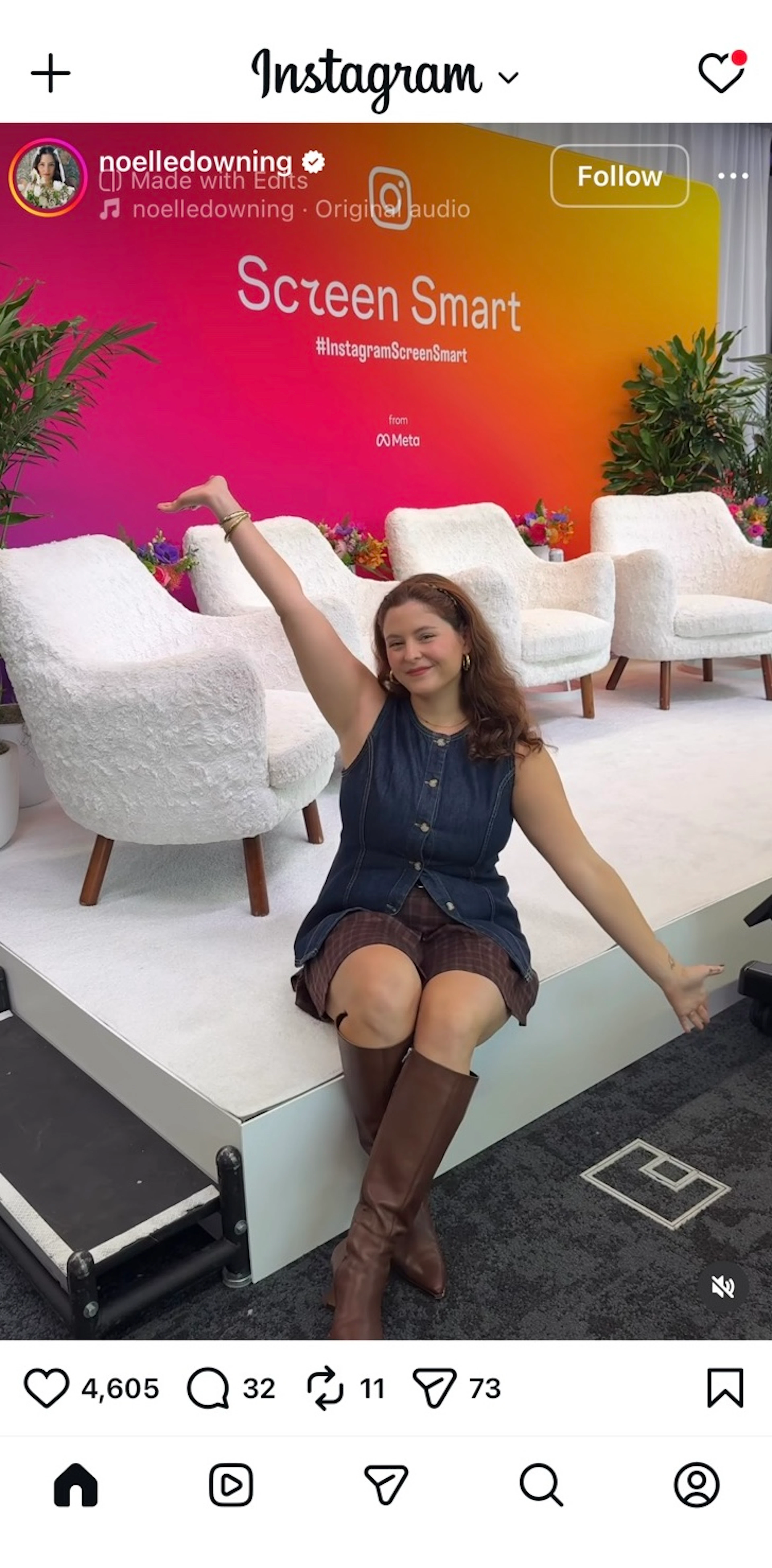
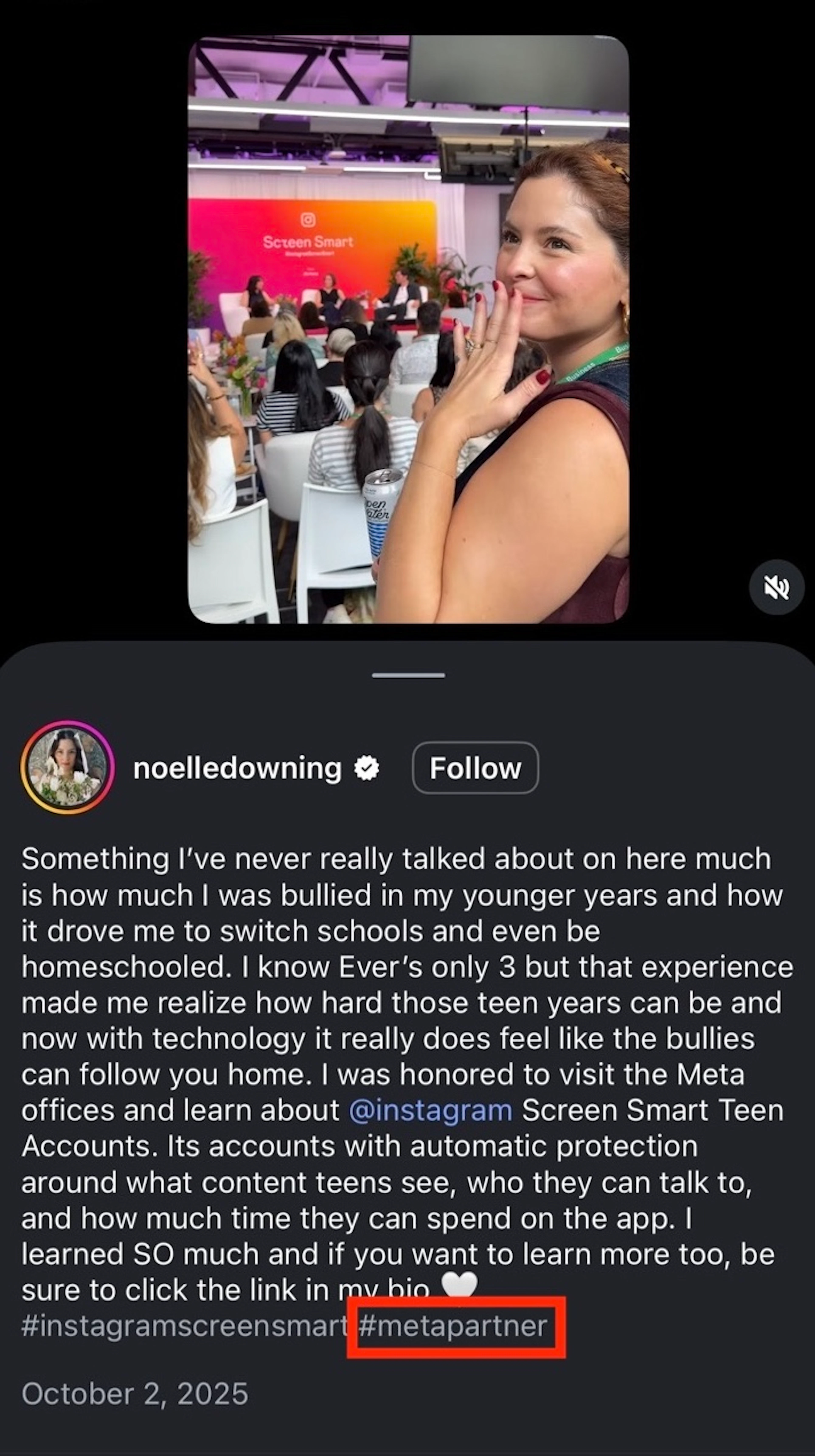
Others, like content creator Noelle Downing, have also interrupted their regular programming to push Meta’s teen safety features. Downing, who lives in New York, posts almost exclusively about fashion and homewares to her one million followers on Instagram. In October 2025, however, she said she was “honored to visit the Meta offices and learn about @instagram Screen Smart Teen Accounts.”
Over a Reel of her striking various poses at the event, Downing said the Teen Accounts have “automatic protection around what content teens see, who they can talk to, and how much time they can spend on the app.” The post ended with #metapartner.
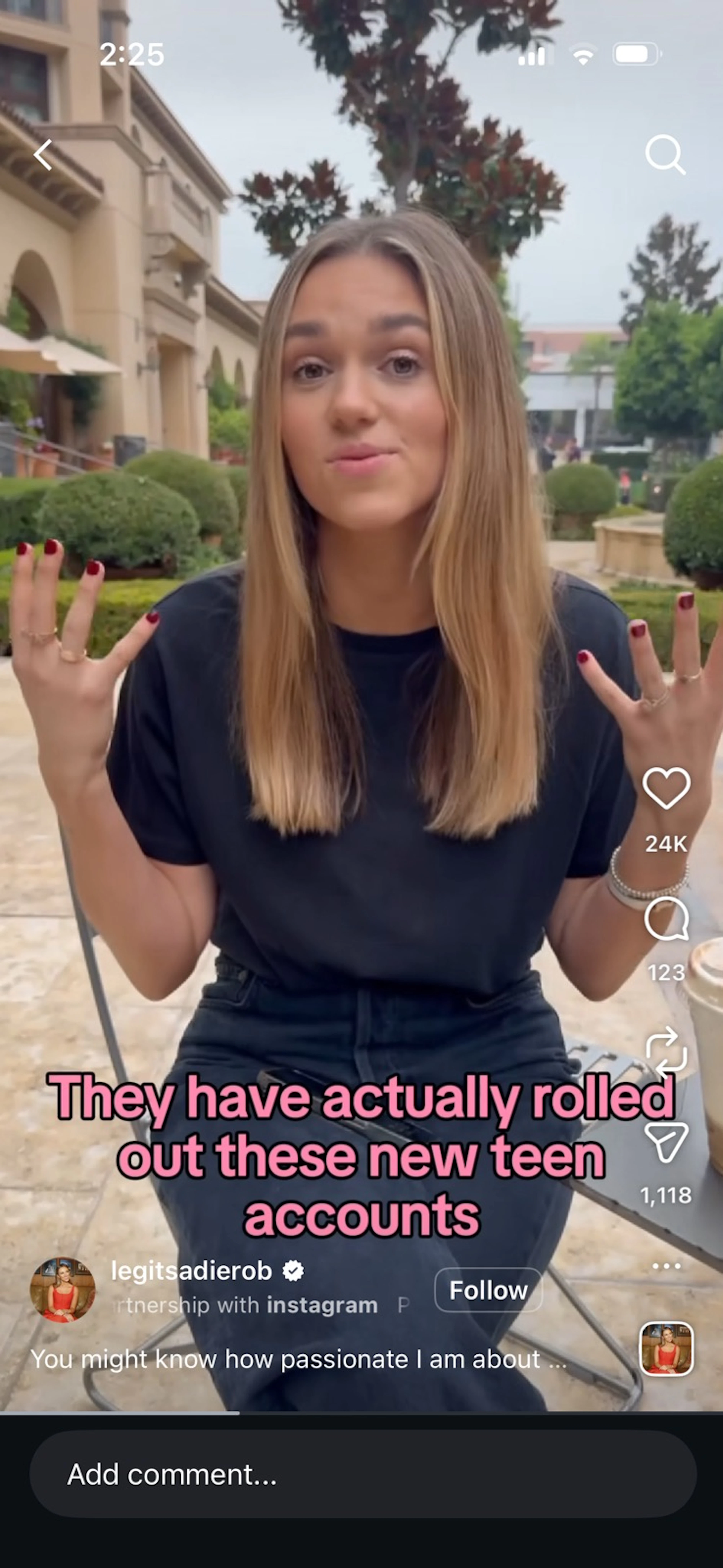
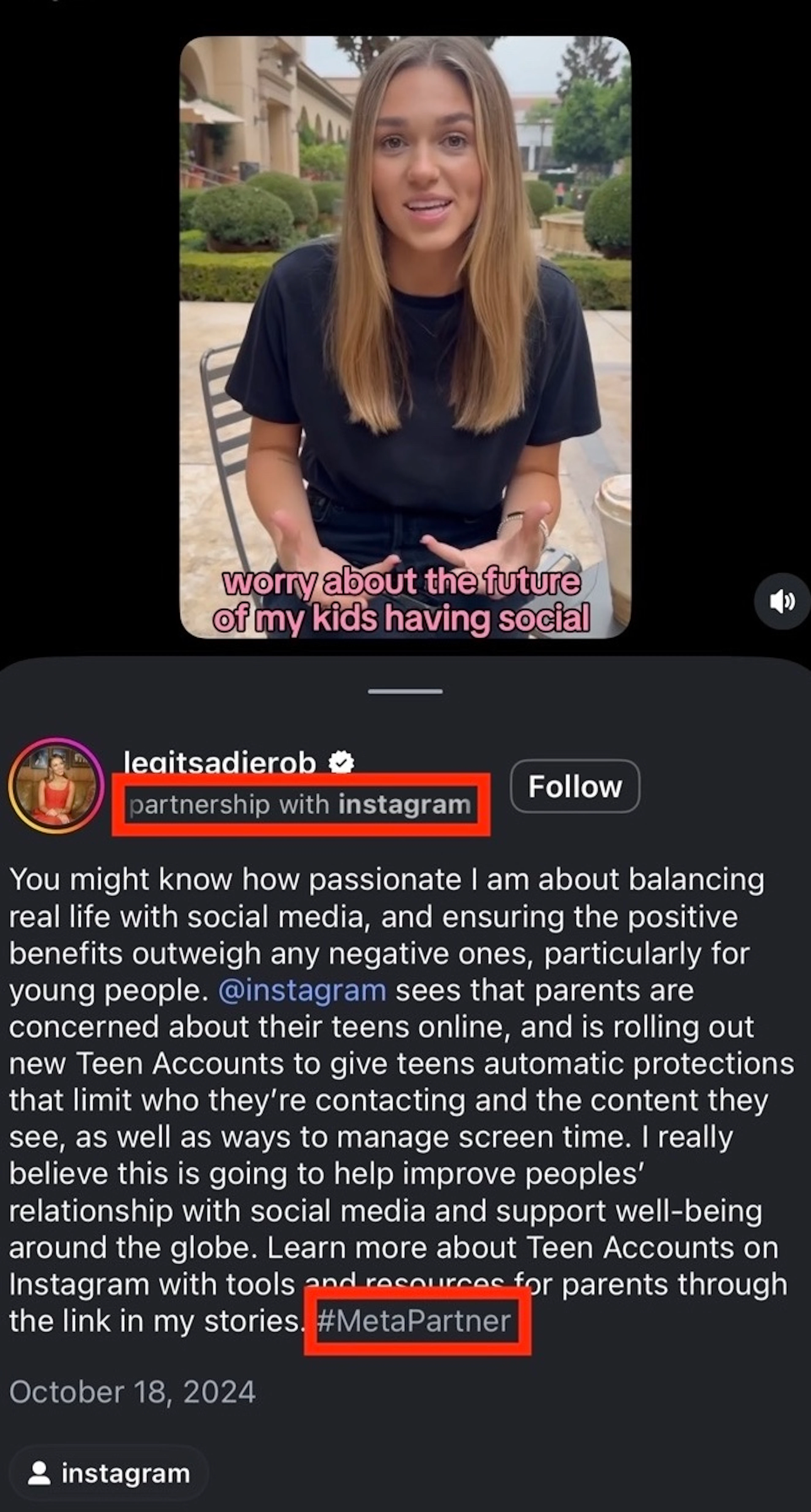
Duck Dynasty star Sadie Robertson Huff posted an Instagram Reel promoting the Teen Accounts.
Duck Dynasty star Sadie Robertson Huff posted an Instagram Reel promoting the Teen Accounts.
Meta has also established ties with some influencer dads, including reality TV star Leroy Garrett. Garrett, who has starred on shows like The Real World and The Challenge, has leveraged his fame to become a popular lifestyle influencer, posting about fitness and parenting to his nearly 300,000 Instagram followers.
In April 2026, he shared a message after attending a Screen Smart event in Chicago. “If you are a parent of a teen, I strongly advise you to take a deep dive into Instagram Teen Accounts, because they are providing maximum protection and it’s up to us to keep our kids safe,” he said. The post had a “paid partnership” label and a #MetaPartner tag.
Garrett did not respond to TTP's questions, but in a statement to CNN, he defended his arrangement with Meta.
“It’s vital that we all come together to navigate these issues and promote a safer online environment for our youth,” he said. “Partnering with Meta allows me to contribute to this important conversation and advocate for the well-being of our children in the digital landscape.”
The other influencers mentioned above did not respond to questions.
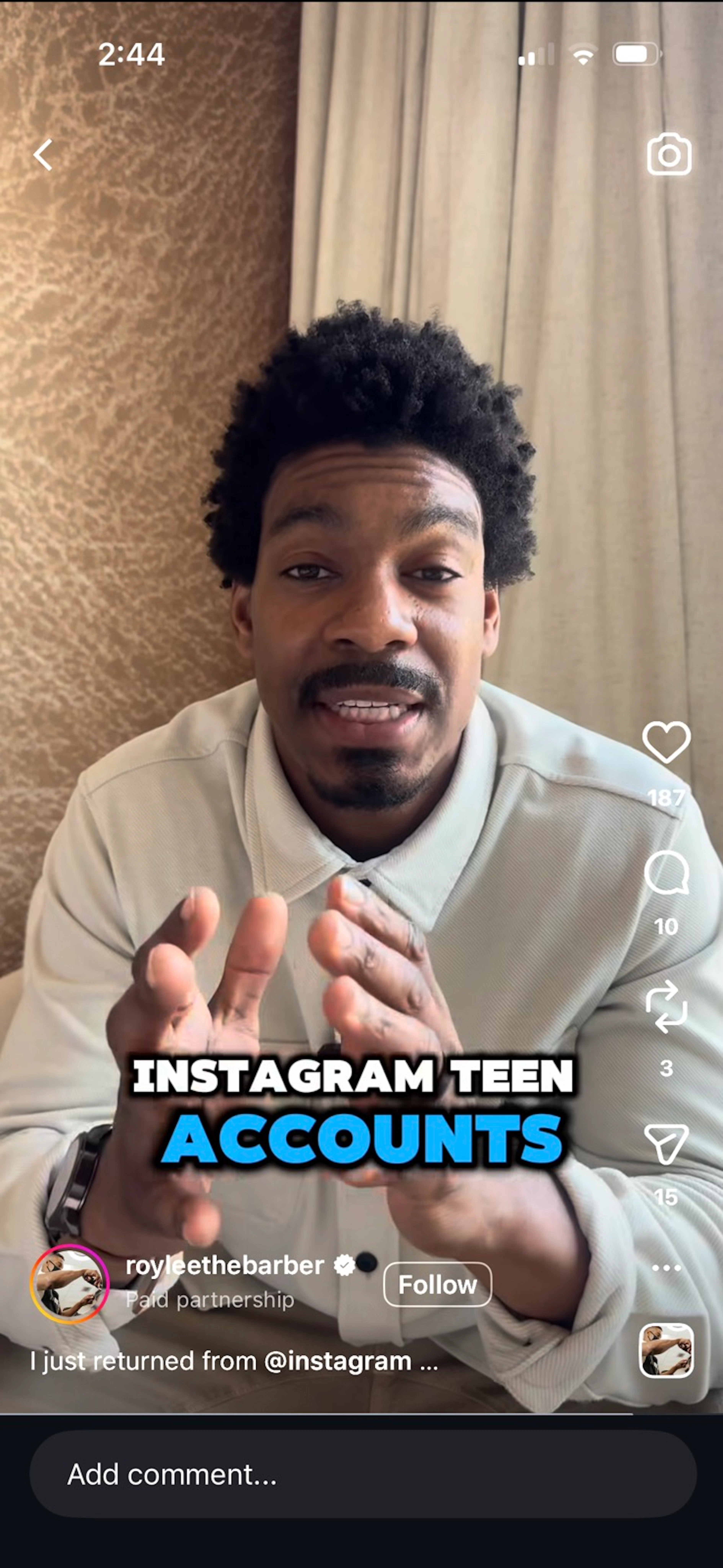
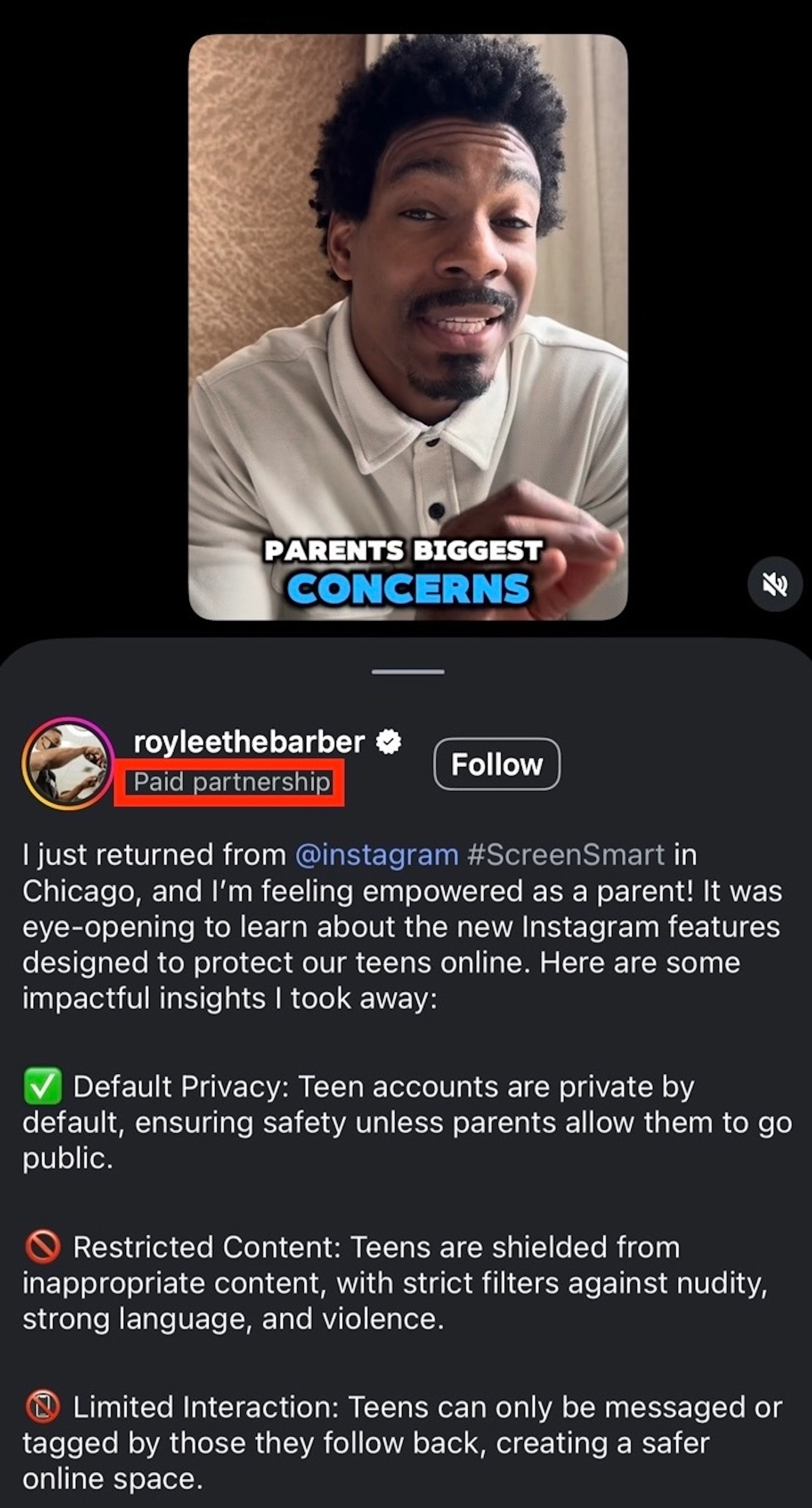
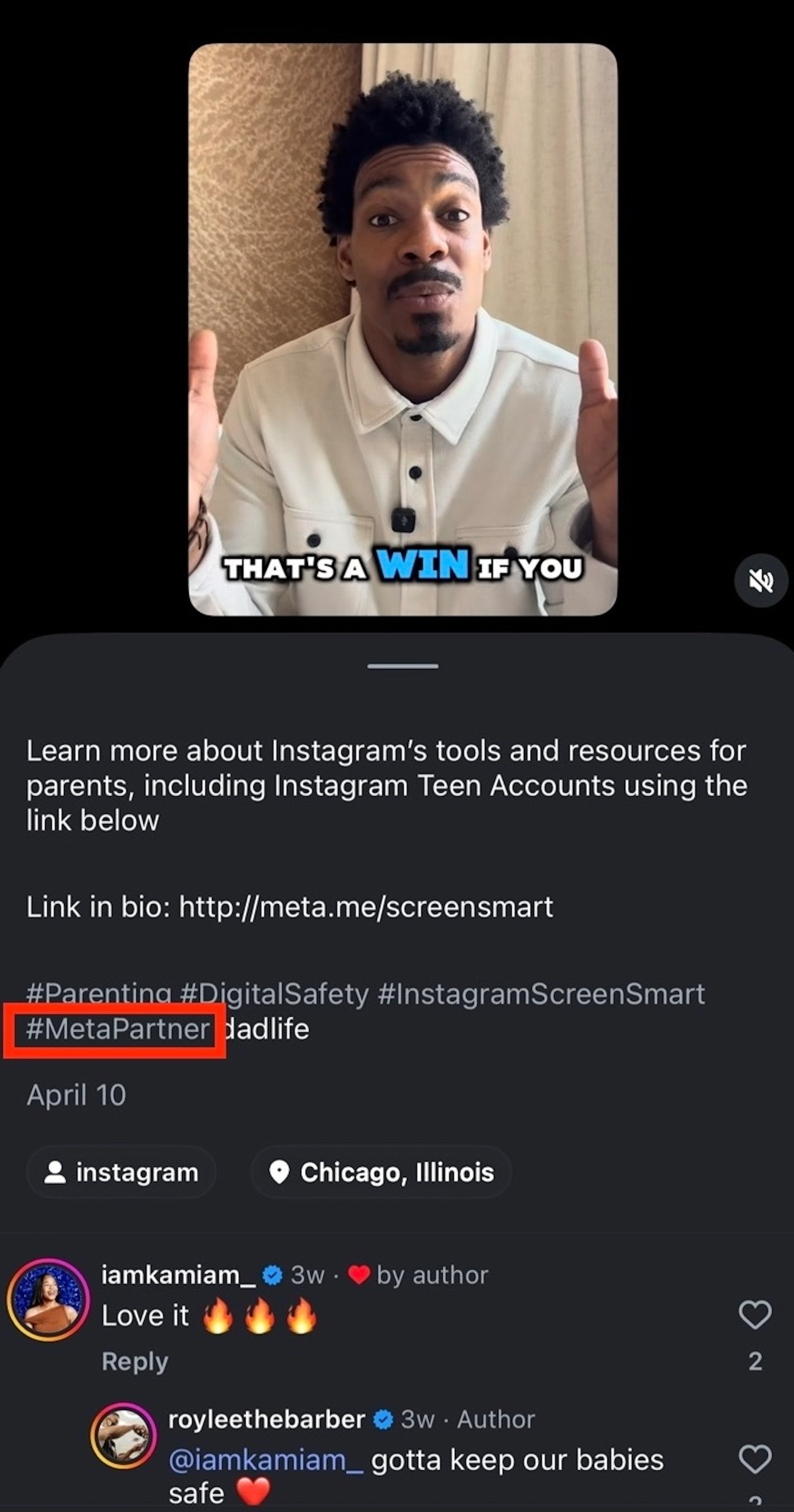
Meta has also deployed some influencer dads to promote its Teen Accounts. This is reality TV star Leroy Garrett.
Meta has also deployed some influencer dads to promote its Teen Accounts. This is reality TV star Leroy Garrett.
These influencer endorsements of the Teen Accounts contrast with the reaction of children's advocates.
When Meta announced the Teen Accounts in September 2024, a U.S. senator and the head of children's media watchdog Common Sense Media called it a cynical attempt to sap momentum from the Kids Online Safety Act in Congress. The bill would have required social media companies like Meta to design their products and services in a way that limits harm to minors. (It ended up stalling in the House.)
Later reports found the Teen Accounts did not live up to their promised protections. In May 2025, The Washington Post reported that the Teen Accounts “fail spectacularly” to shield young users from content related to sex, alcohol, and drugs. The Post article concluded:
What should be excruciatingly clear to any parent: Instagram’s Teen Accounts can’t be relied upon to actually shield kids. The danger they face isn’t just bad people on the internet — it’s also the app’s recommendation algorithm, which decides what your kids see and demonstrates the frightening habit of taking them in dark directions.
A few months later, TTP found that the Teen Accounts exposed minors to brutal fight videos and clips of the Charlie Kirk shooting.
Some of the momfluencer posts reviewed by TTP did not use Meta’s built-in “paid partnership” label and relied solely on the hashtag #MetaPartner or #InstagramPartner to denote a commercial relationship.
It is not clear if these hashtags satisfy Federal Trade Commission guidelines for disclosures by social media influencers. The FTC says influencers should clearly denote any kind of material relationship with a brand partner. It also says disclosures should be made in videos and well as in their attached descriptions, something that was often missing in the influencer posts.
'Talent' scouts
Meta appears to have worked with a number of influencer-focused marketing agencies on its Screen Smart events.
In a November 2025 Instagram Reel, a firm called Influencer Marketing Factory boasted that its “talent,” Shanisse Palmer, “recently joined Meta for a special event centered on Instagram’s new Teen Accounts designed to help teens 13-17 have a safer, more supported experience online.” Influencer Marketing Factory’s website lists Meta as a customer.
In a voiceover on the video, Palmer, whose Instagram account @mommiesjade has more than 83,000 followers, credited the agency with “always connecting me with meaningful opportunities like this,” and thanked Meta for “letting creators be a part of the change.”
In March 2025, Mario Lazzo, a talent agent at the marketing firm Viral Nation, promoted a Meta Screen Smart event in Miami. Meta is one of Viral Nation’s largest brand clients.
The firm Grow Marketing also says it worked on Screen Smart events, including the launch of Teen Accounts at a September 2024 event in New York City.
In an October 2025 Instagram post, Grow Marketing wrote, “What began as a 4-city pilot in 2023 has grown into a marquee, multi-year program” bringing together “parents, experts, and top Meta leaders.” In promotional materials, the firm said the Screen Smart events featured “clinical experts” for “deepening credibility.”
The marketing firms did not respond to questions.
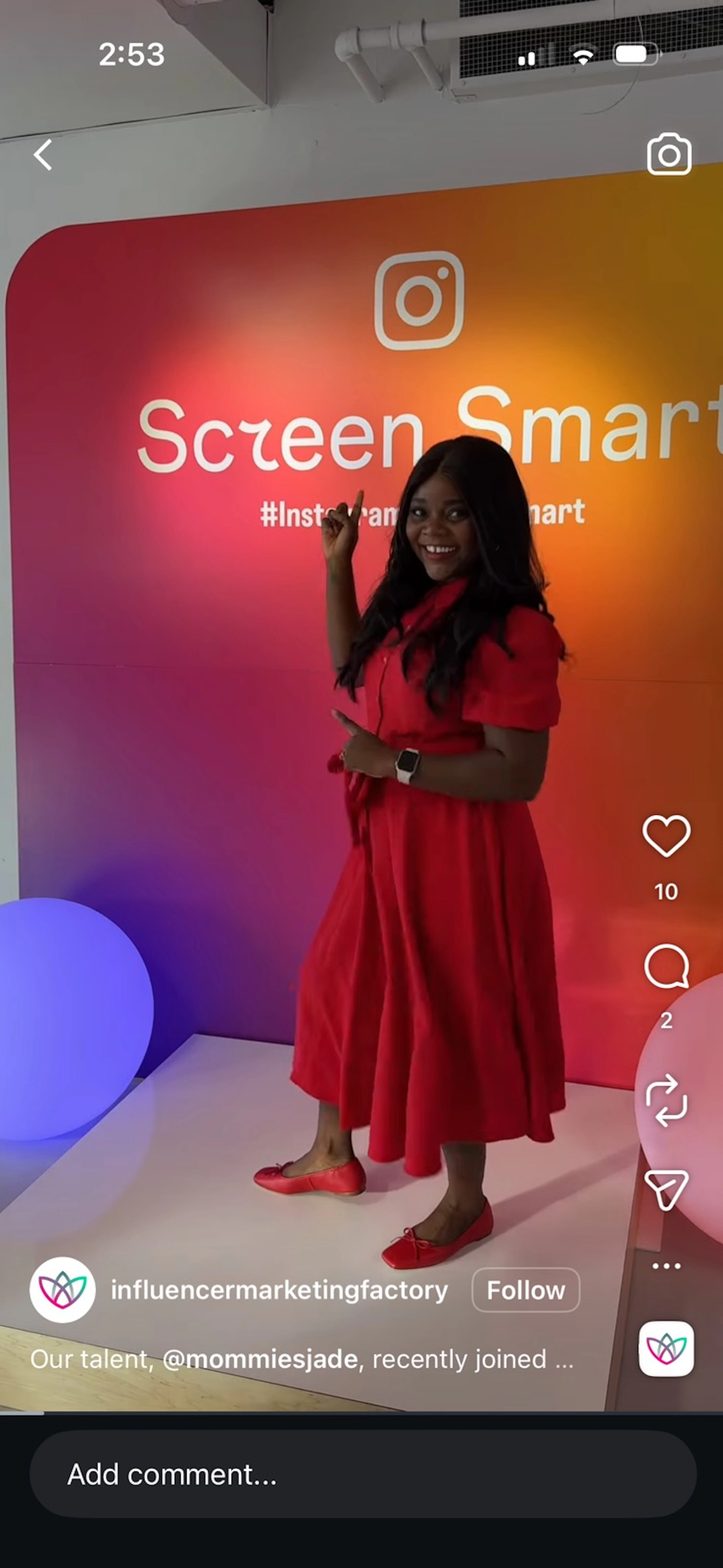
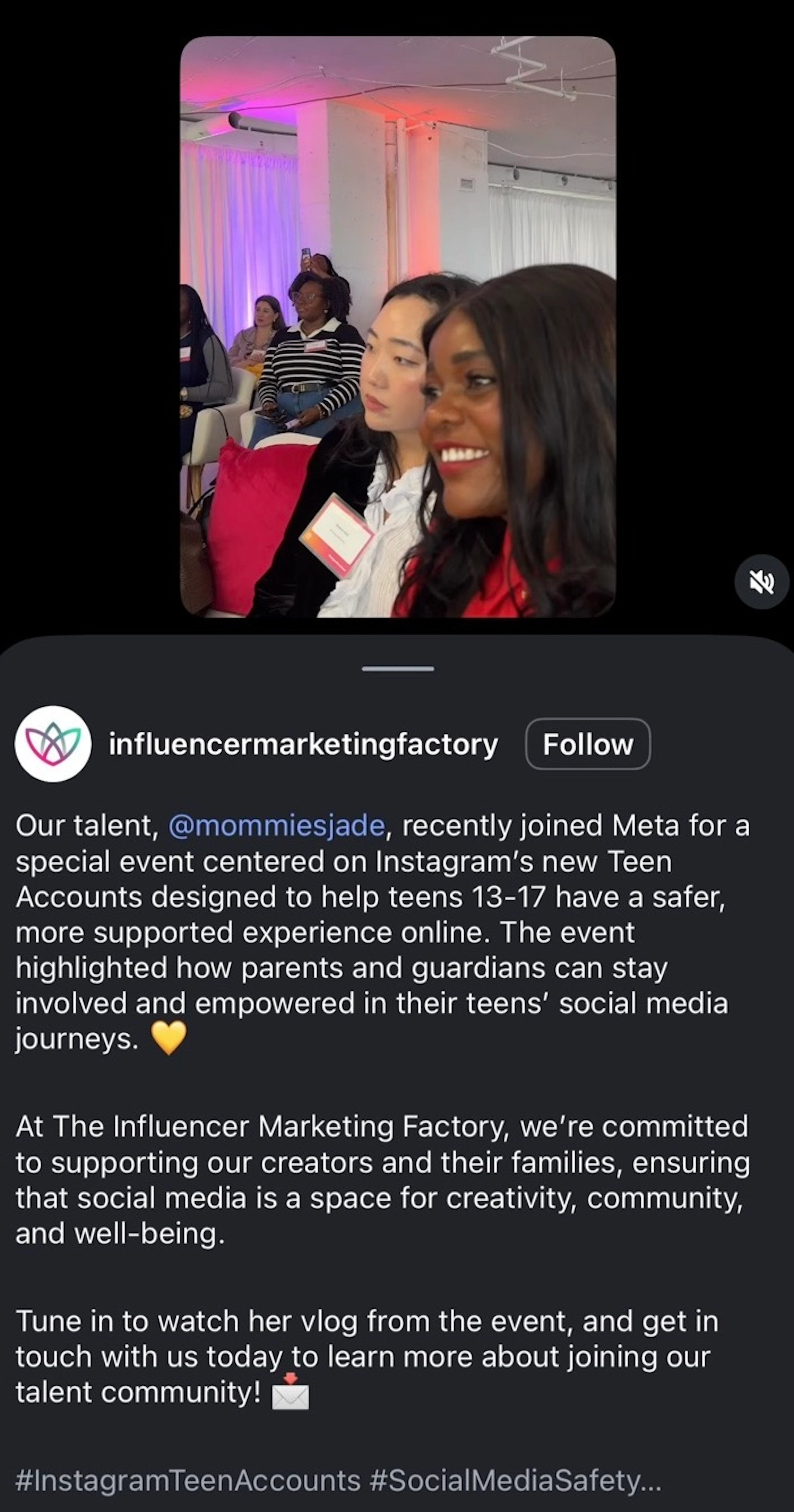
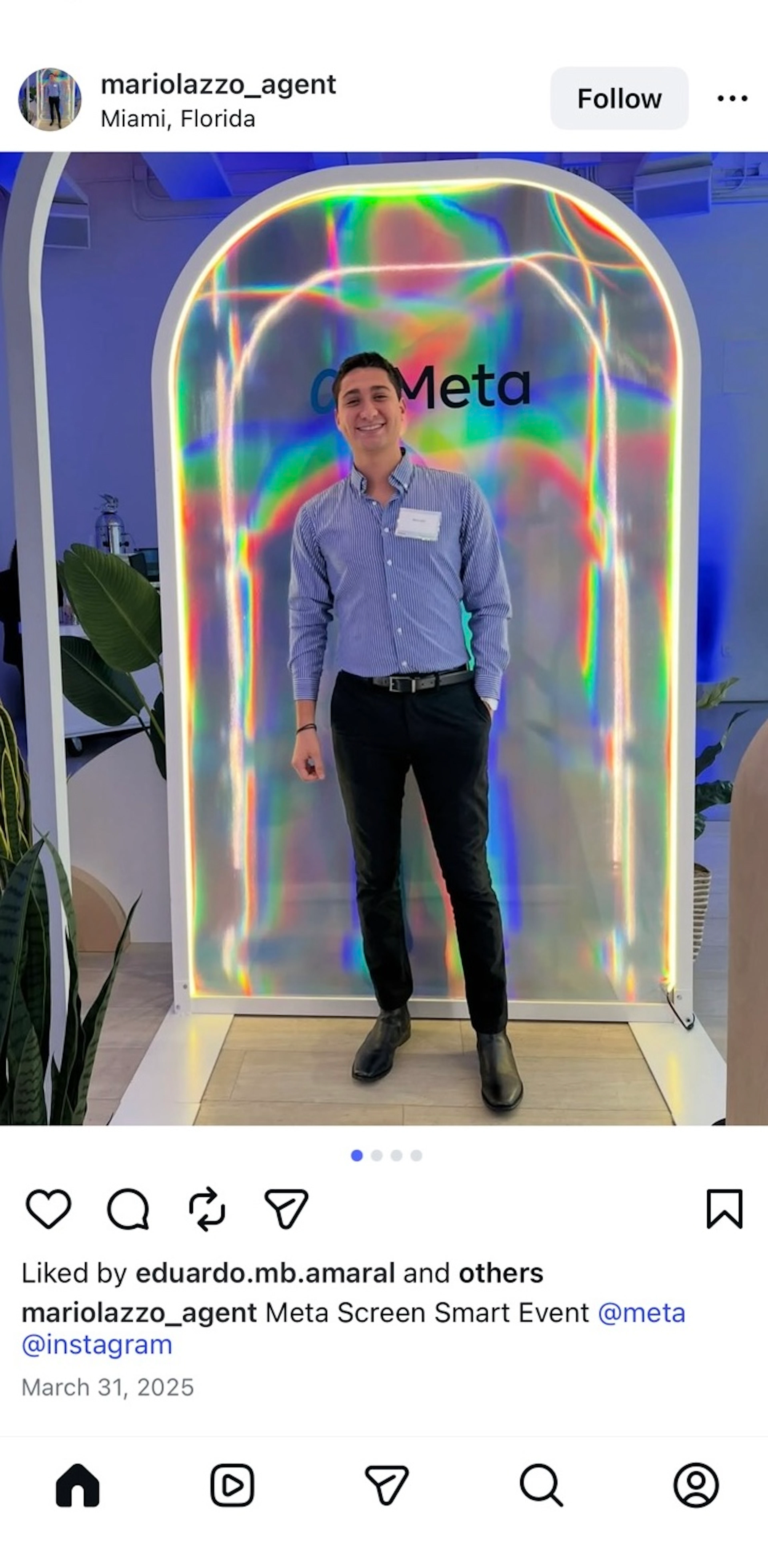
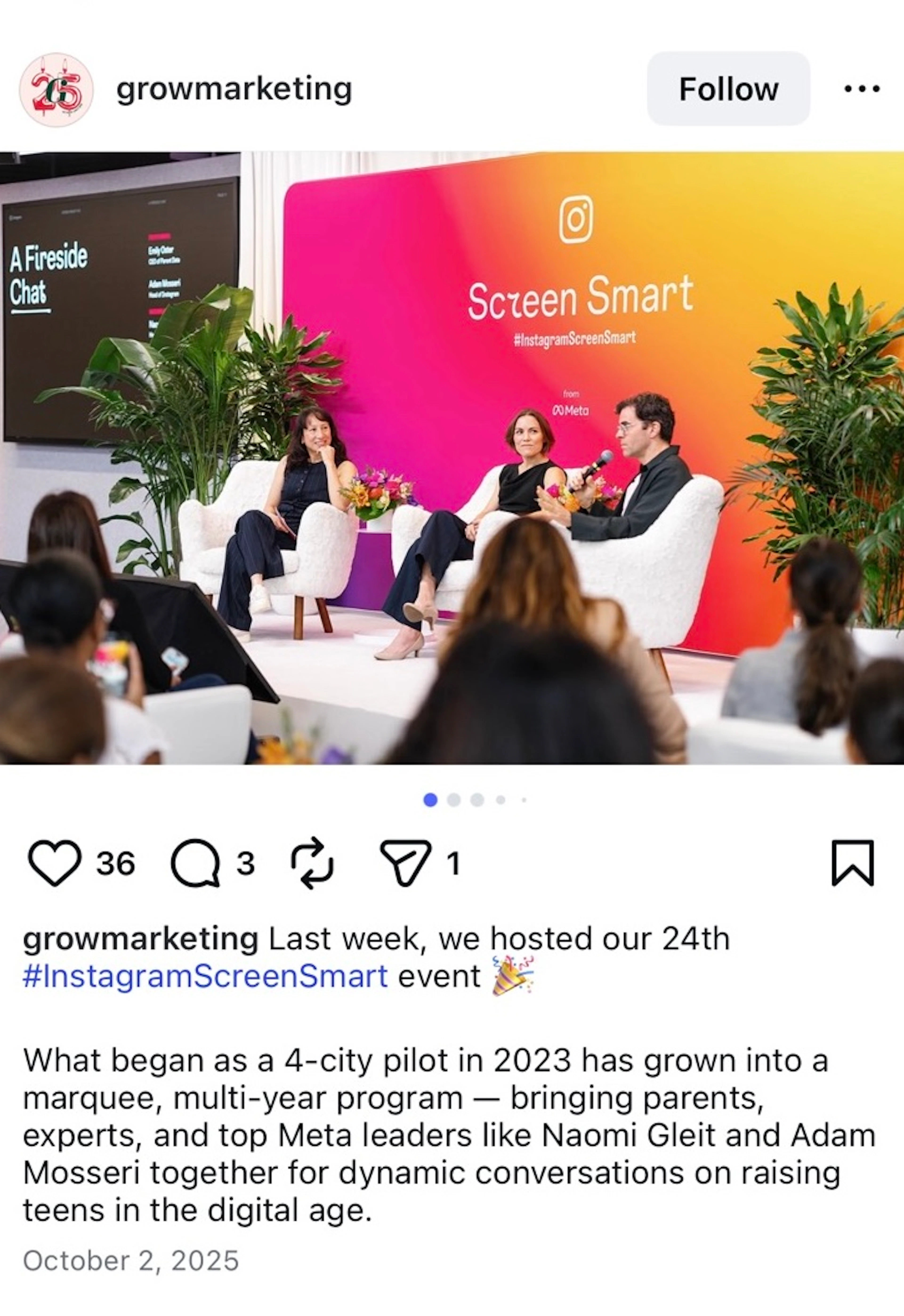
A influencer marketing firm boasted about its "talent," Shanisse Palmer, attending a Screen Smart event.
A influencer marketing firm boasted about its "talent," Shanisse Palmer, attending a Screen Smart event.
The Republican consulting firm Targeted Victory may have also played a role in Meta’s Screen Smart events.
In November 2023, Reed Public Relations posted a “client spotlight” about a Screen Smart event in Nashville. The post included three photos from the event and tagged Targeted Victory’s Instagram account in each one, suggesting the consulting firm was involved.
Targeted Victory has been called “the GOP’s go-to technology consultant firm” and has worked on behalf of the National Republican Congressional and Senatorial Committees, a PAC launched by Sen. Mitch McConnell, Marco Rubio’s Senate re-election campaign, and the National Rifle Association. In 2022, the Washington Post revealed that Meta had hired Targeted Victory to run a campaign to turn the public against its rival TikTok. In its work for Meta, Targeted Victory reportedly planted stories that portrayed TikTok as a threat to children’s online safety.
Targeted Victory did not respond to questions.
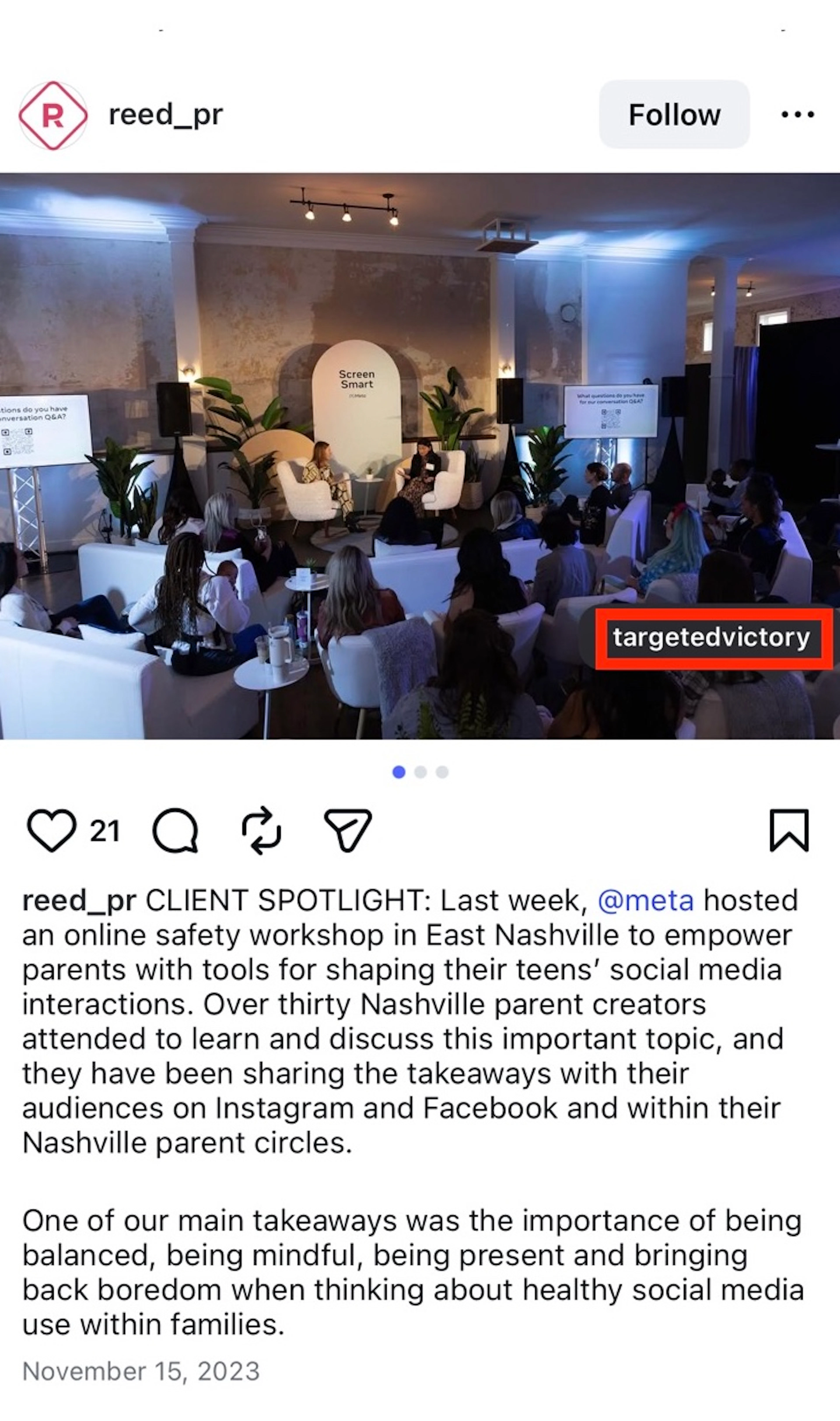
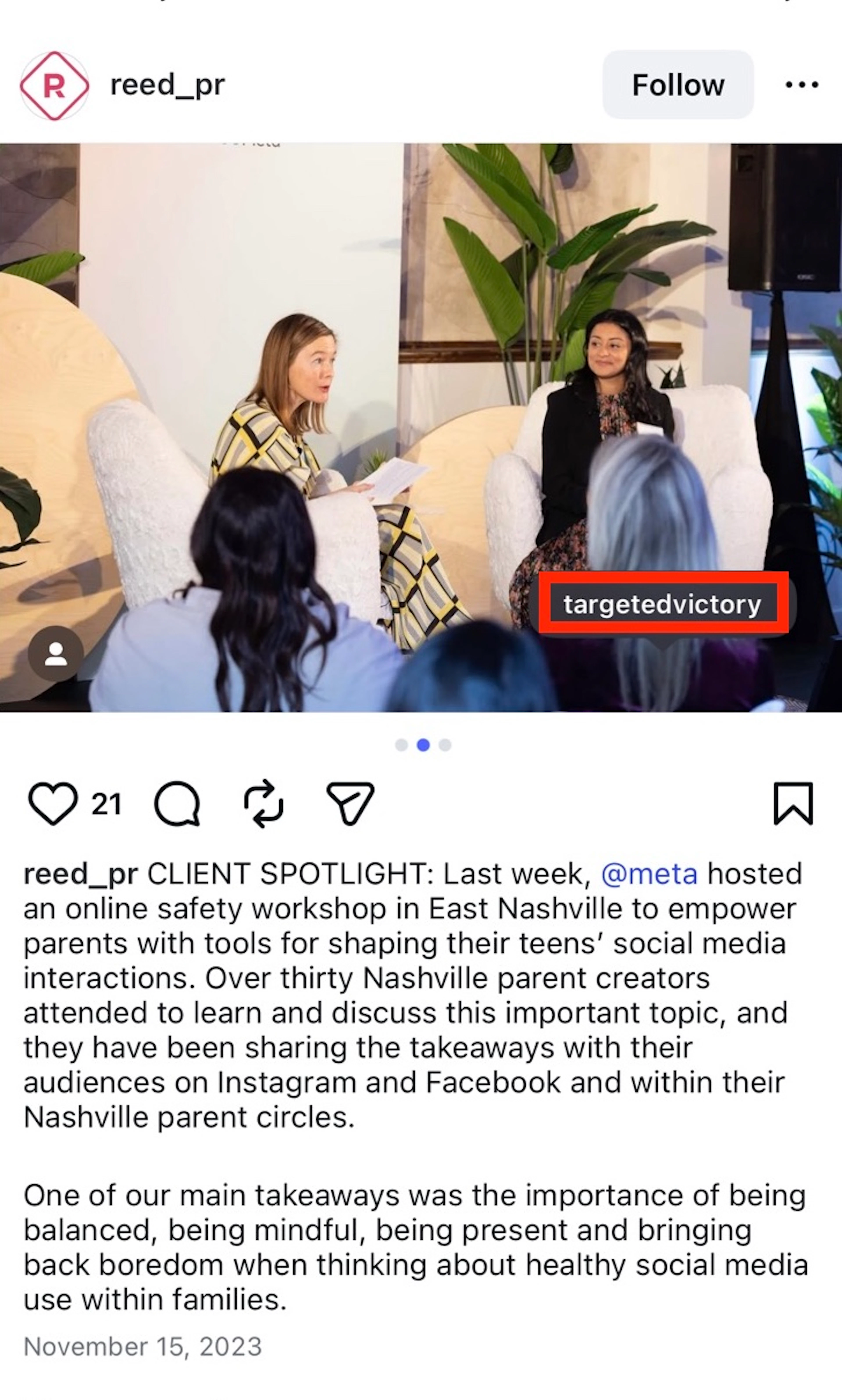
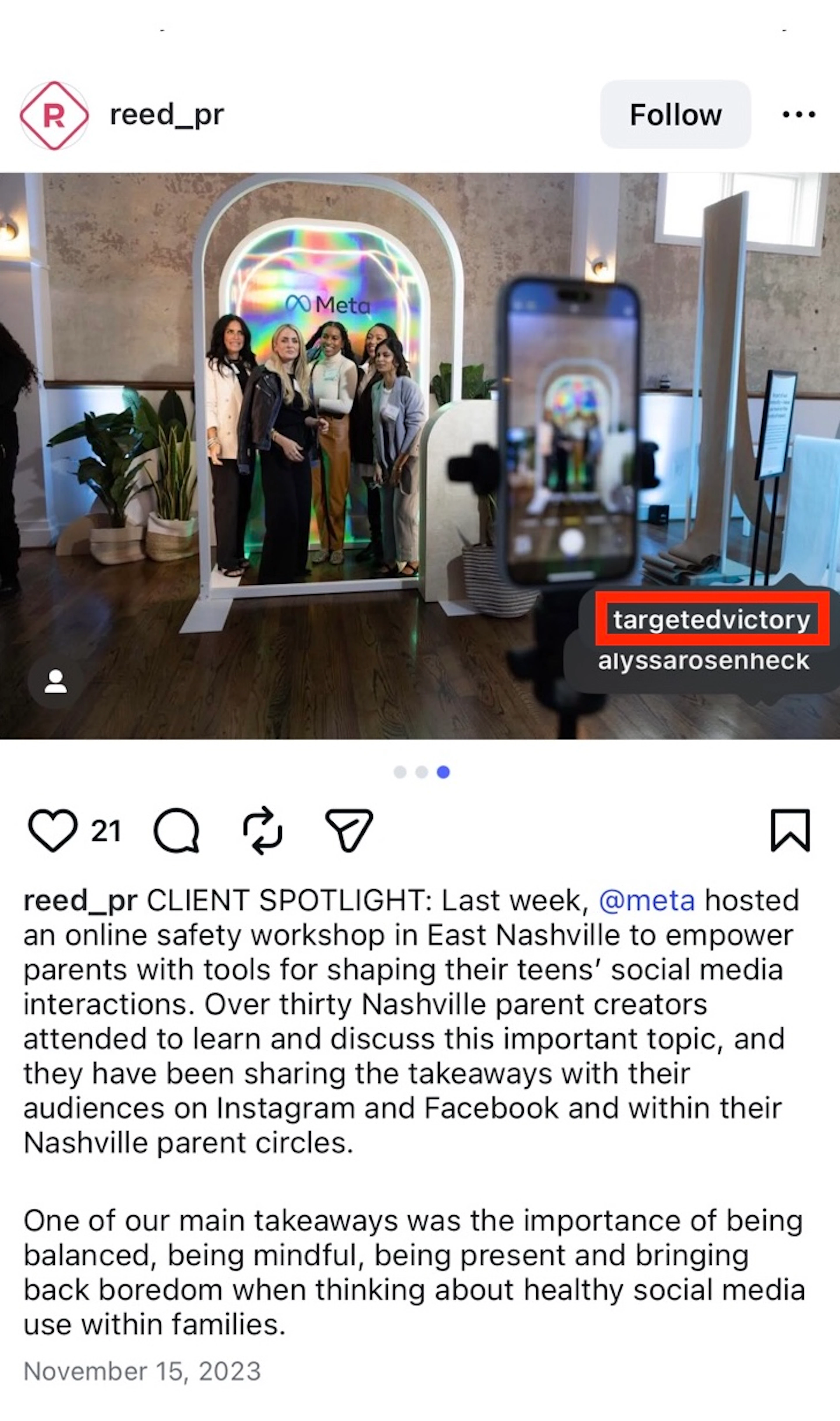
A PR agency posted about a Screen Smart event in Nashville and tagged Republican consulting firm Targeted Victory, suggesting it was involved in the event.
A PR agency posted about a Screen Smart event in Nashville and tagged Republican consulting firm Targeted Victory, suggesting it was involved in the event.
Docs for hire
Over the past several years, Meta has also amassed a network of friendly clinicians who have provided a veneer of medical authenticity to its child safety efforts.
TTP identified 11 doctors, psychologists, and therapists who have promoted Meta’s Teen Accounts and have partnerships with Meta. Another five doctors and professors have appeared at Screen Smart or Meta events as speakers, suggesting they were paid a speaking fee.
One of the most prominent Screen Smart speakers has been pediatrician Dr. Hina Talib, who serves as director of adolescent medicine at the Atria Health and Research Institute, a national spokesperson for the American Academy of Pediatrics, and a clinical associate professor at the Albert Einstein College of Medicine in New York City. Talib shares child health advice from her Instagram account @teenhealthdoc, where she has nearly 93,000 followers.
Talib was a panelist at a 2023 Screen Smart event in Nashville and supplied positive quotes for the program in 2024. In a September 2024 Reel about the launch of the Instagram Teen Accounts, she said:
“As someone who supports teens almost daily with digital wellness, I was so glad to learn Instagram is launching Teen Accounts. This update will inspire important conversation within families with teens already on Instagram or those thinking about it around the corner.”
The post—which got more than 5 million views, far more than her other Reels—discloses a paid partnership with Instagram.
In a statement to TTP, Talib said she worked "briefly" with Meta in 2024 on "two speaking engagements and one social media post." She said she was "provided talking points but I stated that I would not use them, and would instead say what I believe to be true and they could accept or reject it." She did not respond to questions about how much she was compensated by Meta and whether Meta boosted her post about the Teen Accounts.
Talib's website advertises that she is available for “consulting for teen media, organizations, businesses and technology.” Meta has credited her as a “creator for our Screen Smart series.”
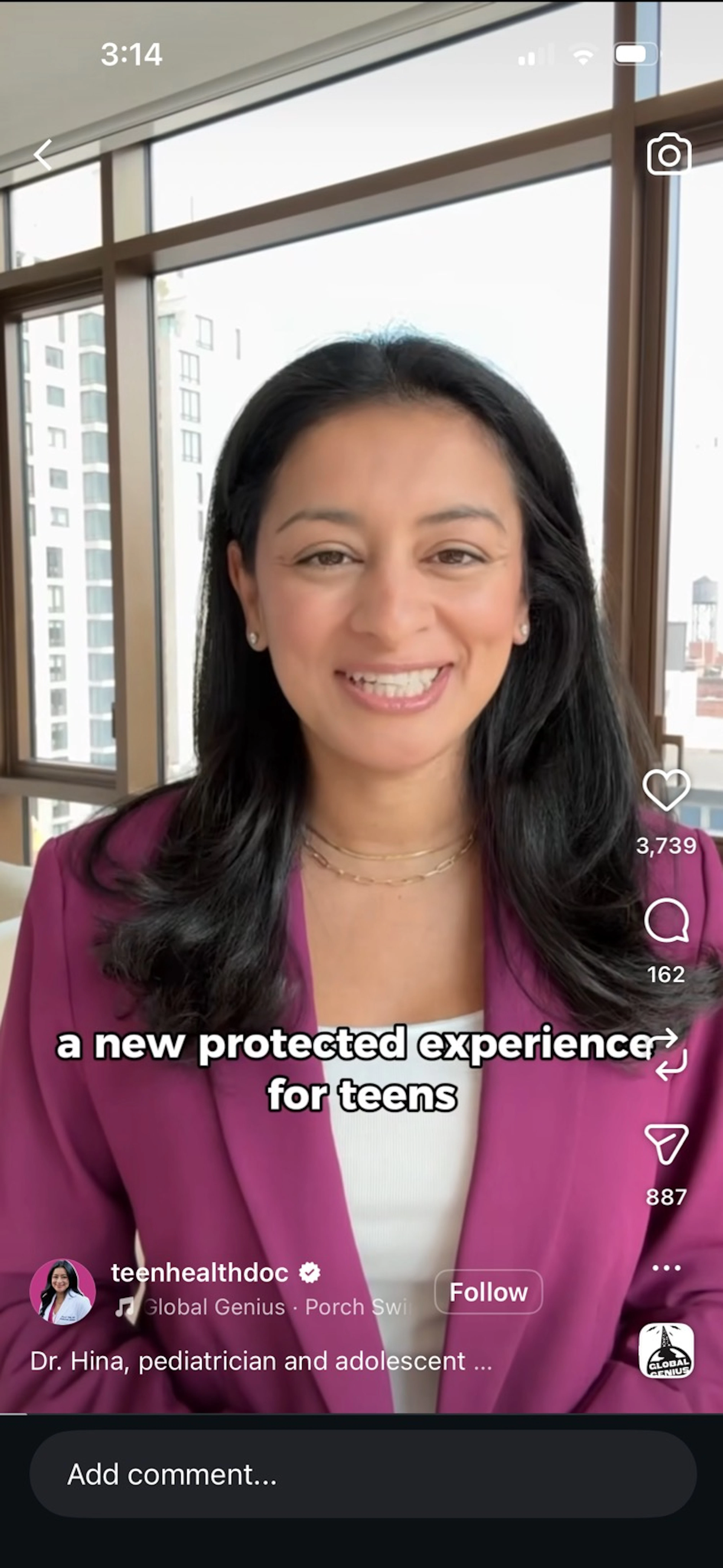
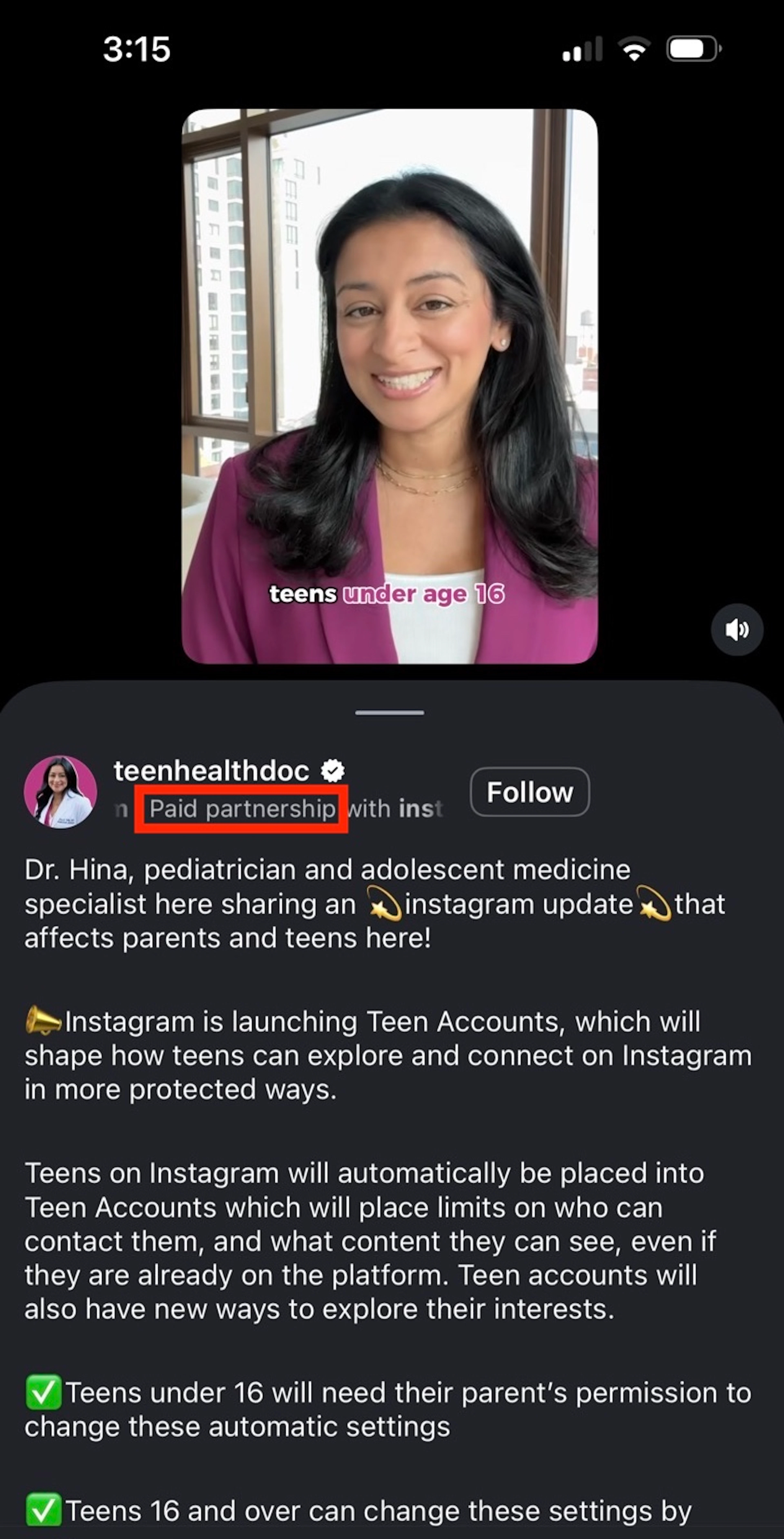
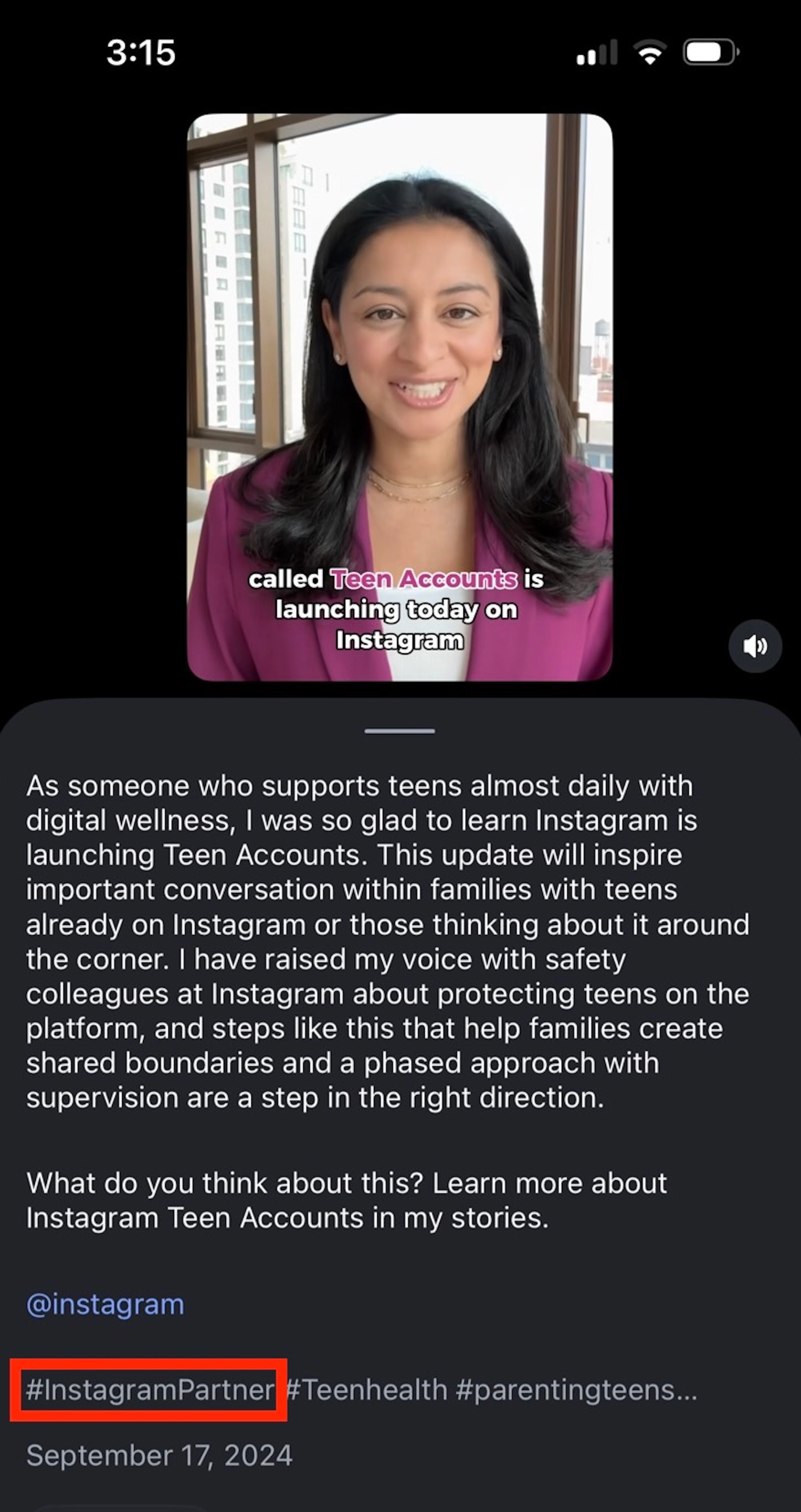
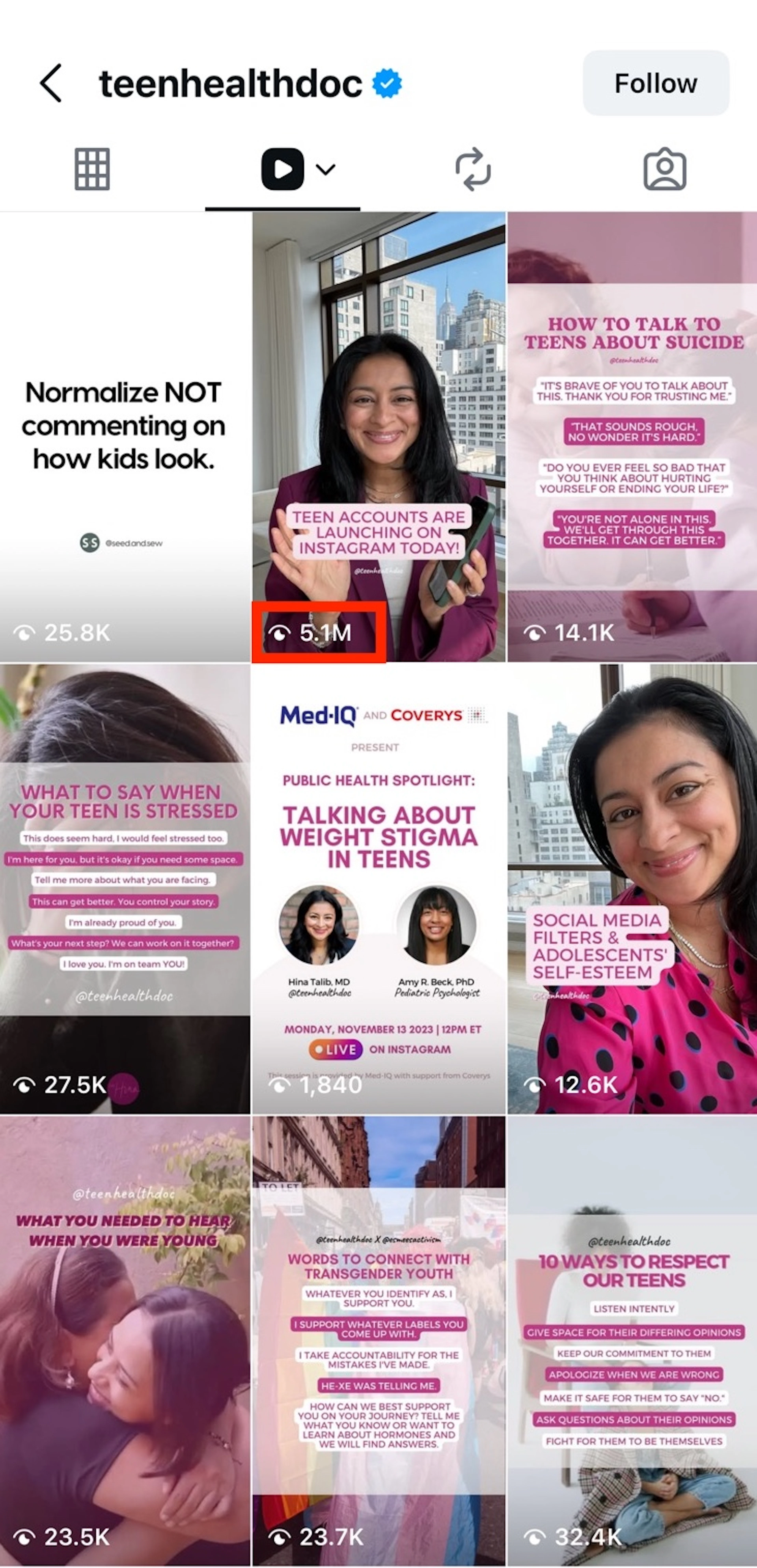
Pediatrician Dr. Hina Talib has participated in Meta Screen Smart events and promoted the Teen Accounts.
Pediatrician Dr. Hina Talib has participated in Meta Screen Smart events and promoted the Teen Accounts.
Dr. Ann-Louise Lockhart, a psychologist at A New Day Pediatric Psychology, a clinic in San Antonio, Texas, is another Screen Smart speaker who has been paid by Meta.
Lockhart has been a staple of the Screen Smart program for several years. In 2024, she headlined at least five Screen Smart events in Charlotte, North Carolina; Columbus, Ohio; New Orleans, Louisiana; Savannah, Georgia; and Salt Lake City, Utah. In an Instagram post about those appearances, she indicated she has a paid partnership with Meta.
She also promoted Meta’s Teen Accounts and parental supervision tools in several television interviews that appear to have been filmed on the same day in January 2024. Across these interviews, Lockhart talked about how parents can use Instagram settings to supervise their children’s social media use—a message that puts the onus on parents to master a raft of platform features and takes the focus away from Meta’s own obligation to shield young users from dangerous content.
On her clinic’s website, Lockhart listed the TV hits as “sponsored by Meta,” but the segments did not consistently disclose that fact. One interview was preceded by a “Sponsored by Meta” intro screen, but two others contained no mention of the Meta sponsorship at all. During an interview with a Fox station in Rochester, New York, which a chyron indicated was "provided by Meta," a news anchor asked Lockhart about the child safety lawsuits against the company. She responded, “Although this is sponsored by Meta, I’m not employed by Meta," and dodged the question.
Three of the four TV stations doing the interviews are owned by Sinclair Broadcast Group, which is known for spreading right-wing disinformation and requiring its anchors to recite the same scripts. A PR Newswire pitch indicates Meta organized and provided topics for the Lockhart interviews.
Lockhart has continued to promote Meta’s child safety agenda in 2026. In April, she took part in a fireside chat with Meta’s vice president of strategic partnerships for trust and safety, Neil Potts, at an “intimate salon dinner” in Los Angeles.
Lockhart, who has nearly 100,000 followers on Instagram, has repeatedly used the #MetaPartner hashtag on her Screen Smart posts. On an events booking website, she advertises a $7,500 speaking fee and highlights her Meta Screen Smart appearances as an example of recent engagements.
Lockhart did not respond to questions.
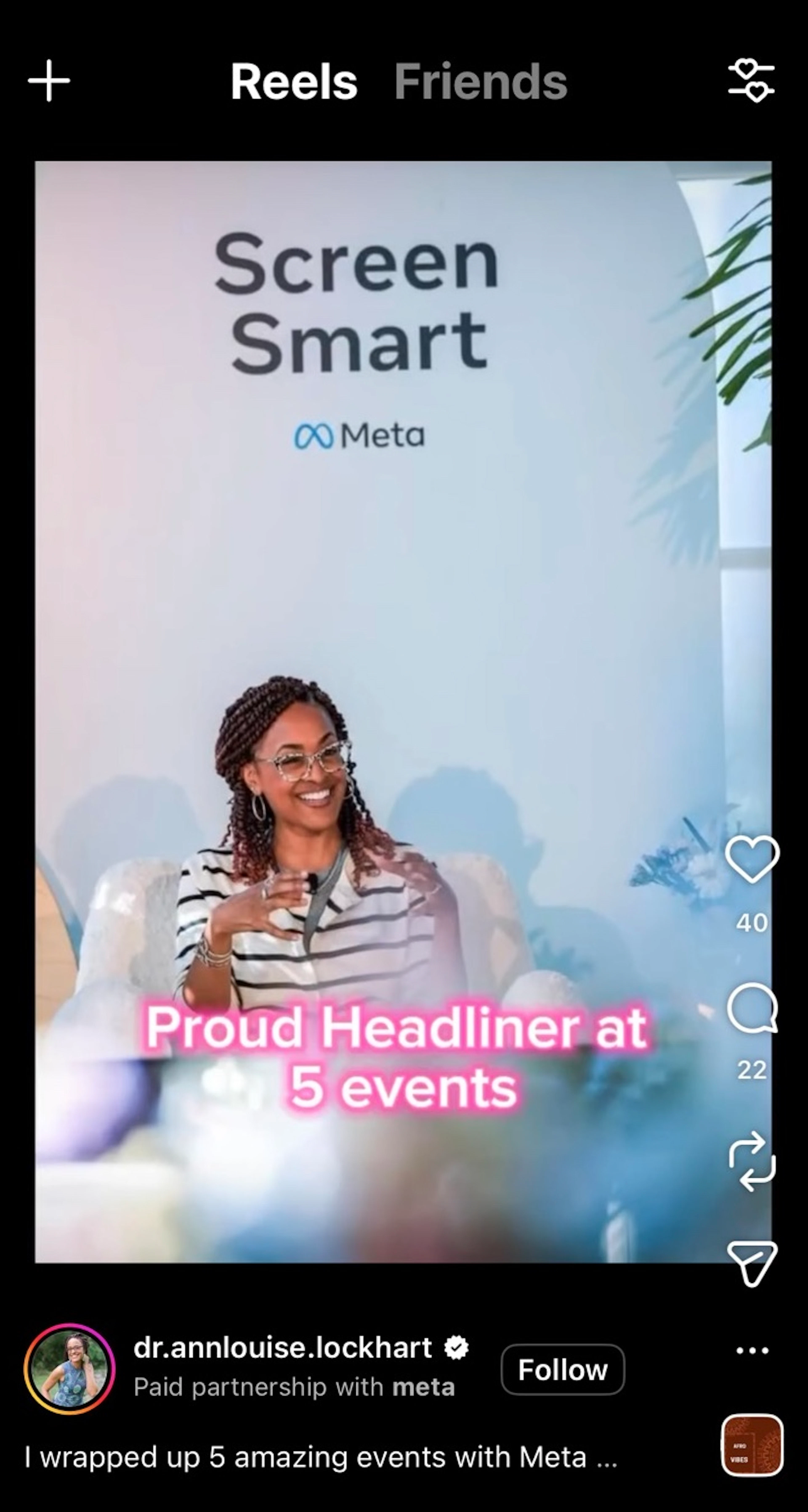
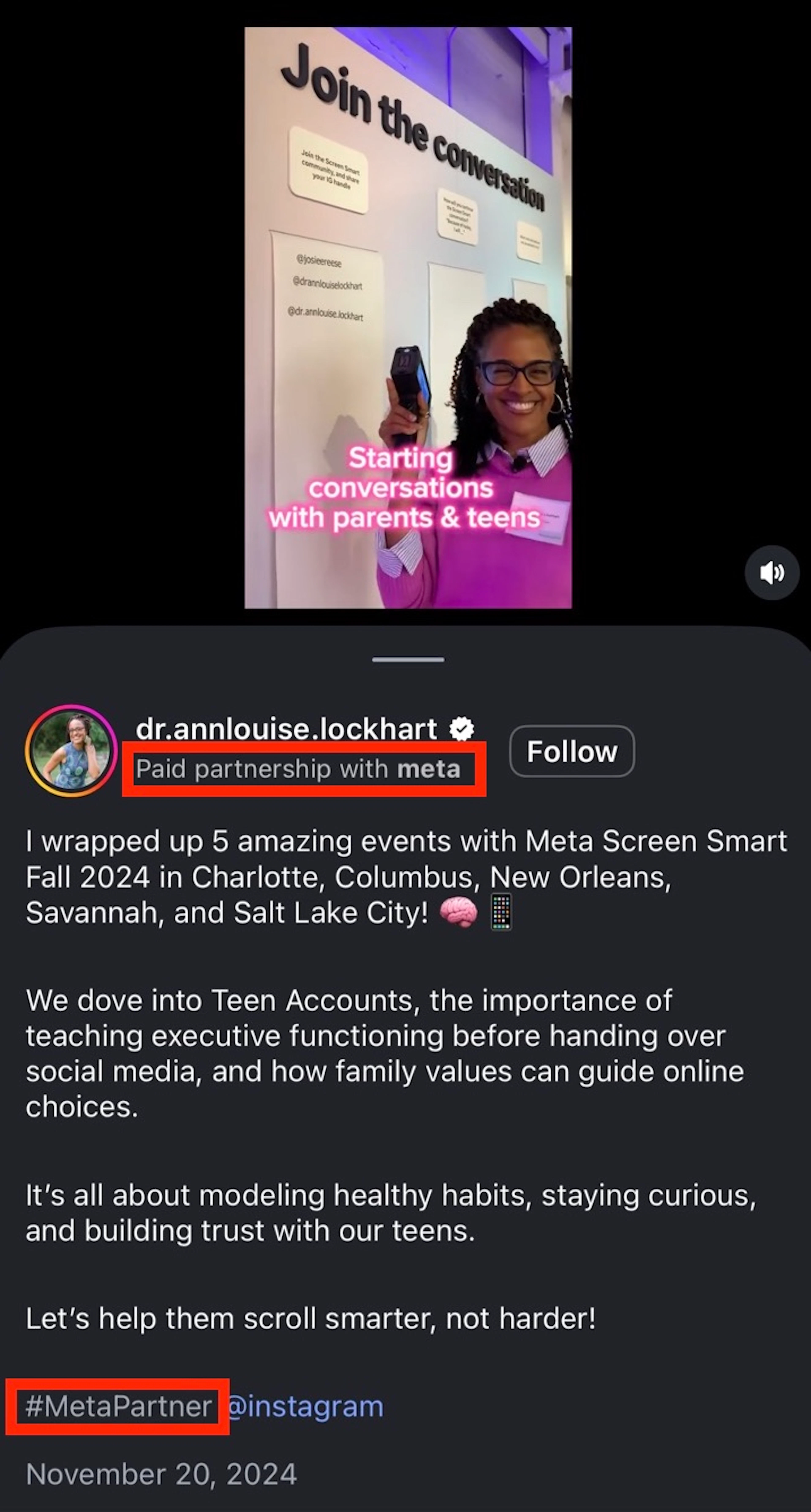
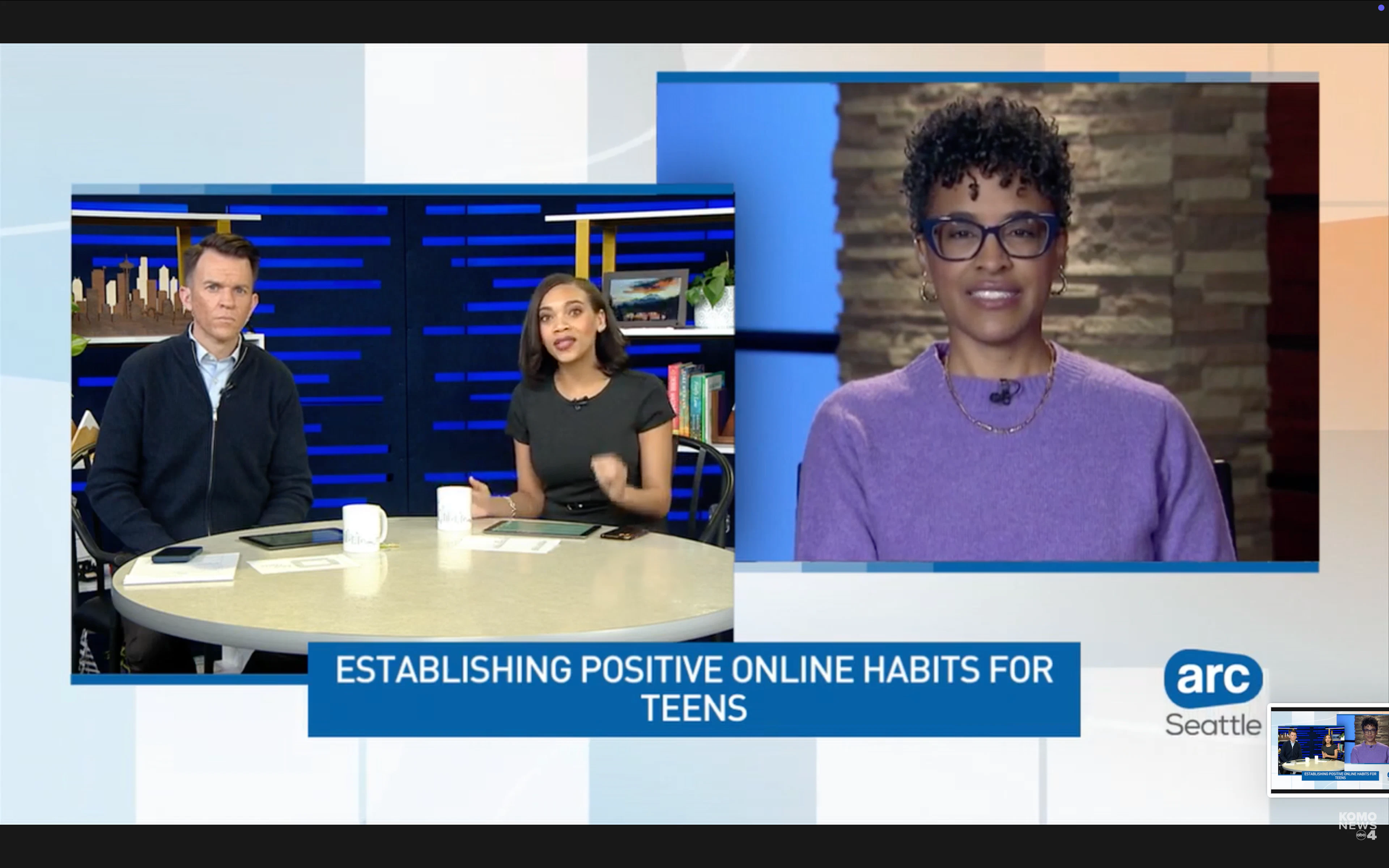
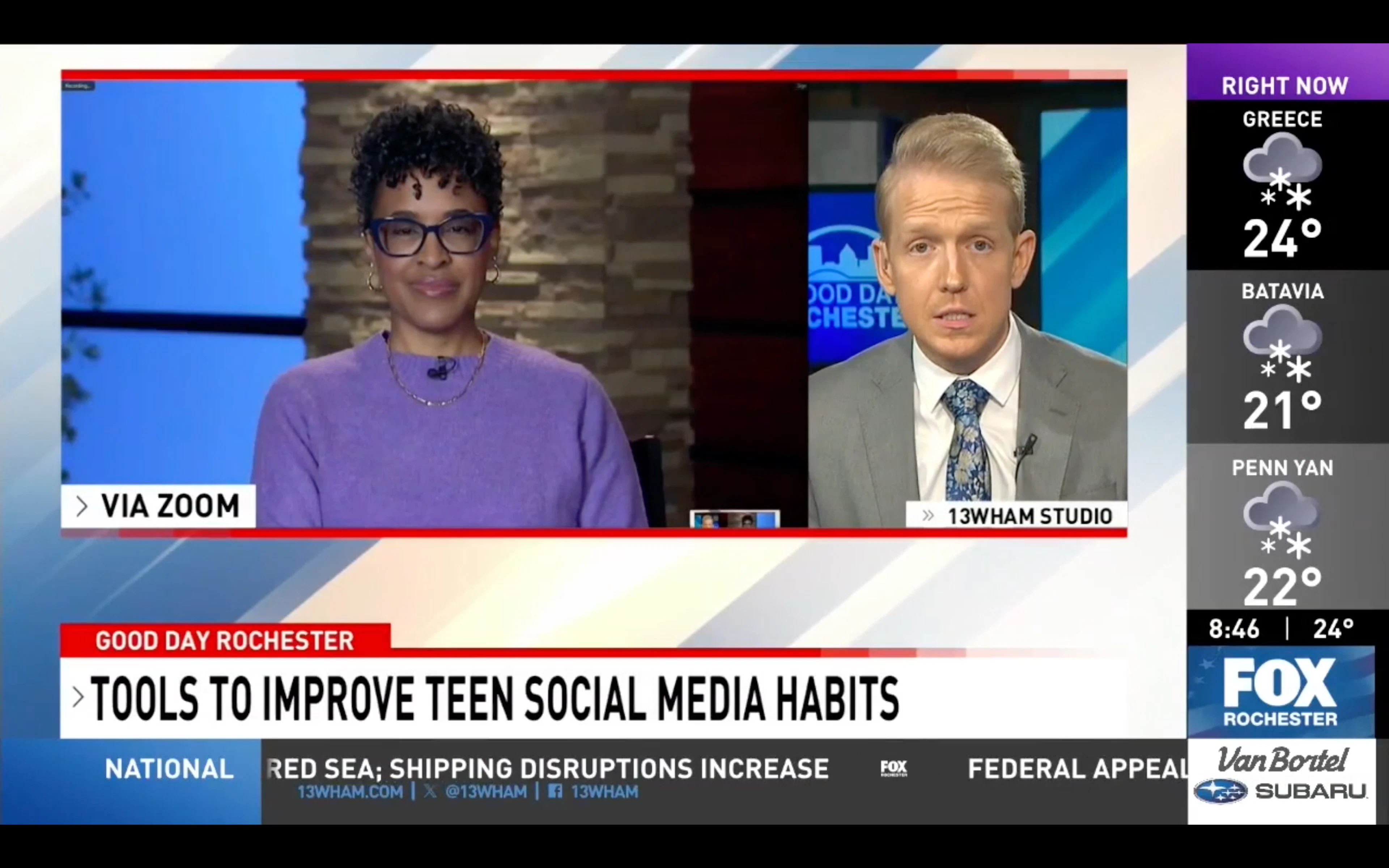
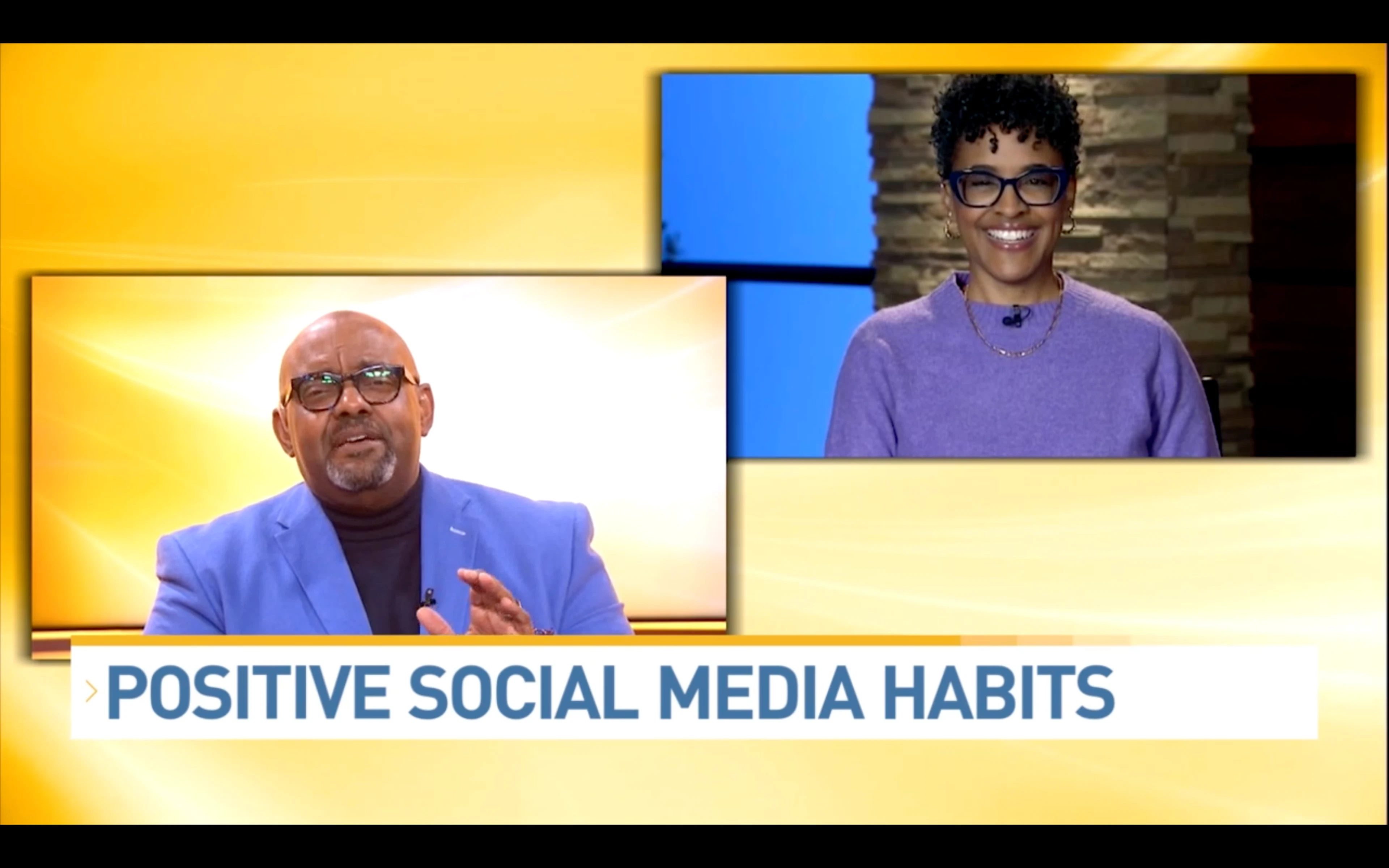
Psychologist Dr. Ann-Louise Lockhart has been a staple of Meta Screen Smart events.
Psychologist Dr. Ann-Louise Lockhart has been a staple of Meta Screen Smart events.
Dr. Rachel Goldman, a psychologist and clinical assistant professor at New York University’s Grossman School of Medicine, attended Meta’s October 2025 event in New York City. “As a mom and psychologist, I know how overwhelming it can feel to keep up with what our kids are seeing online,” Goldman told her Instagram followers, using the hashtag #MetaPartner. Over video of her posing at the event, which featured pink lighting and manicure stations, she praised Instagram’s “major update for teen accounts, guided by PG-13 standards.”
At the time, Meta had just announced it would be applying a PG-13 film rating standard to Teen Accounts to ensure they show age-appropriate content. Months later, the company walked back its use of PG-13 after the Motion Picture Association objected, called the company’s use of the rating “highly misleading” because it does not follow MPA’s “curated process.”
Goldman did not respond to questions.
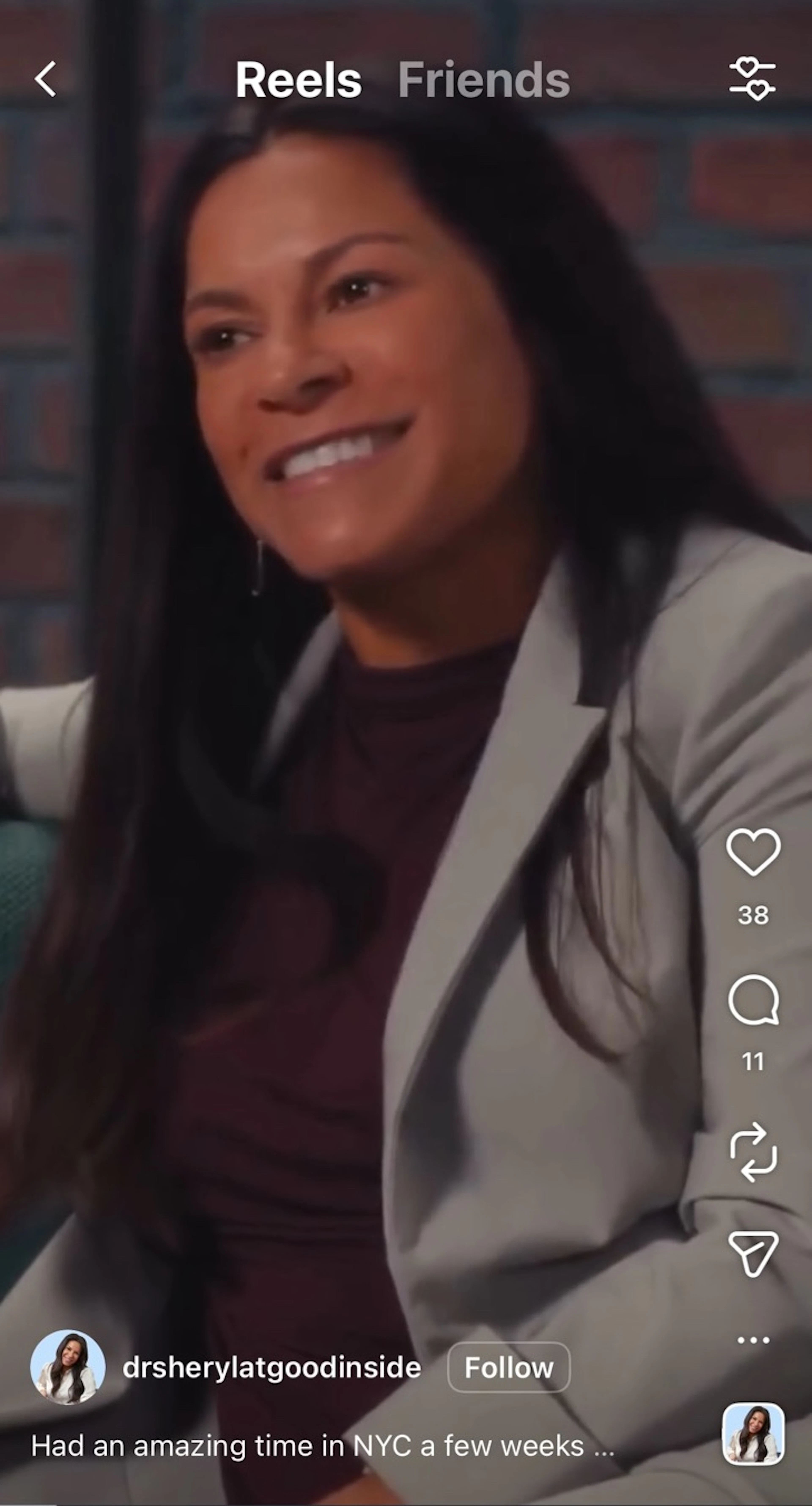
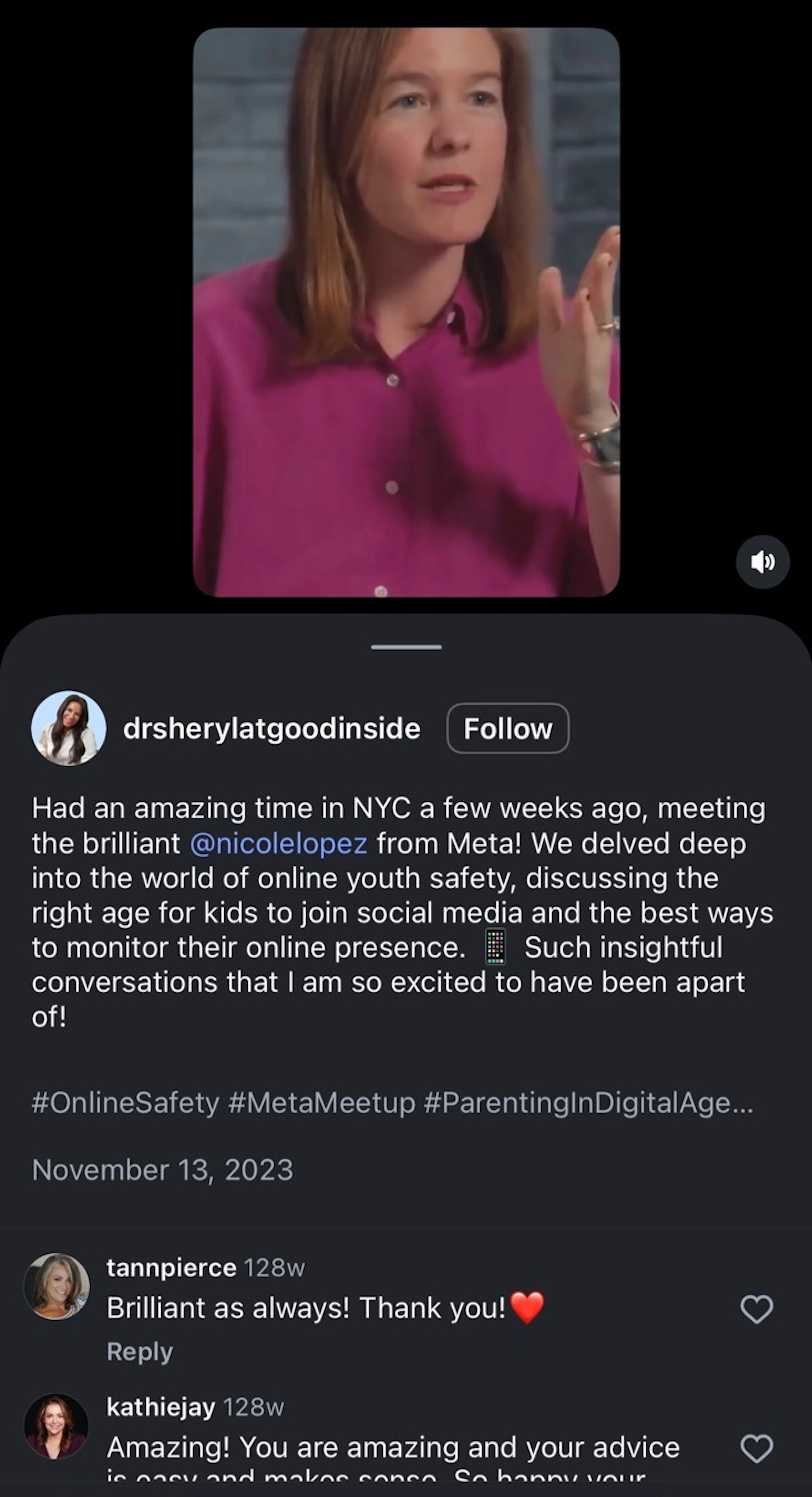
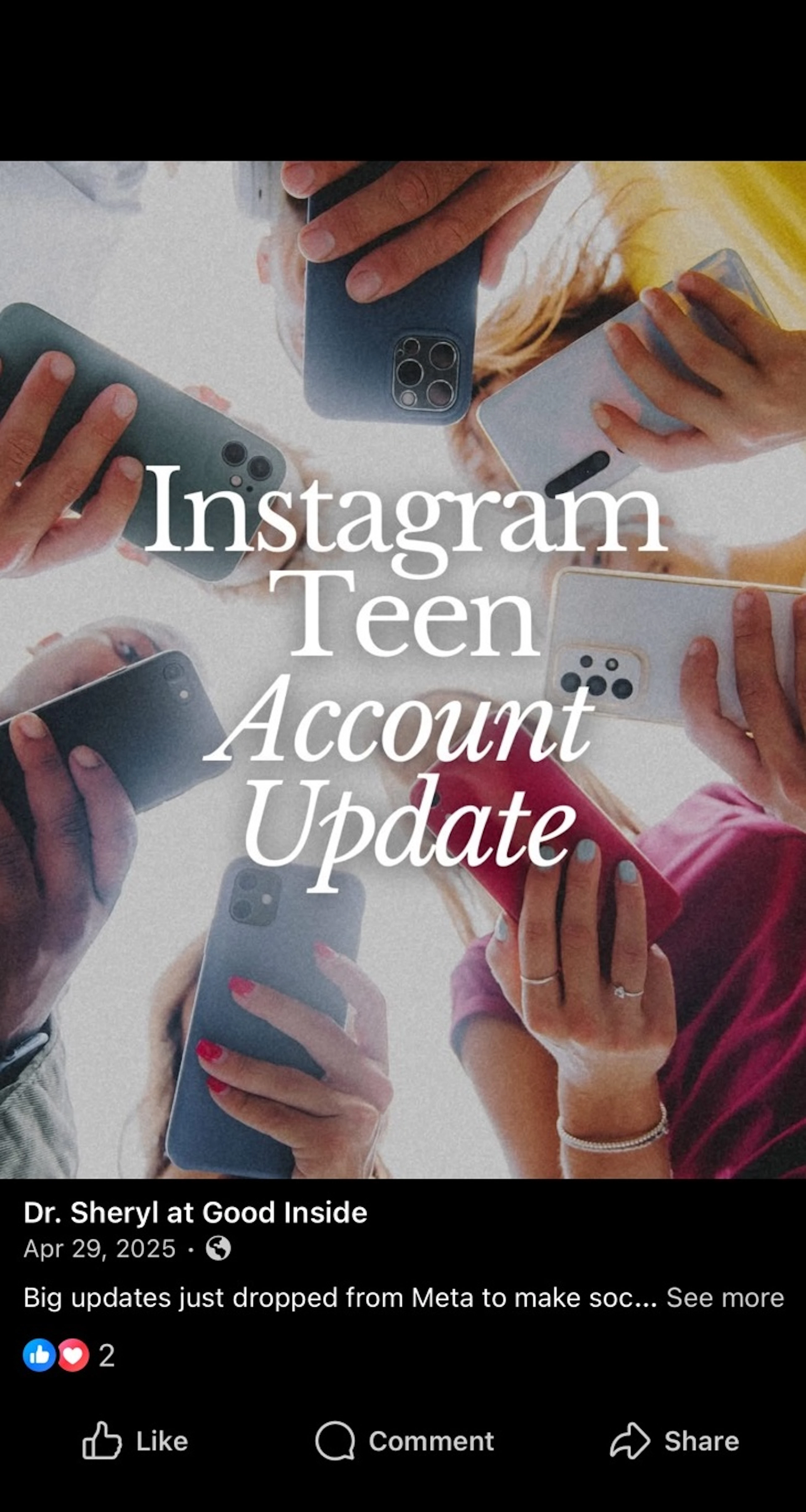
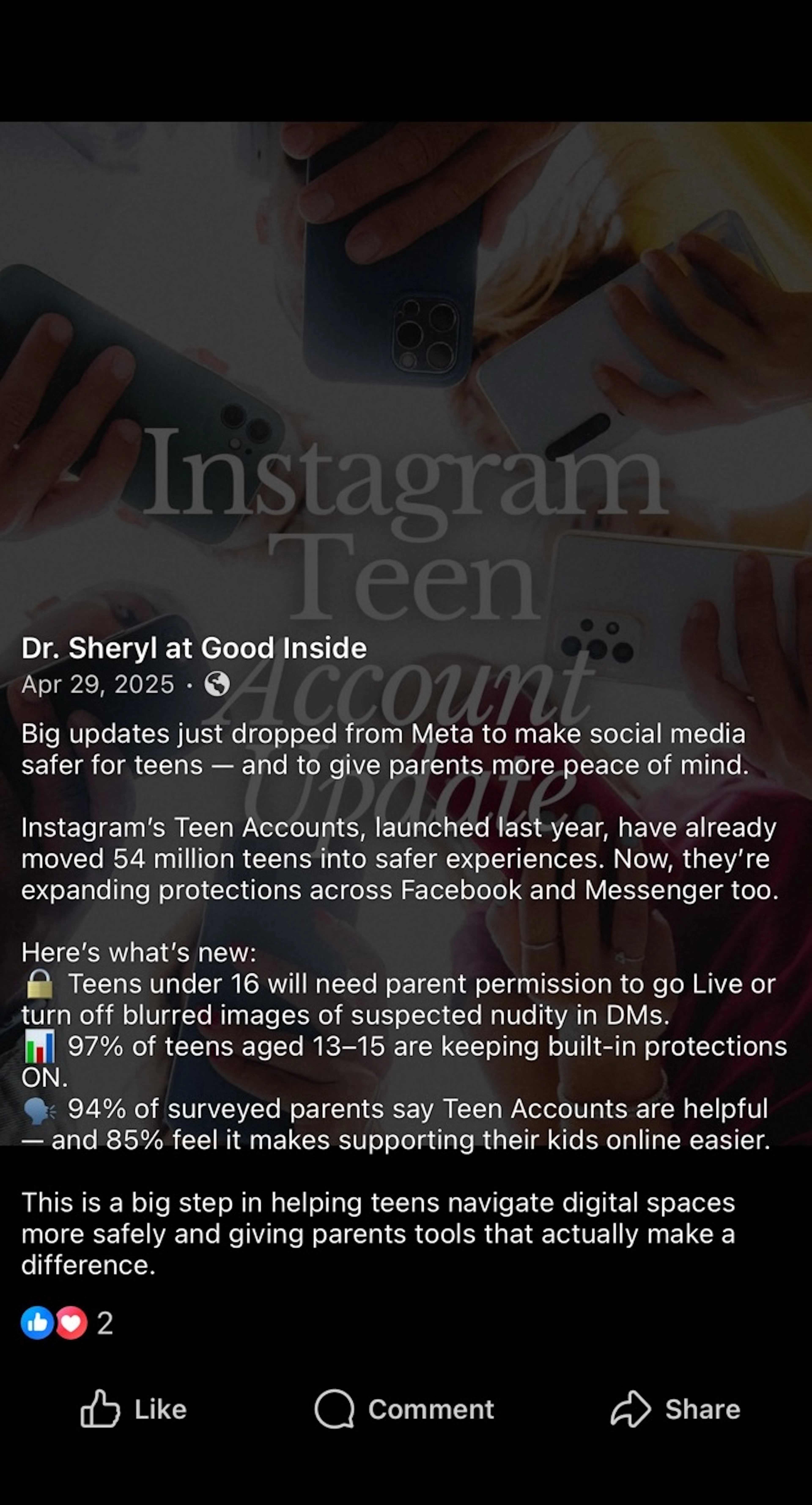
Another example is Dr. Sheryl Ziegler, a clinical psychologist with a private practice in Denver. In November 2023, she did an online talk with Nicole Lopez, Meta’s then-director of youth safety policy, about “the right age for kids to join social media and the best ways to monitor their online presence.” Ziegler later promoted Meta’s Teen Accounts, which she praised for “giving parents tools that actually make a difference.” TTP did not find any disclosures indicating a partnership with Meta, but Ziegler did list Meta among her speaking engagements. One speaker website puts her fee at $30,000 to $50,000 for live events and $10,000 to $20,000 for virtual events.
Ziegler did not respond to questions in advance of our report's publication, but her communications team later contacted TTP to deny that she has ever been paid by or received any benefits from Meta. At the same time, TTP discovered that the list of Ziegler's speaking engagements (including Meta) has been removed from her website, which her team claimed was "unrelated" to our inquires. In addition, TTP found a LinkedIn post by Ziegler's husband referencing her as a keynote speaker at a Meta event. Ziegler's representative said the post "likely references an inaccurate description previously included on her website that implied she had given an official talk at Meta. That characterization was incorrect."
The American Psychological Association—of which Ziegler is a member—appears to have a more skeptical view of parental controls on children’s social media accounts. In an April 2024 report, the association stated:
Granting parents and caregivers greater access to their children’s social media accounts will not address risks embedded within platforms themselves. … [A]s a sole strategy, this approach ignores the complexities of adolescent development, the importance of childhood autonomy and privacy, and disparities in time or resources available for monitoring across communities. Some parents might be technologically ill-equipped, lack the time or documentation to complete requirements, or simply be unavailable to complete these requirements.
That same year, the APA joined the U.S. surgeon general in calling for action against platforms “designed to keep kids engaged for as long as possible with few safeguards.” In February 2023 testimony to the Senate Judiciary Committee, the association’s chief science officer, Dr. Mitch Prinstein, talked about how the “likes” feature on social media platforms can reduce teens’ inhibition toward dangerous and illegal behavior.
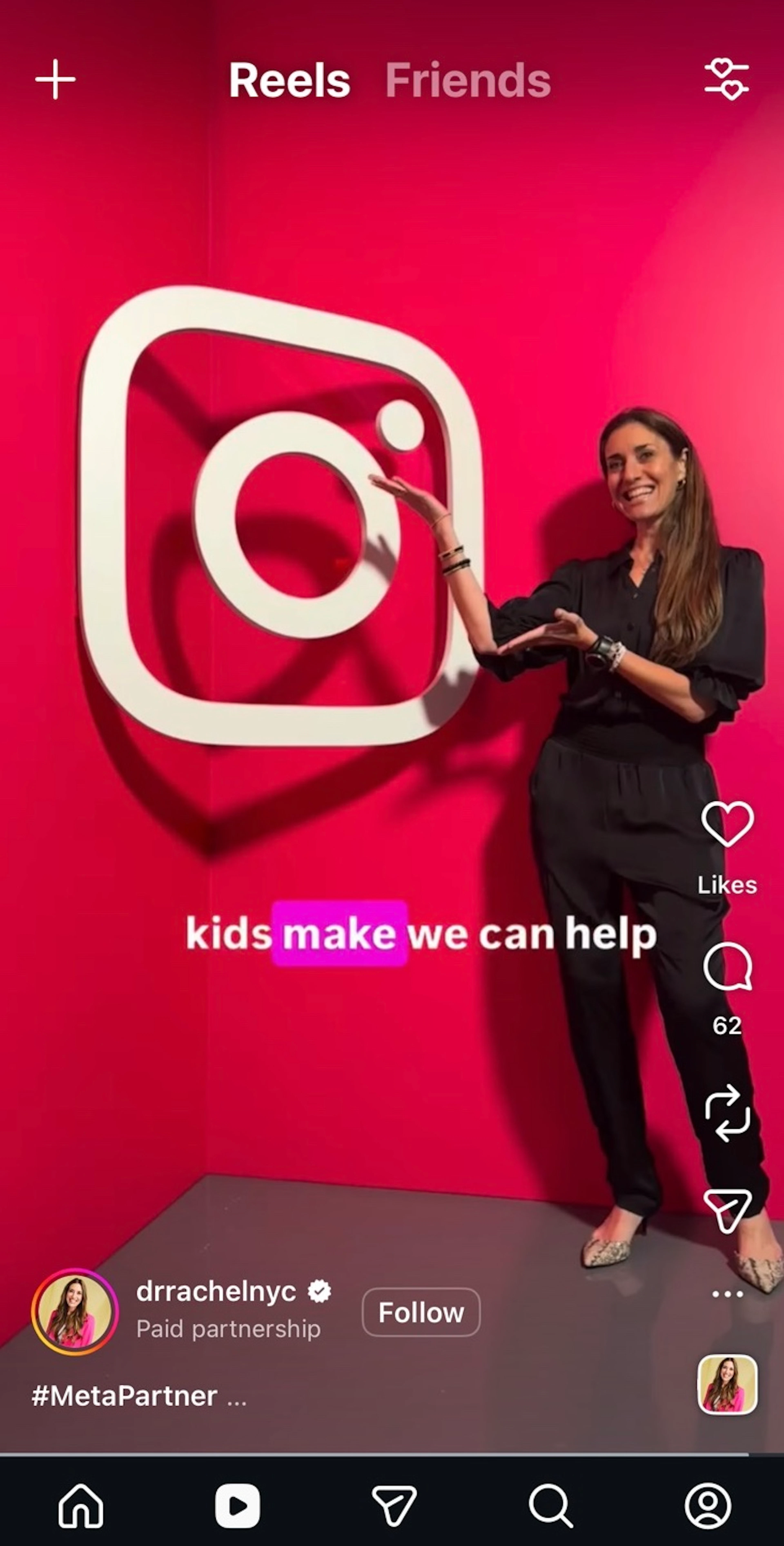
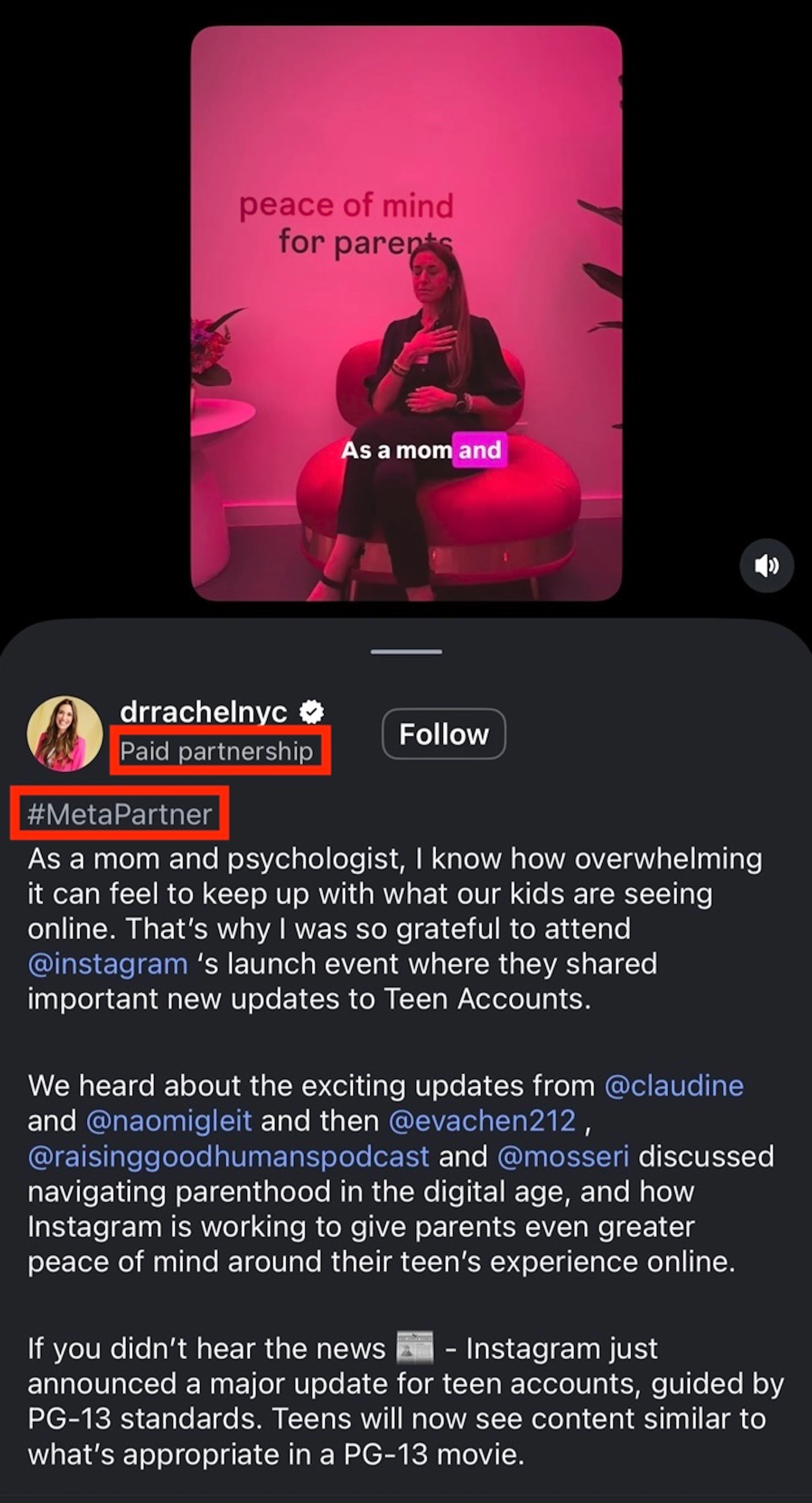
Another psychologist, Dr. Rachel Goldman, posted about attending a Screen Smart event and praised the Teen Accounts.
Another psychologist, Dr. Rachel Goldman, posted about attending a Screen Smart event and praised the Teen Accounts.
Here is the full list of doctors who appeared at Meta events or promoted the Teen Accounts and disclosed a partnership with Meta.
Here are other doctors who have appeared at Meta events or posted about Meta products.
Astroturf operation
Meta has also deployed momfluencers to push for legislation that would shift responsibility for user age verification onto its competitors.
As detailed in media reports, Meta has spent millions of dollars lobbying for bills would require the Apple and Google app stores—not Instagram and other individual apps— to ensure users meet the age requirement for apps. Congress is weighing the federal version of the legislation, the App Store Accountability Act, while Utah, Texas, Louisiana, and Alabama have enacted their own versions of the bill.
Bloomberg News revealed in July 2025 that Meta is a stealth funder behind the Digital Childhood Alliance, a coalition of conservative organizations that has endorsed App Store Accountability Act efforts nationwide. TTP’s investigation found that Meta is also recruiting Instagram influencers to push this legislative agenda.
In an Instagram Reel posted by Dallas content creator Jayla Henry in April 2025, Henry briefly shows a Meta information sheet handed out at a Screen Smart event. The sheet argues that requiring app stores to notify parents and get their approval when their teens want to download an app is the “best, most effective way” to ensure safe experiences. It calls for legislation to enshrine this model:
“An app store age approach minimizes the amount of data any one app collects. In fact, parents already provide this information when they purchase a teen’s phone and set up their teen’s account. Parents and teens should not have to provide sensitive information like government IDs to dozens of apps to verify their age.”
TTP identified a number of Meta-affiliated influencers pushing this agenda.
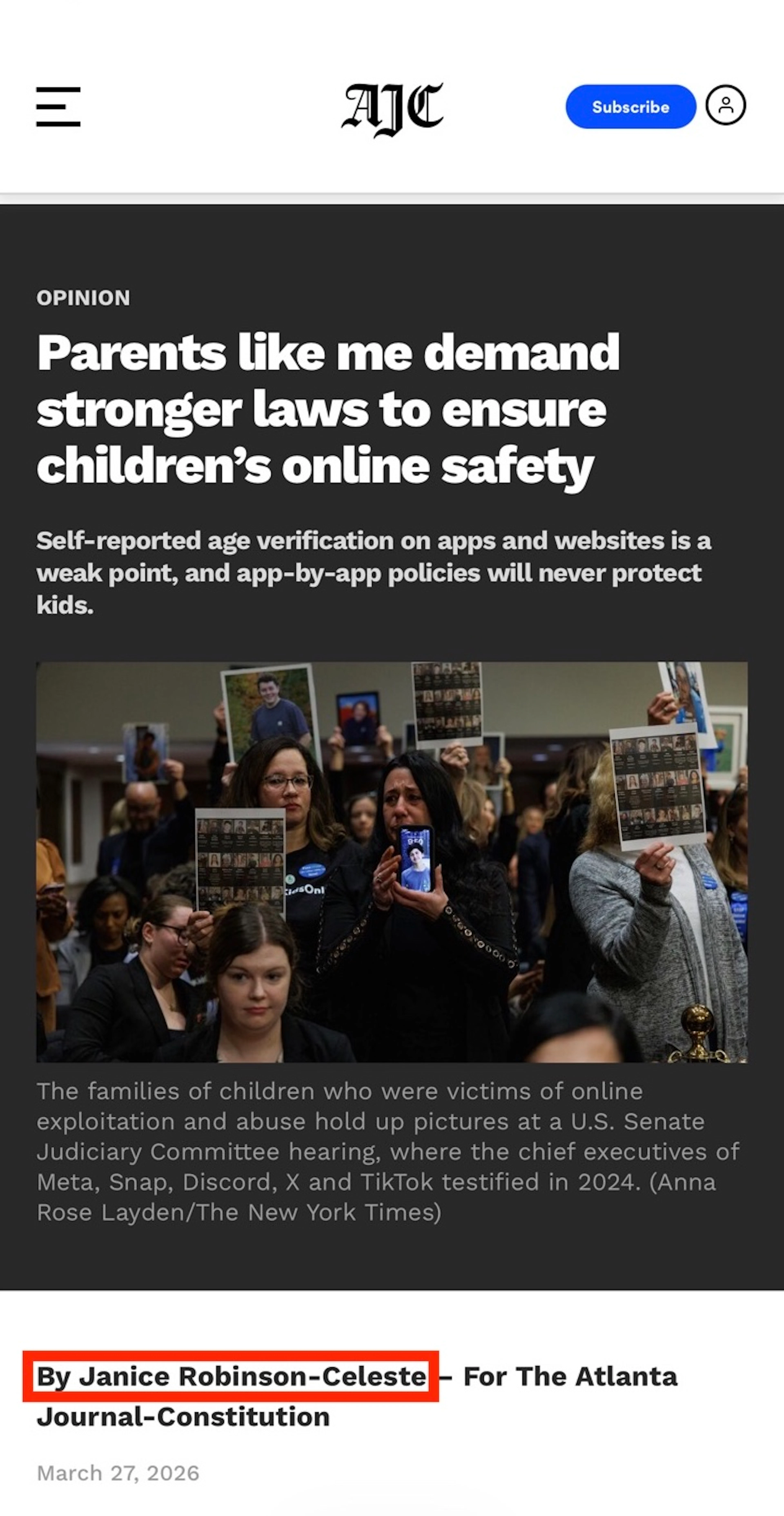
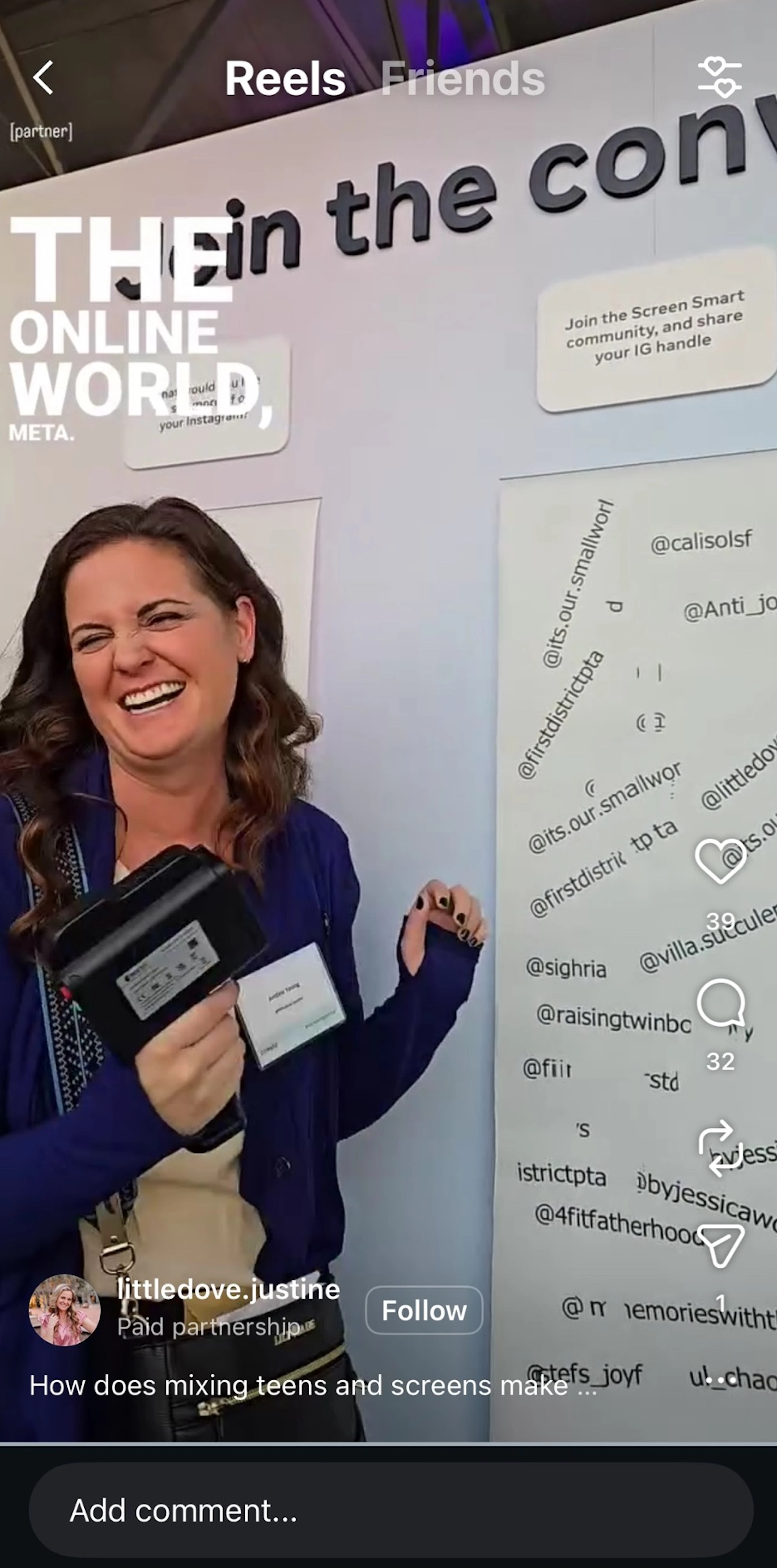
One example is Janice Robinson-Celeste, CEO of Successful Black Parenting Magazine. She posted a series of Teen Account promotions on her Instagram account in November 2024, tagging them with #MetaPartner. In a separate note on her website, she disclosed receiving “financial compensation from Meta for appearing at its Screen Smart event” in Savannah, Georgia.
In March 2026, Robinson-Celeste penned an op-ed in the Atlanta Journal-Constitution titled “Parents like me demand stronger laws to ensure children’s safety.” The article called on Georgia lawmakers to pass Senate Bill 467, the state’s version of the App Store Accountability Act, and urged Congress to pass a federal app store bill as well. In the op-ed, Robinson-Celeste made no disclosure of her prior financial relationship Meta.
In a statement, Successful Black Parenting Magazine said Robinson-Celeste received a stipend to cover "travel, lodging, and content creation" related to the Screen Smart event. It said Meta "did not review, approve, or control her content prior to publication." Regarding the op-ed, the magazine said, "The opinions expressed were solely her own, and she was not compensated in any way for writing the piece."
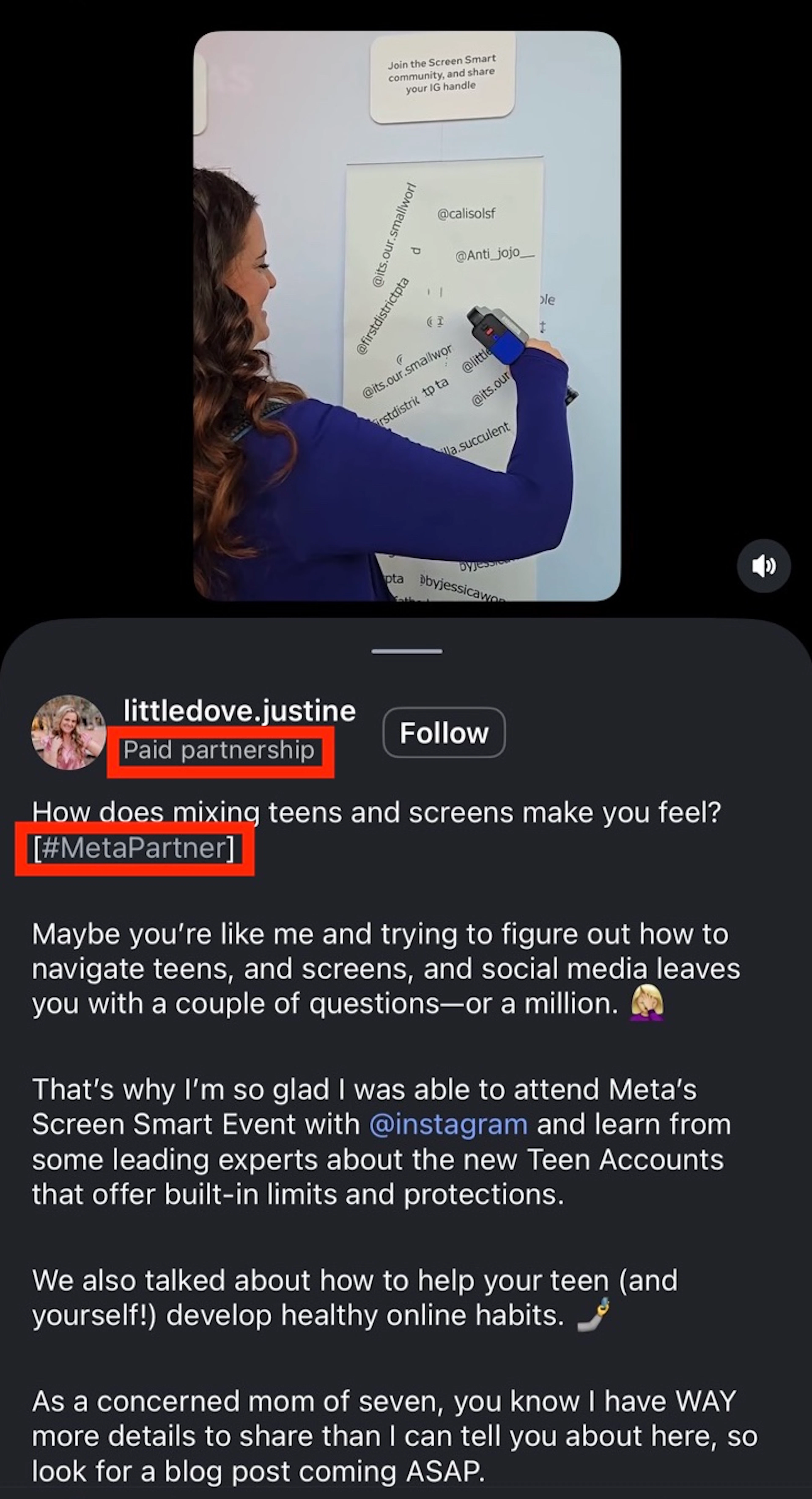
Another Instagram influencer, Justine Young, posted about attending a Screen Smart event in San Francisco in November 2024, indicating she has a paid partnership with Meta. She made a similar disclosure on her motherhood and travel blog, saying she had “partnered with Meta to attend this event.”
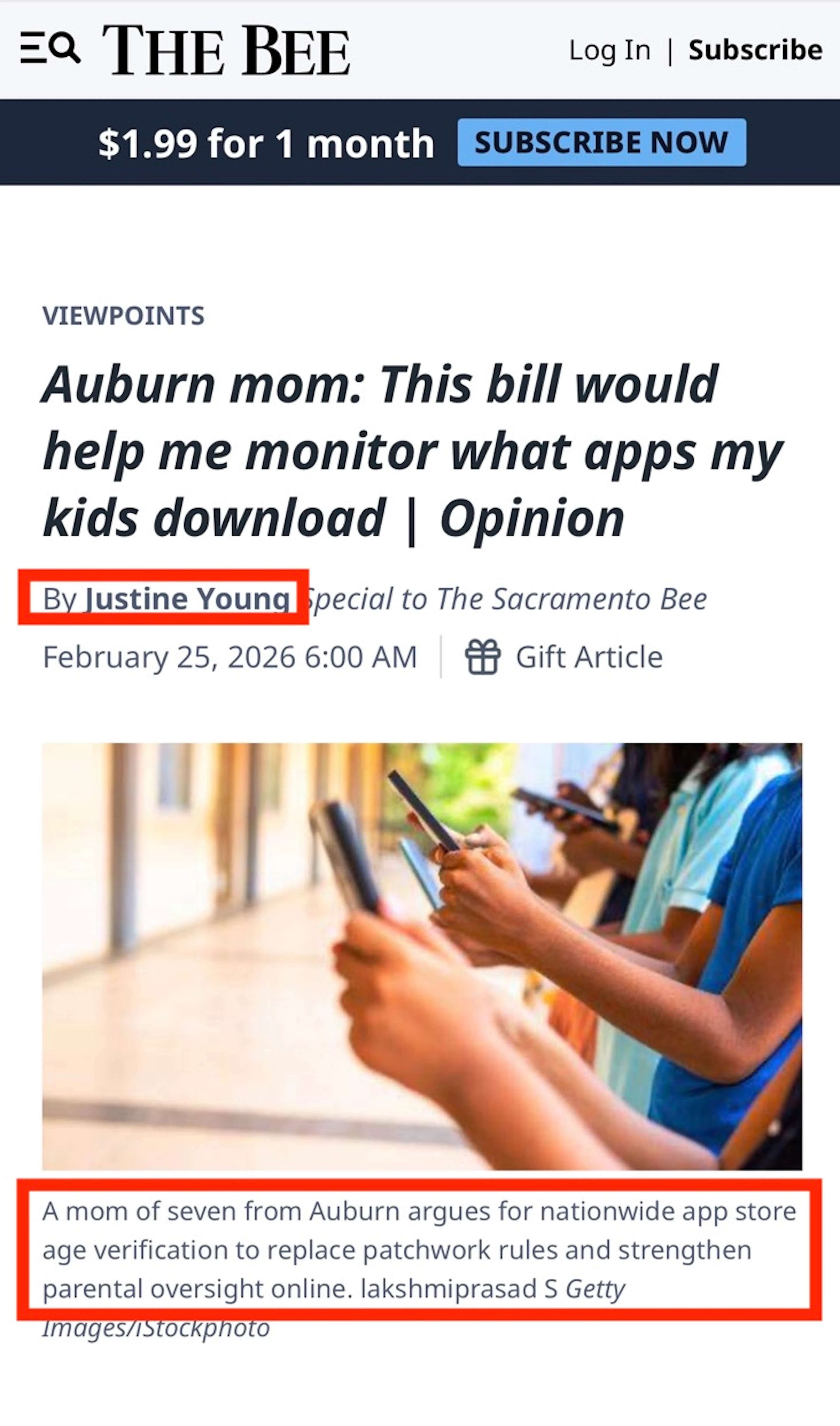
About a year later, in February 2026, Young’s name appeared on an op-ed in the Sacramento Bee calling on Congress to pass the federal App Store Accountability Act. She wrote:
“Rather than asking parents to manage dozens of apps individually, this proposal recognizes the role app stores already play as the main gateway to digital content. By requiring age verification and parental approval at the point of download, it creates a single, consistent checkpoint that families can rely on.”
The op-ed included no disclosure of her prior financial relationship with Meta.
Young did not respond to questions, but she told CNN she was “not compensated in any form” for the op-ed and "did not feel the need to disclose that I had any type of relationship with Meta.”
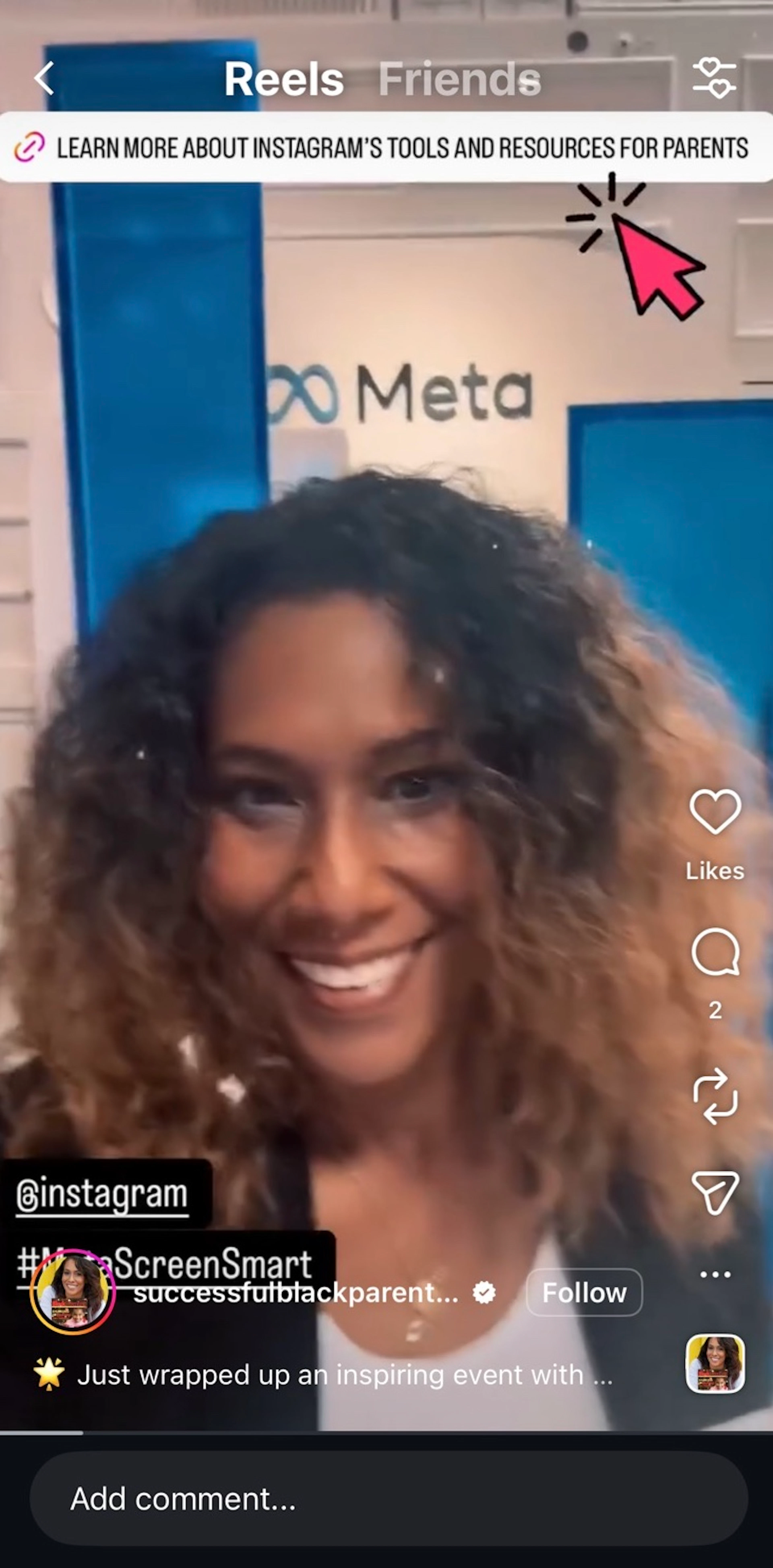
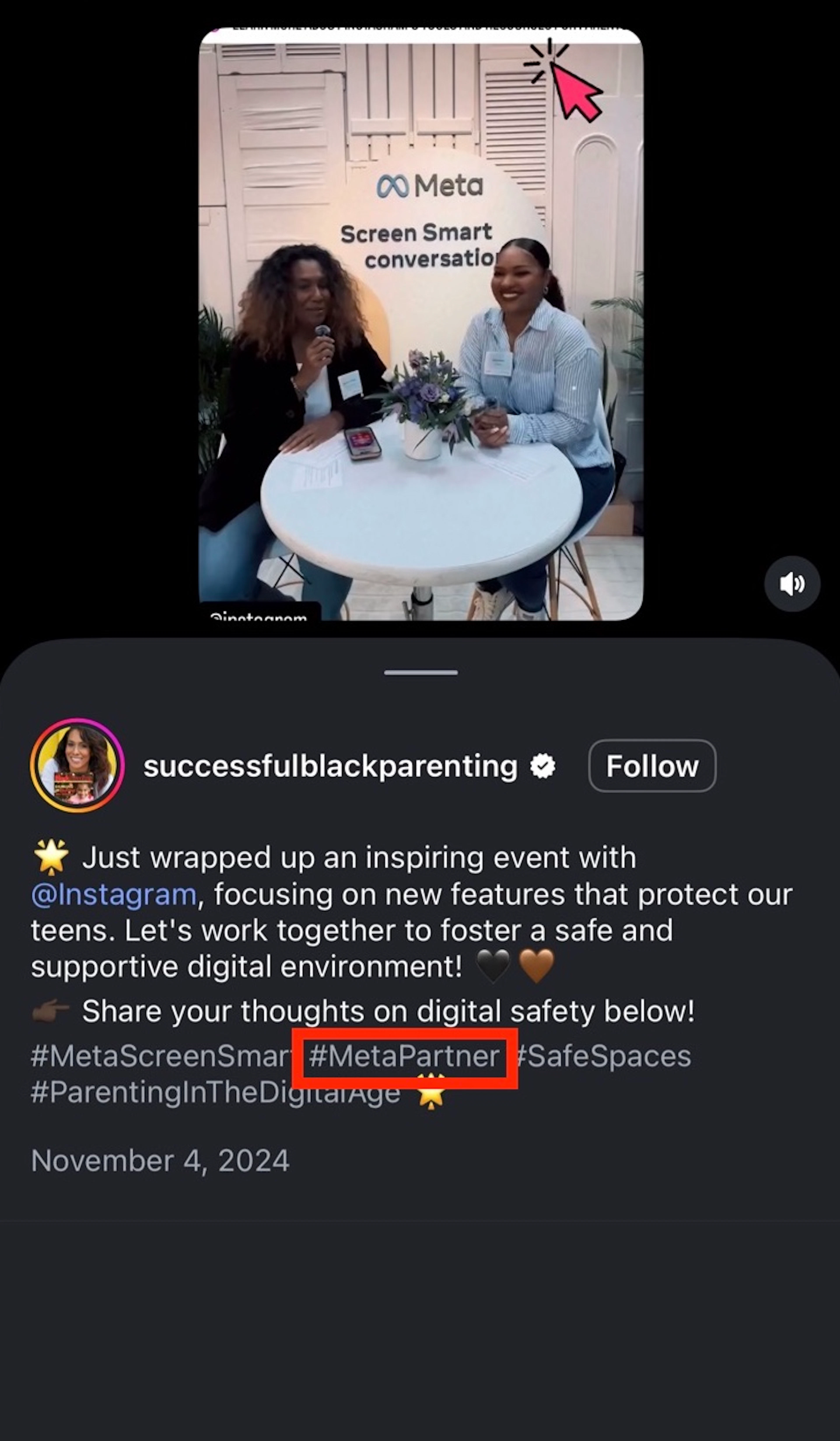
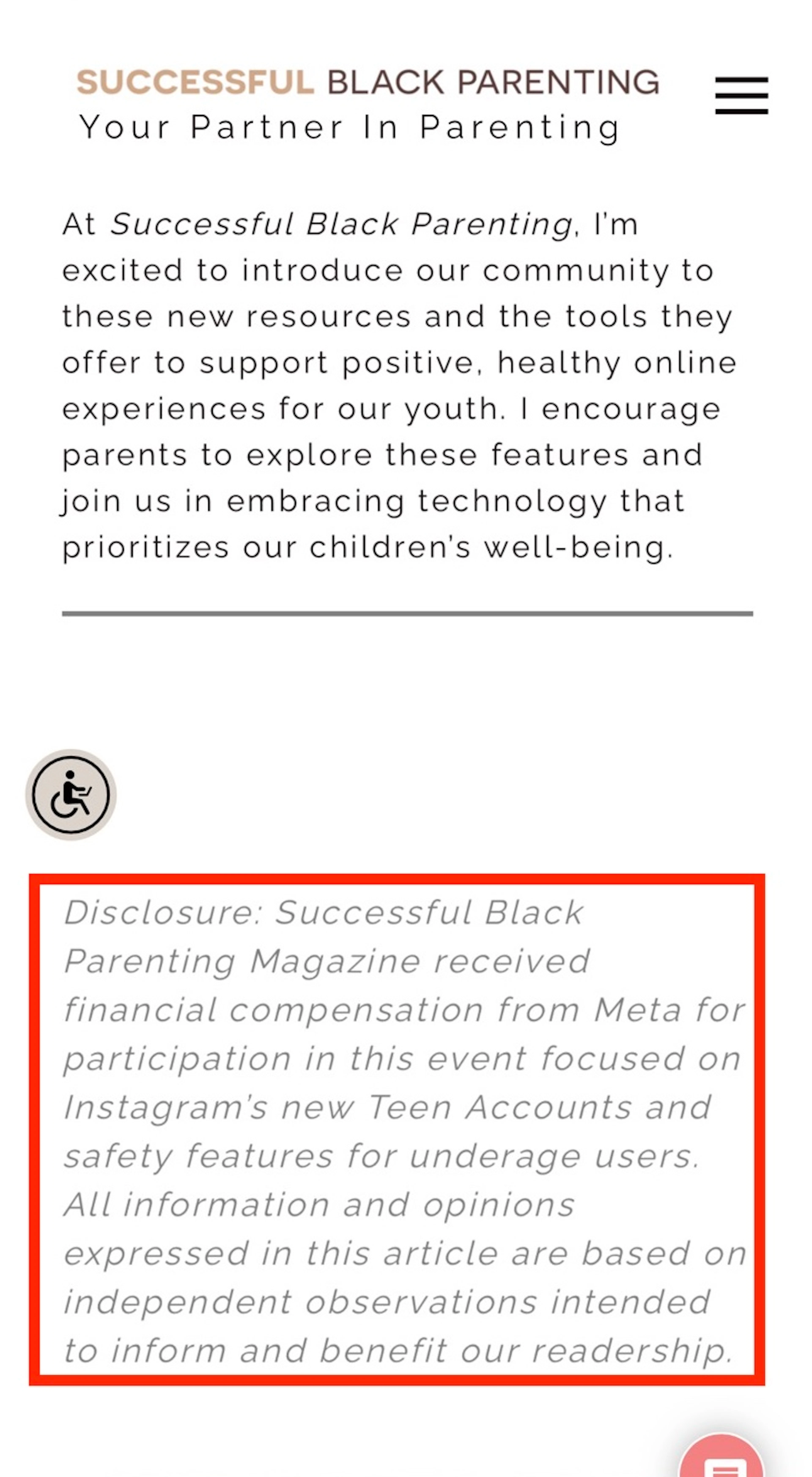
Janice Robinson-Celeste, CEO of Successful Black Parenting Magazine, posted a series of Teen Account promotions.
Janice Robinson-Celeste, CEO of Successful Black Parenting Magazine, posted a series of Teen Account promotions.
Shannon Bird, a Salt Lake City mother of five and former NBA dancer, built an 81,000 Instagram following posting photos and videos of herself and her family. She is perhaps best known for calling the police in the middle of the night because she had run out of baby formula. In November 2024, she attended a Screen Smart event and touted the Instagram Teen Accounts in a Reel that included a paid partnership disclosure and the hashtag #MetaPartner.
Less than a year later, she authored an op-ed in the Salt Lake Tribune encouraging other states to follow Utah’s leading in passing an App Store Accountability Act. She also appeared at a Council of State Governments conference in Jackson Hole, Wyoming, where she took part in a Meta-sponsored session titled “Youth Well-Being: Parental Tools for Platform Safety.” Bird documented the appearance on Instagram, writing, “So honored to represent @meta, the state of Utah & motherhood @csgwest.”
Kristen Gardiner, a Texas parenting influencer with nearly 42,000 followers on Instagram, posted an Instagram Story about attending a Screen Smart event in August 2024, using the hashtag #MetaPartner. Gardiner recounted how Ravi Sinha, Meta’s head of child safety policy, spoke at the event about the need for legislation requiring app stores to verify ages. She added, “Our current legislation is so behind what is actually needed to keep kids safe.”
A few months later, in May 2025, Gardiner posted an endorsement of the Texas App Store Accountability Act and urged her followers to contact lawmakers in support of the bill. Gardiner noted she had a partnered with the Digital Childhood Alliance, Meta’s advocacy arm, but did not disclose her prior ties to Meta.
Bird and Gardiner did not respond to questions.
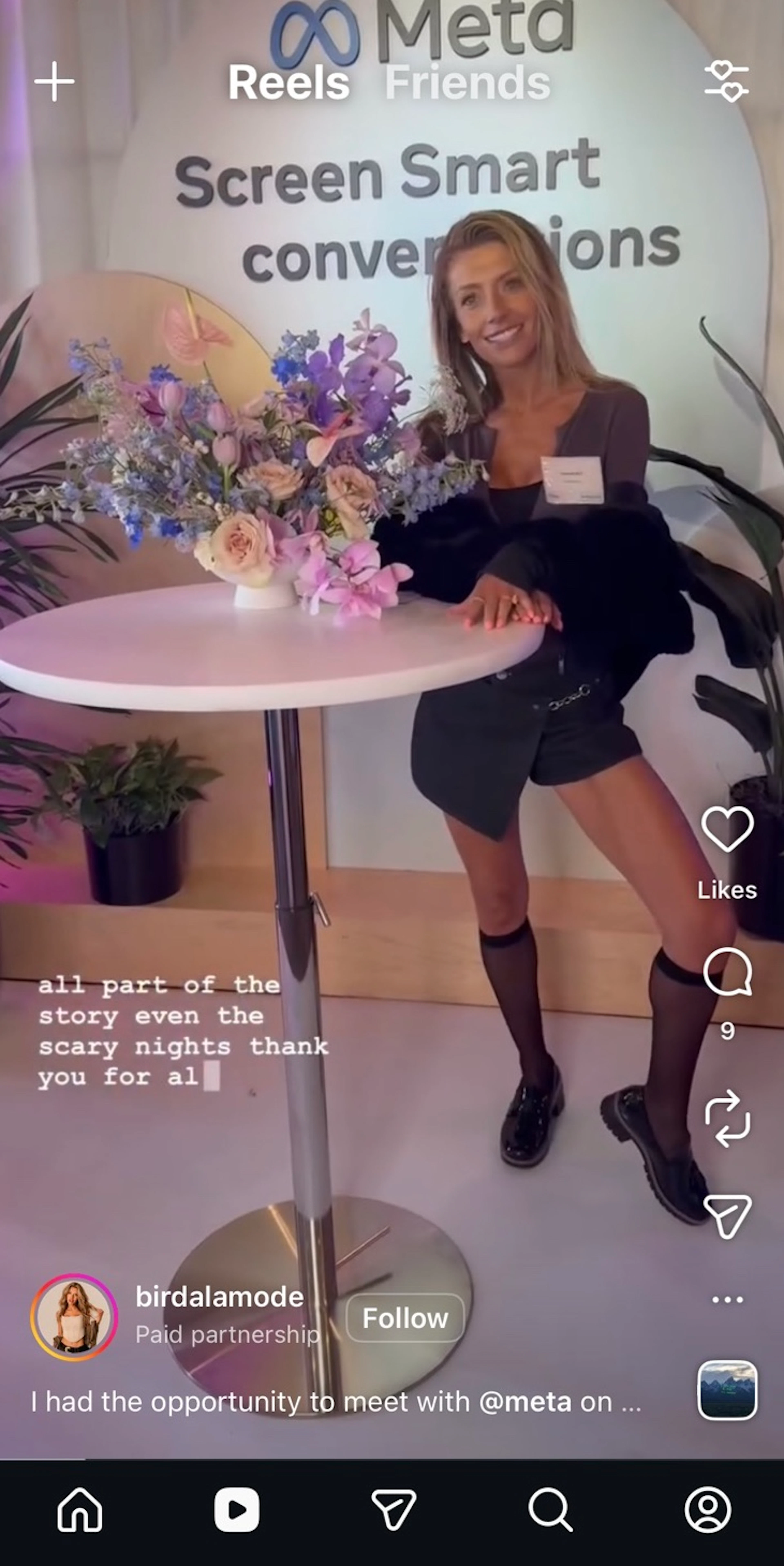
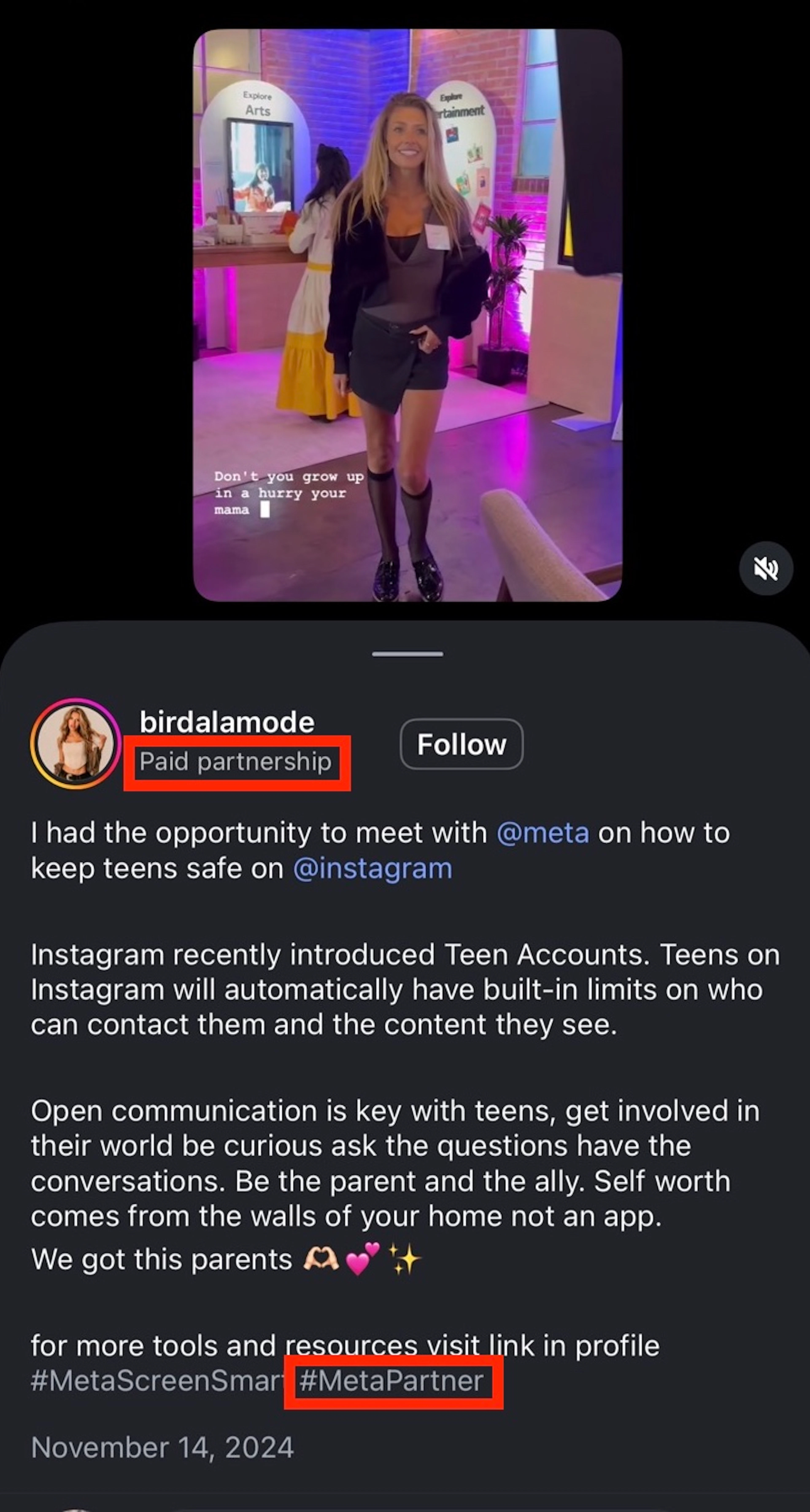
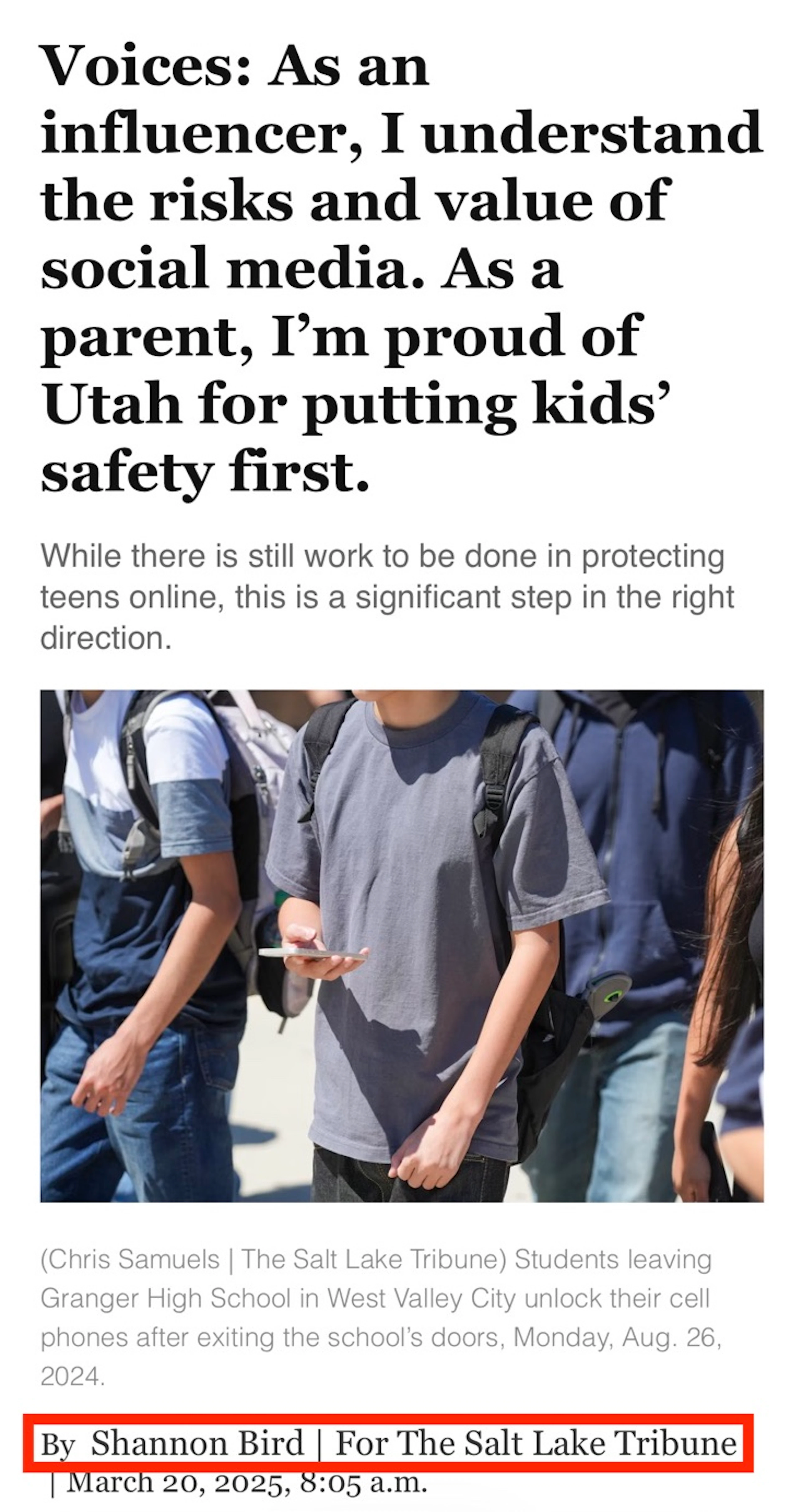
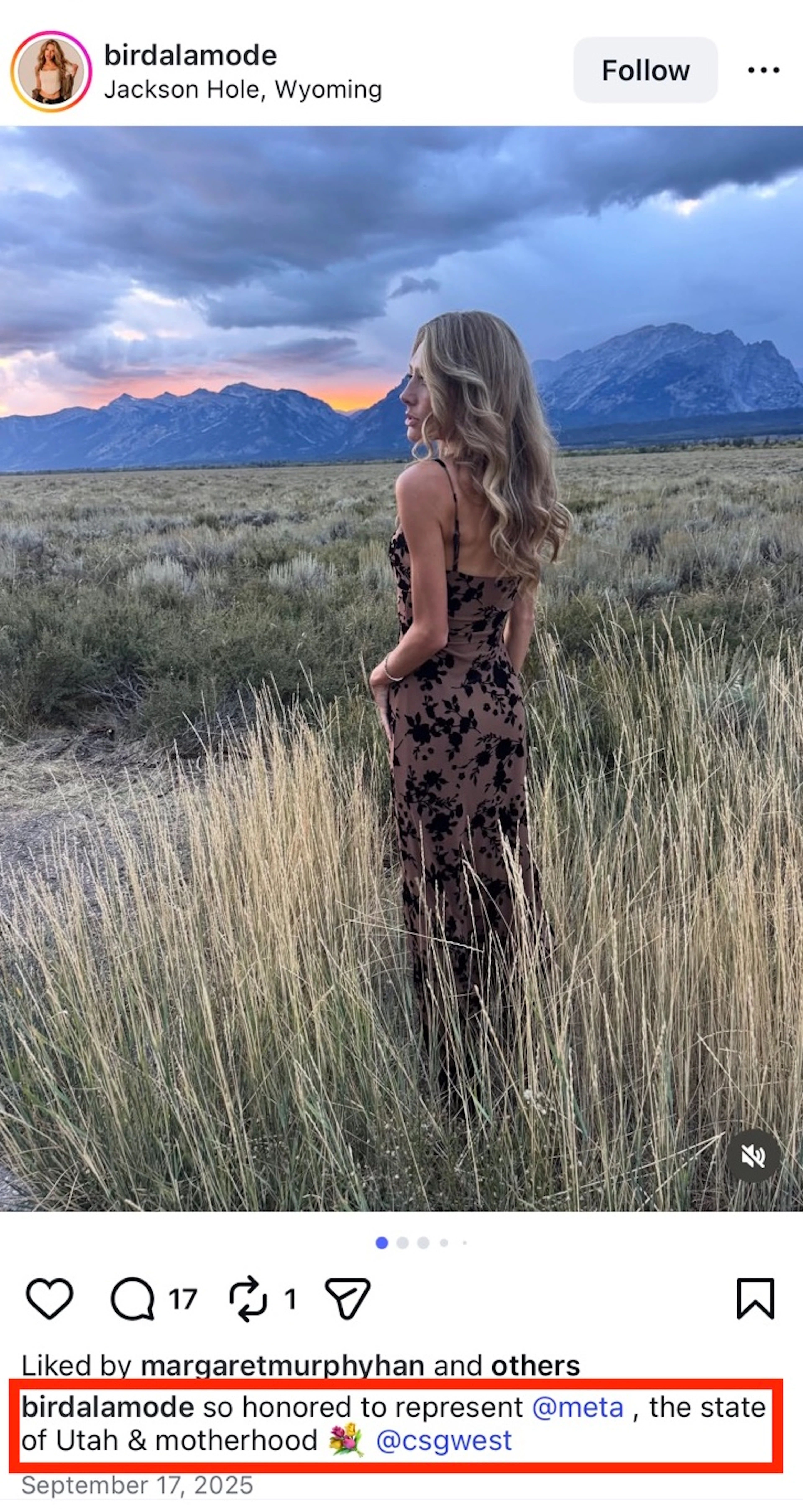
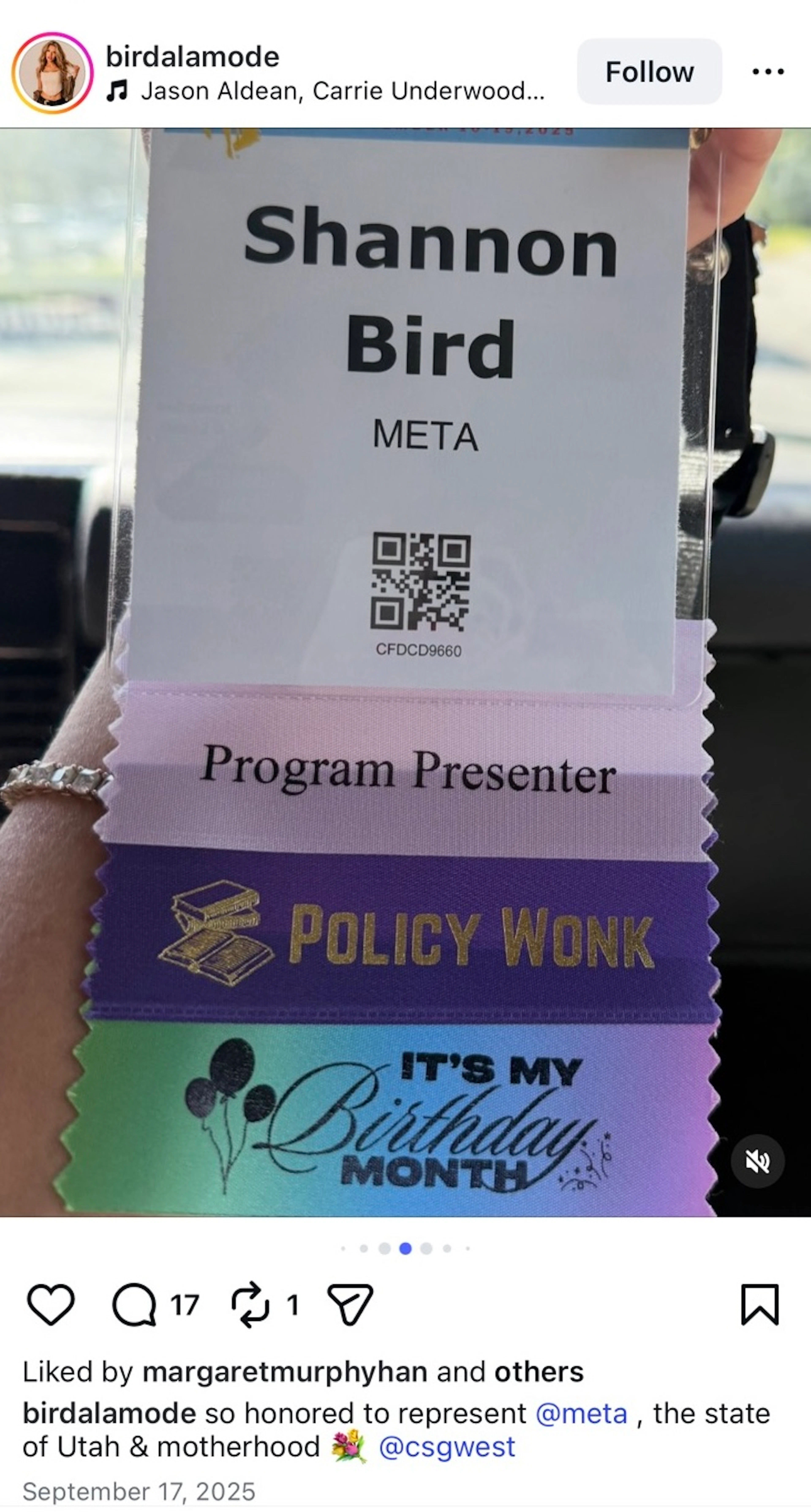
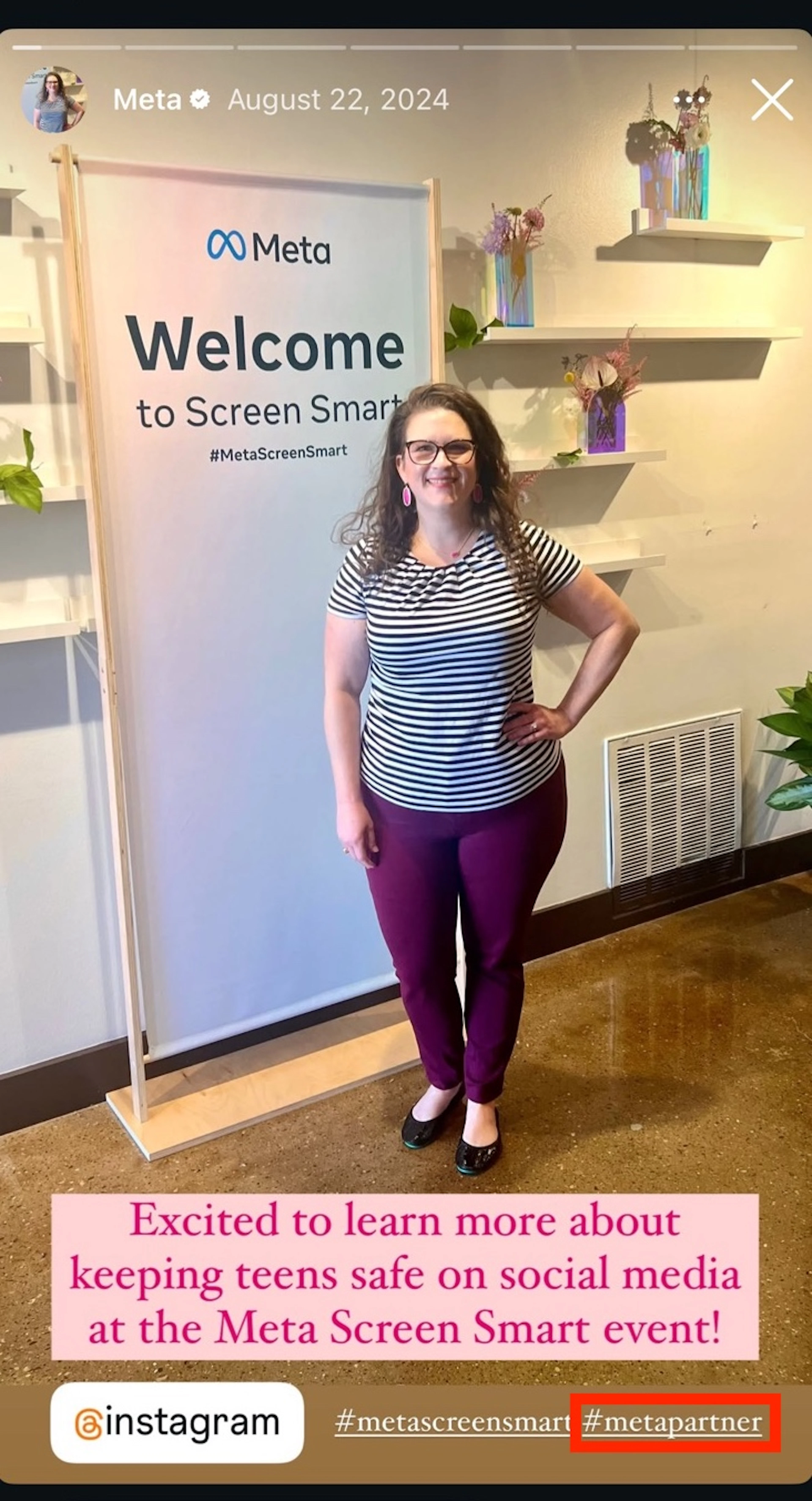
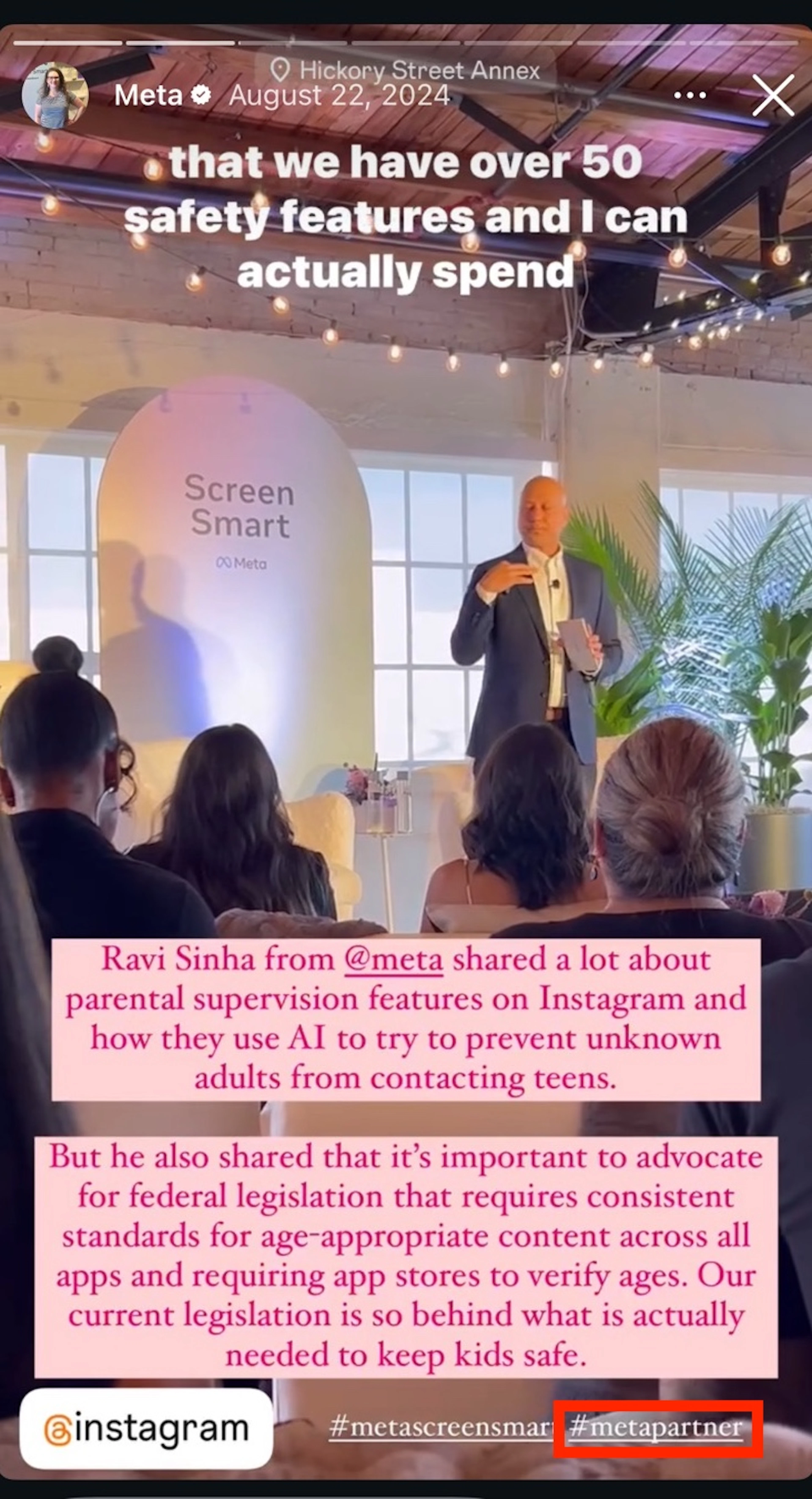
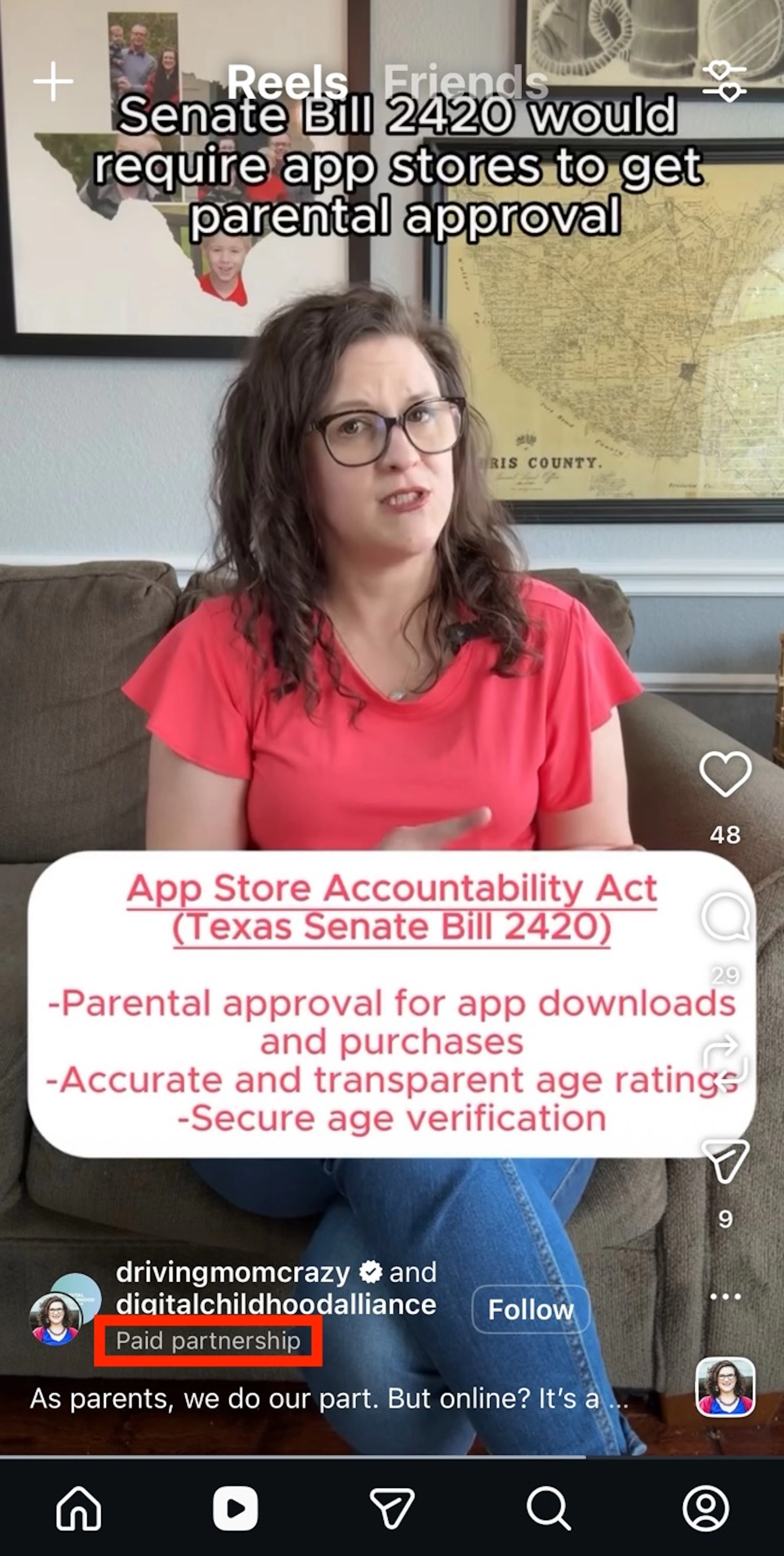
Shannon Bird, a Salt Lake City mother of five and former NBA dancer, attended a Screen Smart event and touted the Teen Accounts in a Instagram Reel.
Shannon Bird, a Salt Lake City mother of five and former NBA dancer, attended a Screen Smart event and touted the Teen Accounts in a Instagram Reel.
TTP also found signs that Meta is turning to college athletes to spread its policy messaging.
In March 2026, a pair of Instagram Threads by Luke Altmyer, quarterback for the University of Illinois Fighting Illini, and Vanderbilt University track star Gianna Bullock talked up the need for app stores to enforce age verification and parental consent for downloading apps. Both posts use the hashtag #MetaPartner and had a paid partnership label. Another Instagram post by Ty Simpson, quarterback for the University of Alabama Crimson Tide, had a similar message and disclosure.
Altmyer, Bullock, Simpson did not respond to questions.
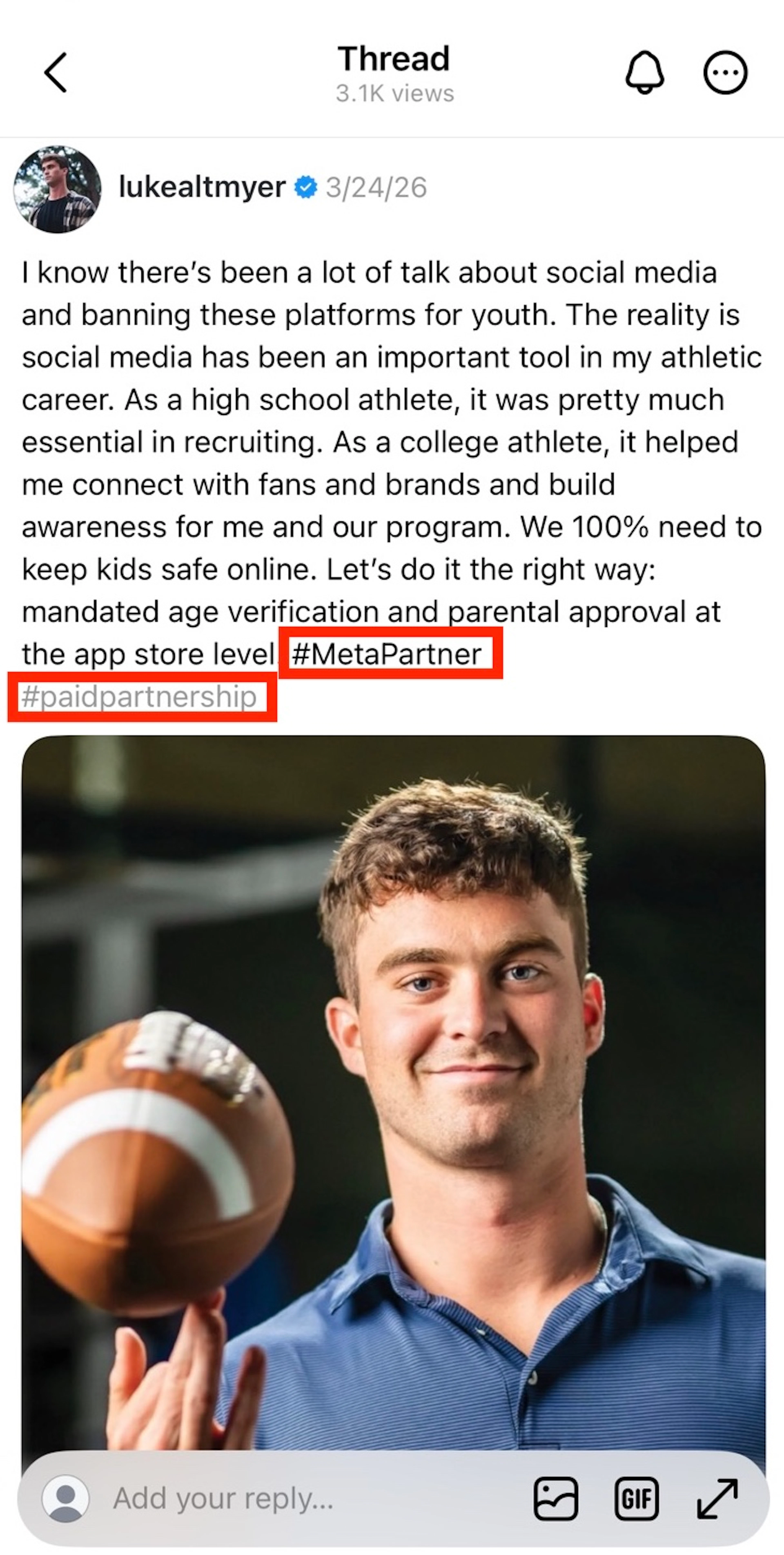
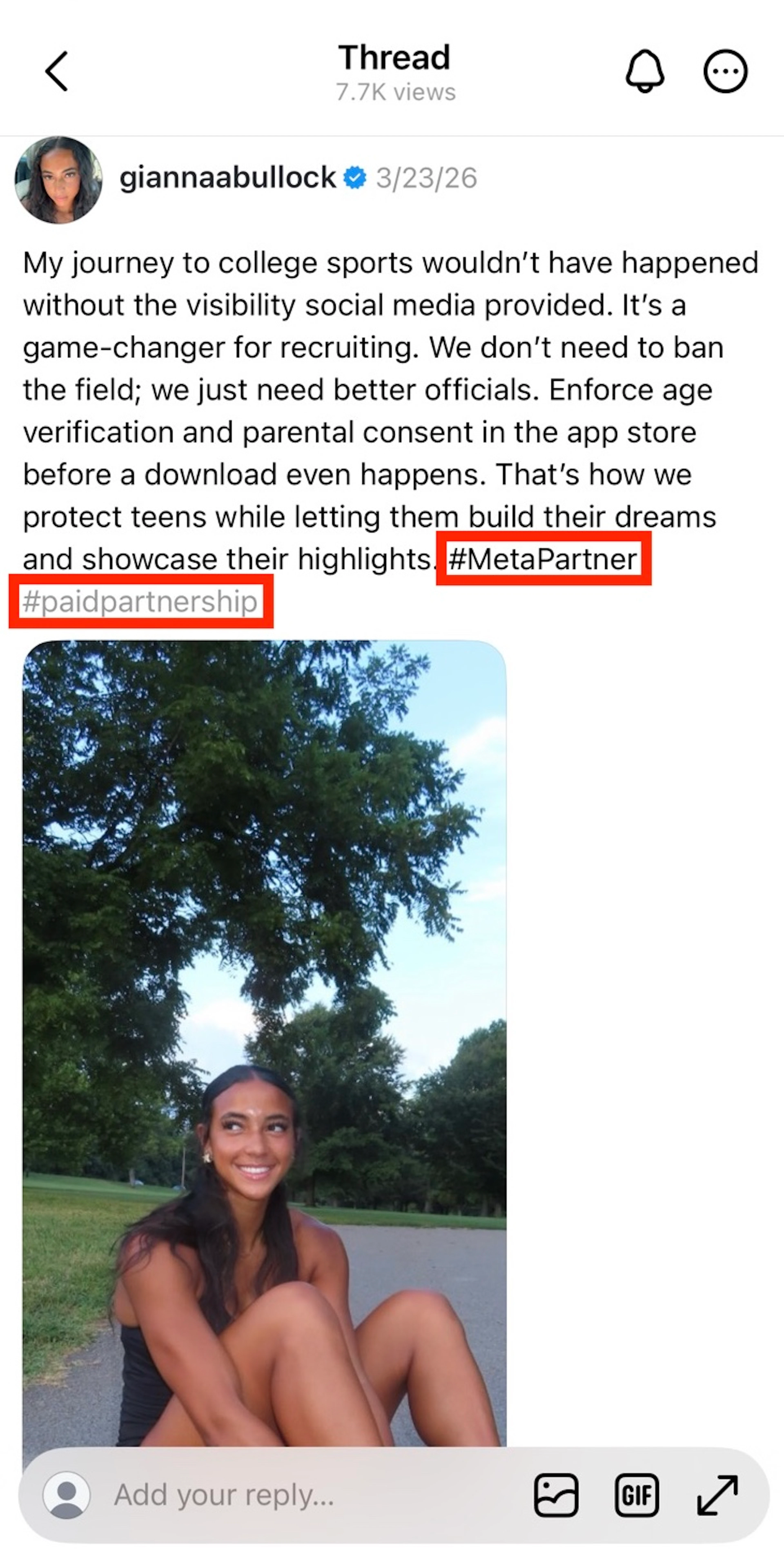
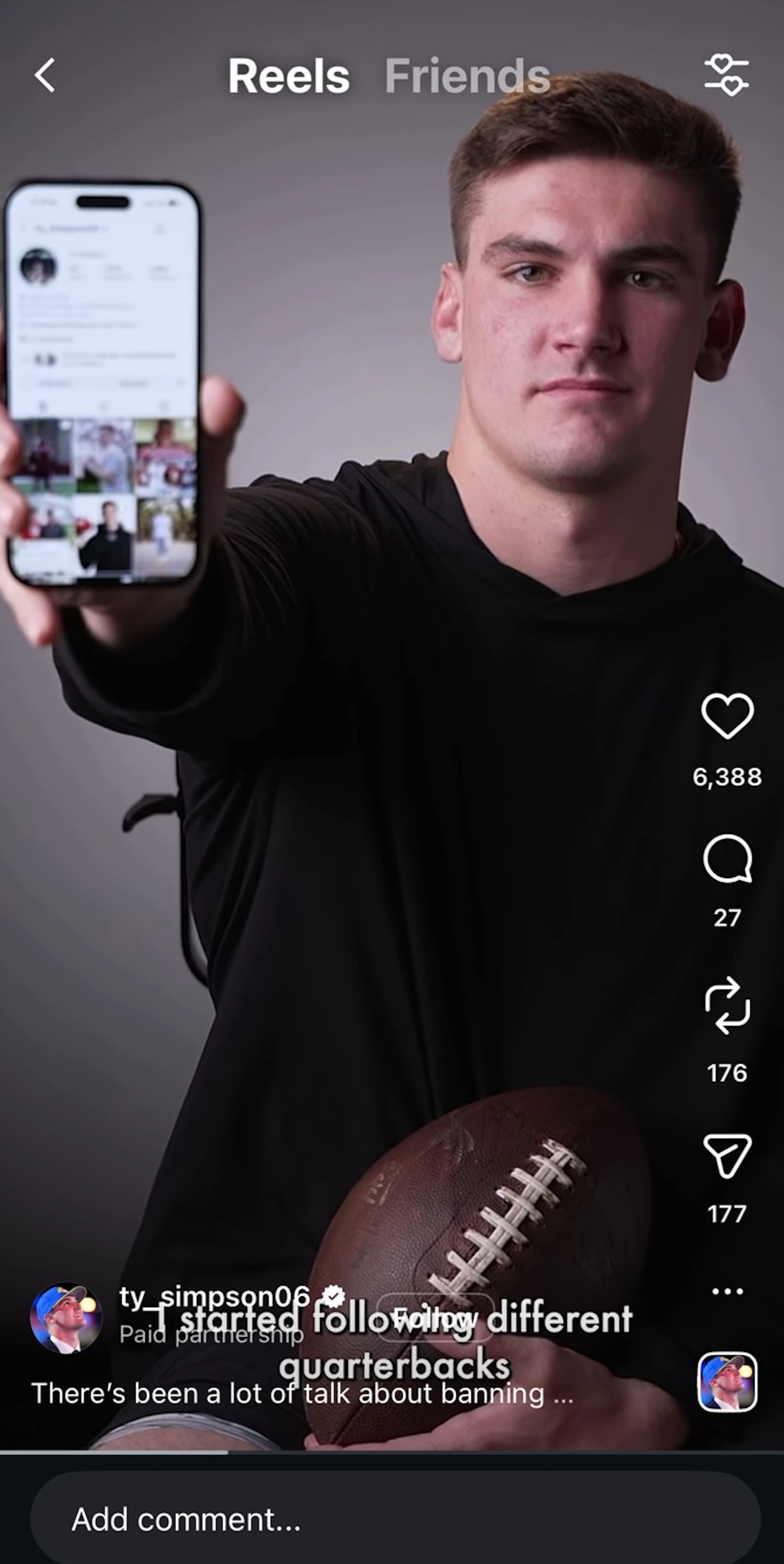
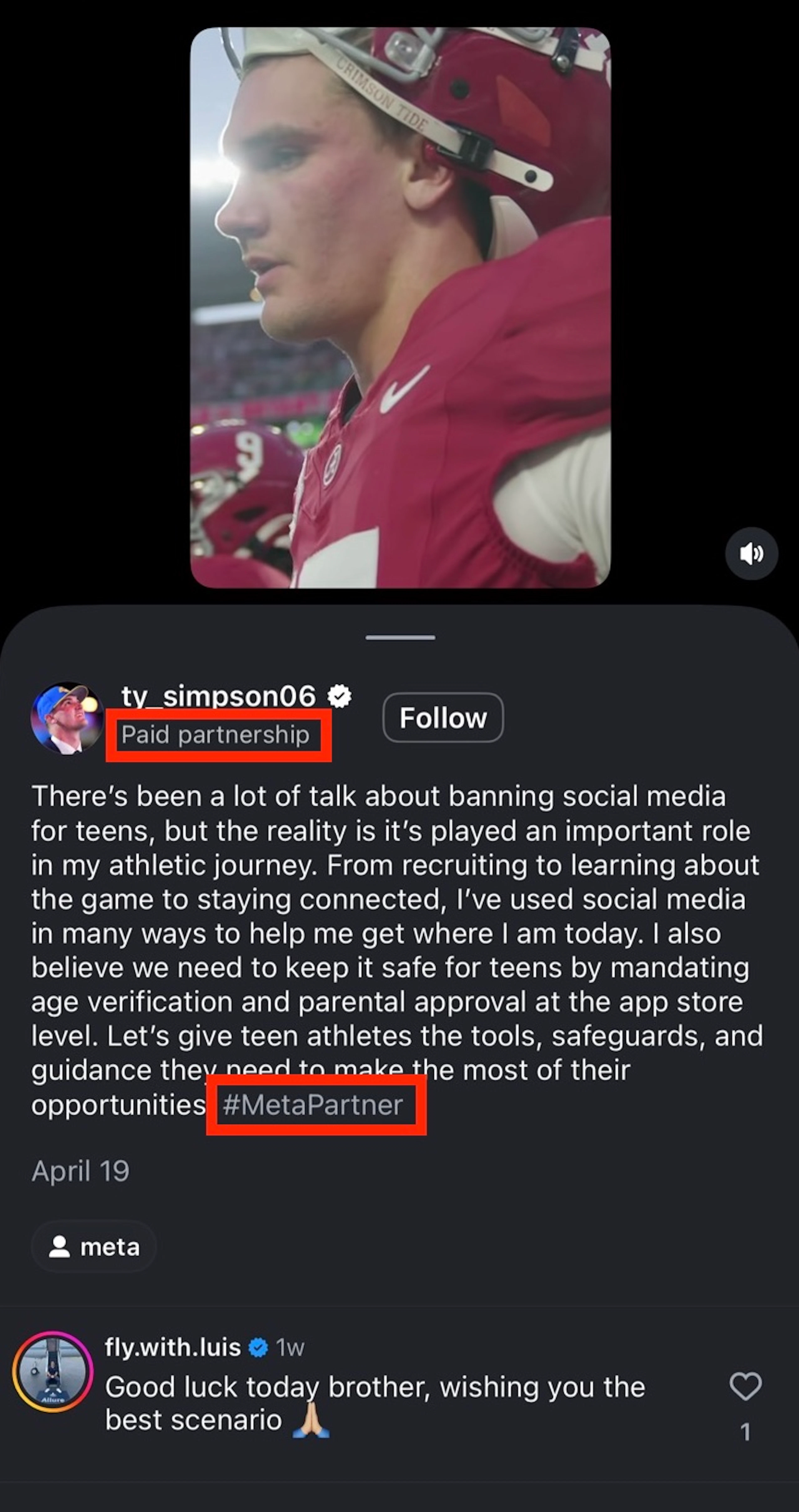
Meta is also turning to college athletes like University of Illinois quarterback Luke Altmyer to spread its policy messaging about age verification.
Meta is also turning to college athletes like University of Illinois quarterback Luke Altmyer to spread its policy messaging about age verification.
Conclusion
As Meta comes under increasing pressure over its record on child safety, it is cultivating a network of Instagram influencers—including moms, doctors and psychologists—to help it promote a sunnier picture of its efforts to protect young users. Many of the influencers disclose paid partnerships with Meta, meaning they are being compensated for their positive posts about Instagram’s teen safety features.
Meta has also been using these influencers as a political astroturf operation to build support for bills that put the onus on app stores—not individual apps like Instagram—to verify the age of users. Lawmakers and others should be aware of these tactics when they consider how to hold Meta accountable for its impact on minors.
If you have worked with Meta as a creator and want to share your experience, reach out to us at contact@techtransparencyproject.org.
Note: This report has been updated with Meta and influencer comments made to CNN and an influencer comment made to TTP post-publication. It also corrected a paragraph on the status of litigation against Meta.