Ben Kramer had a plan. The 54-year-old and his husband intended to pay off their house in Redmond, Washington, and retire at 60. But Kramer started playing the DoubleDown Casino game on Facebook about a decade ago.
Kramer got hooked on the slots, playing nearly 50 hours a week. And when his free chips ran out, he used his credit card to buy more. Over time, he lost “well over $220,000,” threatening both his retirement plan and his marriage, according to an ongoing lawsuit against Facebook.
Kramer’s story—one of more than two dozen cited in the litigation—highlights how Facebook plays a critical role in the business of so-called social casinos. The apps, ranging from online slots to roulette to poker, offer gambling for fun, not a payout, and claim to be free to play. But they require users to put in real money if they want to keep playing when their free chips run out, leading some people to rack up huge debts. Kramer's law firm Edelson PC did not respond to a request for comment.
Facebook helps social casinos attract and hook players while collecting a slice of the revenue for itself. One way Facebook makes money from the games is through the 30% service fee it charges on payments made through its platform. It also collects ad revenue when the apps advertise on Facebook. While Facebook’s parent company Meta does not disclose the fees it generates from social casinos, it is clearly profiting from the games, which have grown to be an estimated $9 billion market.
The Tech Transparency Project found that Facebook is also running ads for so-called sweepstakes casinos, another type of online game that has been banned or declared illegal in multiple states. Sweepstakes casinos offer free-to-play options but allow players to put in real money for the chance to win real prizes.
Facebook’s lucrative arrangement with these games is part of a broader pattern of disregard for the financial security of its users. As detailed in a recent Reuters report, Meta is earning a “fortune” from fraudulent ads, with the company projecting internally that 10% of its 2024 revenue, or $16 billion, came from ads for scams and banned goods. TTP has shown how scam advertisers who use deepfake videos of politicians to hawk fictitious government benefits are often among the top ad spenders on Meta platforms.
As legal and regulatory pressure grows on social casinos and sweepstakes, Meta shows no signs of changing its policies, which allow these games as long as they’re targeted at users over 18.
Meta did not respond to questions and a request for comment.
Free to play, with a catch
Social casinos are thriving on Facebook. The platform’s games section includes a “casino” category, which recently listed 88 offerings, with names like Electric Slots and Vegas Craze. One Vietnamese card game claims to have 583,000 players. Another popular game, Slot Mate, boasts 210,000 players.
The games promise that they are free to play. But when the free tokens run out, players can use real money to buy virtual coins and keep playing. Players never have a chance to win back any real money.
A recent Securities and Exchange Commission filing from Playstudios Inc., a Las Vegas company that develops social casinos and gets “a significant number” of its players from Facebook, spells out exactly how the system works.
The company, which makes MyVEGAS Slots, my KONAMI Slots, and other social casinos, said players get free virtual currencies when they launch a game for the first time, and they may get more “at periodic intervals or through targeted marketing promotions.”
Playstudios, like other social casino operators, primarily generates revenue “from the sale of in-game virtual currencies, which players can choose to purchase at any time to enhance their playing experience. Once purchased, our virtual currency cannot be withdrawn from the game, transferred from one game to another or from one player to another, or be redeemed for monetary value.”
Playstudios did not respond to a request for comment.
One casino game executive has shed light on how the games don’t always play fair. In a 2011 interview, Glenn Walcott, the then-president of DoubleDown Interactive, said social casinos can adjust their wins and losses instead of providing random results.
“We’re a social gaming company. We aren’t a gambling company. Our games aren’t built to be bulletproof like you’d need to be if you’re a real gambling company,” Walcott told the Seattle tech news site GeekWire. “We can do things to make our games more [fun] that if you were an operator in Vegas you’d go to jail for, because we change the odds just for fun.”
DoubleDown Interactive and its parent company DoubleU Games did not respond to questions and a request for comment.
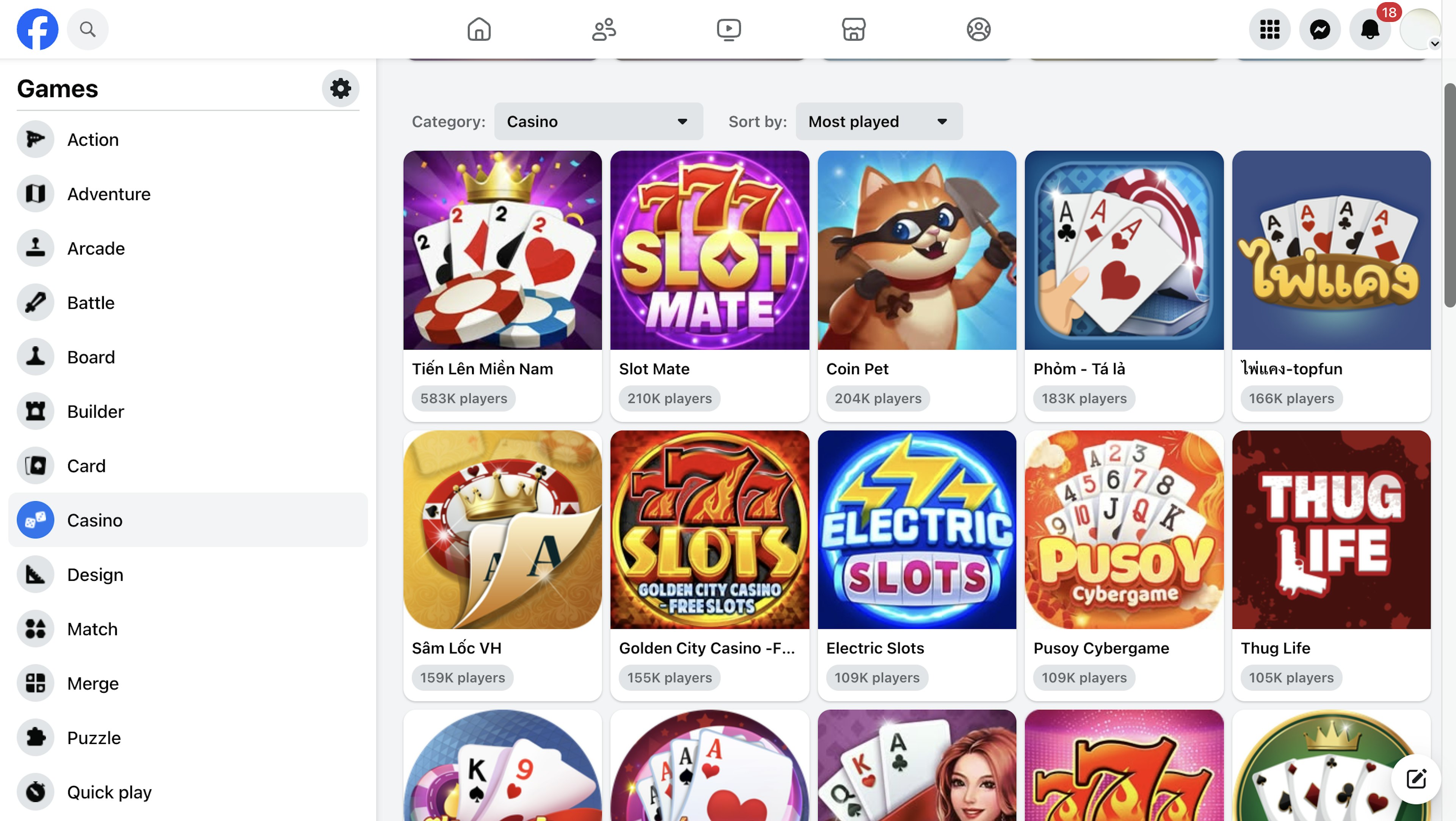
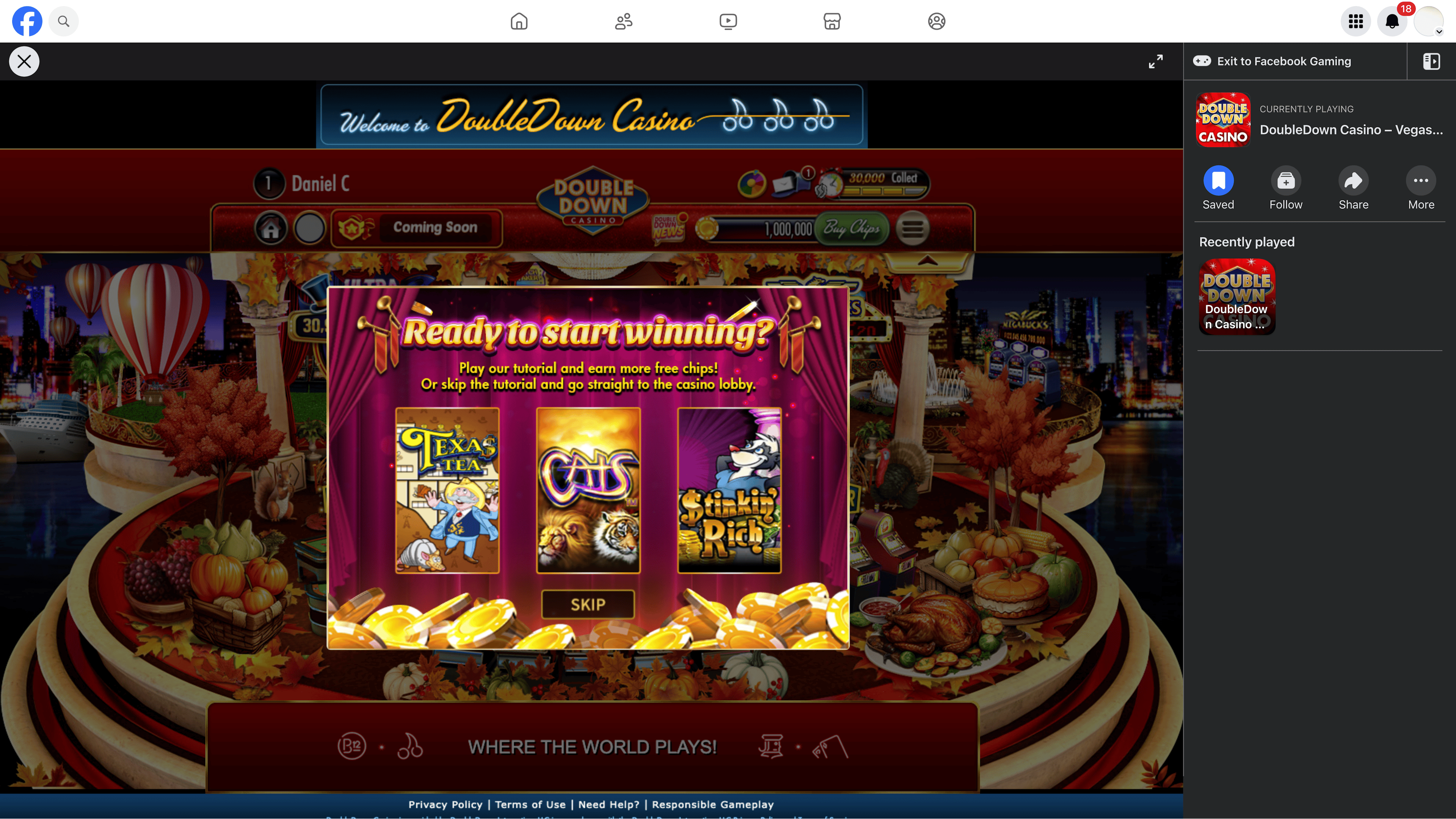
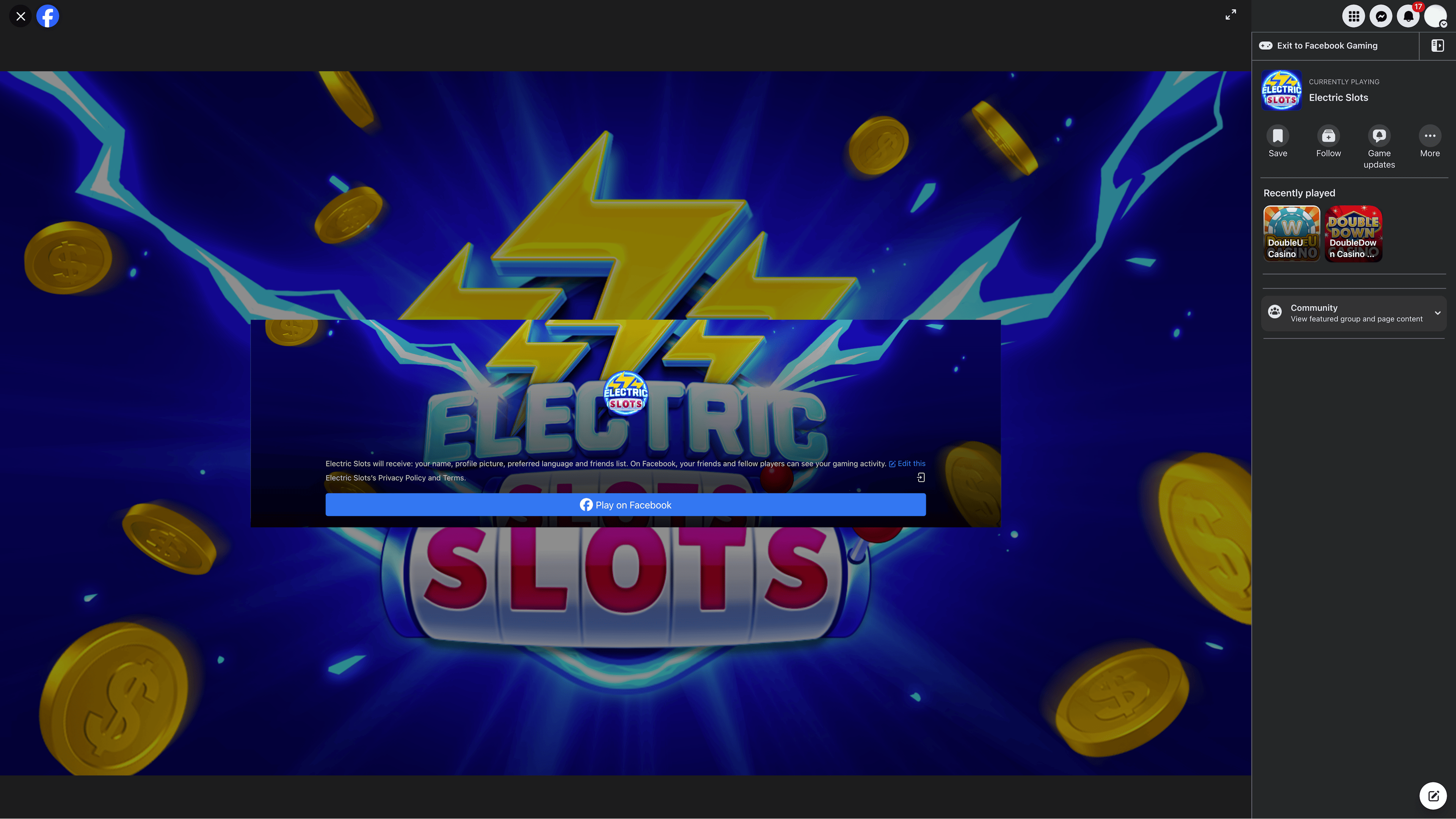
Facebook's games section includes a “casino” category with dozens of offerings.
Facebook's games section includes a “casino” category with dozens of offerings.
Facebook’s role
Facebook does far more than simply host social casinos apps. It also provides them with tools to attract new players and keep them playing longer, while taking a cut of the resulting revenue stream.
Meta has detailed how several social casino app developers use Facebook features to boost their user base, highlighting them as “success stories.”
One developer, the abovementioned DoubleU Games, used Meta’s “lookalike” advertising tool “to identify new audiences similar to their current player segments.” DoubleU Games also used Facebook’s sharing feature “to create a viral effect,” gaining 750,000 new visits to its Double U Casino game every day, Meta said.
Another developer, Murka, encouraged people playing its Scatter Slots game to invite friends to log into Facebook so they could see each other’s progress and play in tournaments together. According to Meta:
“Not only did Facebook logged in players show high engagement, but they also monetized better. 35% of Scatter Slots monthly average users used Facebook Login to sign in, and these players showed 7X higher tendency to pay compared to other players. Facebook logged in players currently generate 71% of the total revenue of the game.”
Murka also used Facebook’s lookalike tool and demographic data to determine which players were claiming hourly bonuses in the game, adjusting its outreach to target those who were not.
Murka did not respond to a request for comment. Murka's website indicates that it was acquired by investment giant Blackstone in 2019, but a representative of Blackstone, Alexandre Pichot-Nussle, said his firm exited its investment in Murka and no longer owns it. He declined to answer questions about who now owns Murka.
Facebook is providing these audience-building features while taking a 30% service fee when the players of these games buy virtual chips on its platform. (Facebook does not allow players to make in-game purchases on the Facebook iOS app for iPhone and iPad, presumably because Apple would charge its own 30% fee.)
Facebook began requiring all gaming companies to use its payments system and pay the fee in 2011. It also collects revenue when social casino apps run ads on its platform.
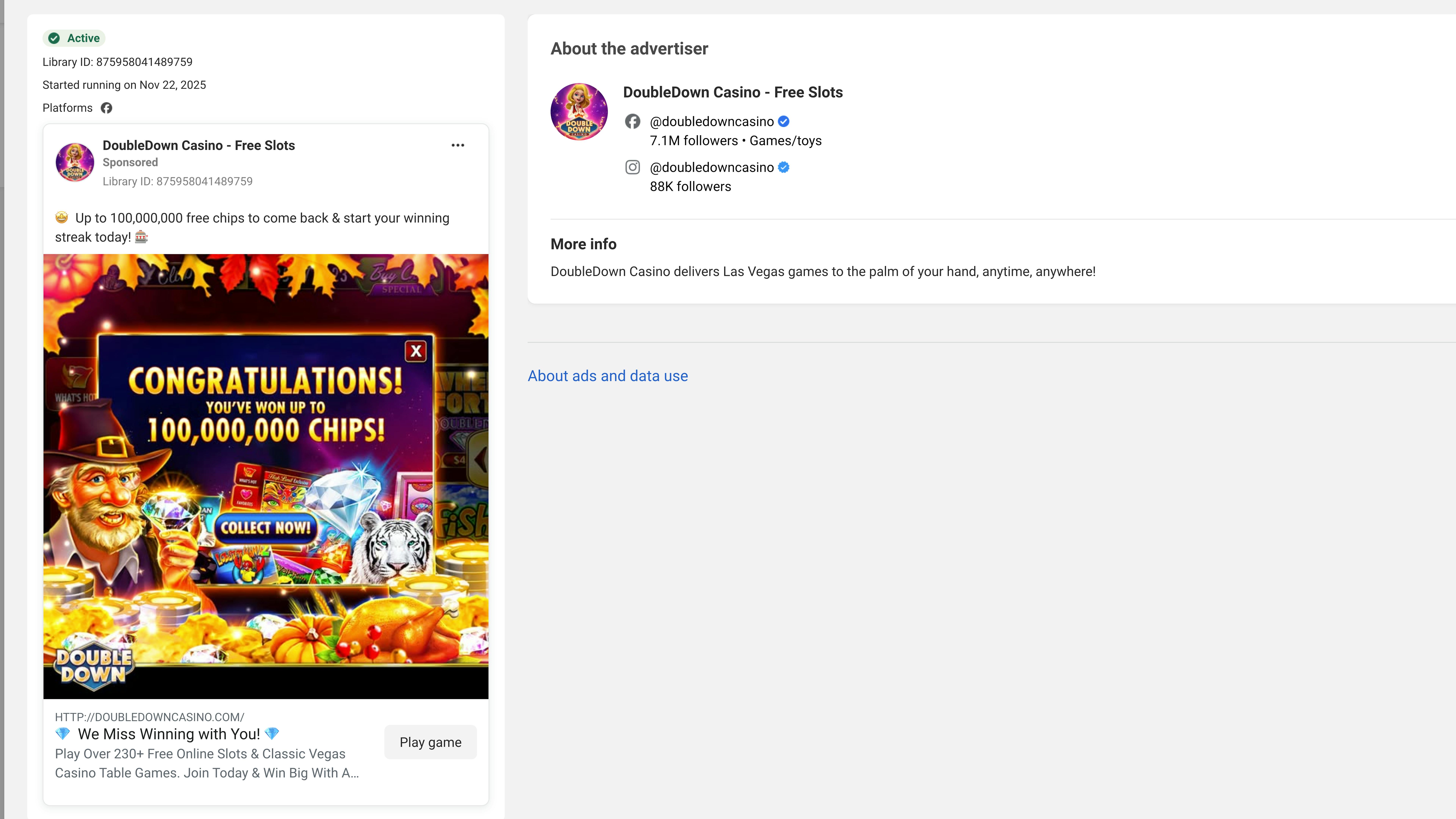
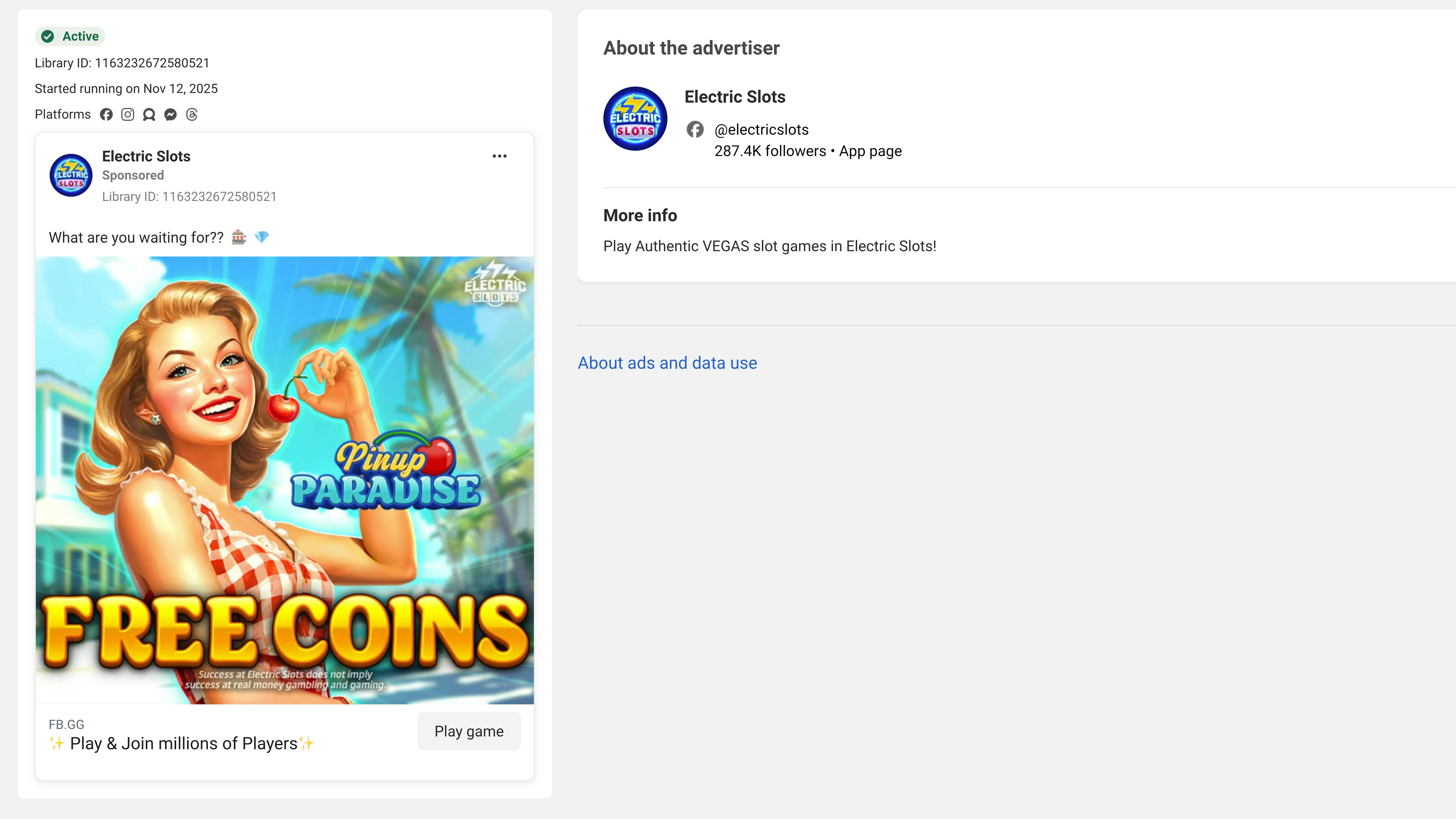
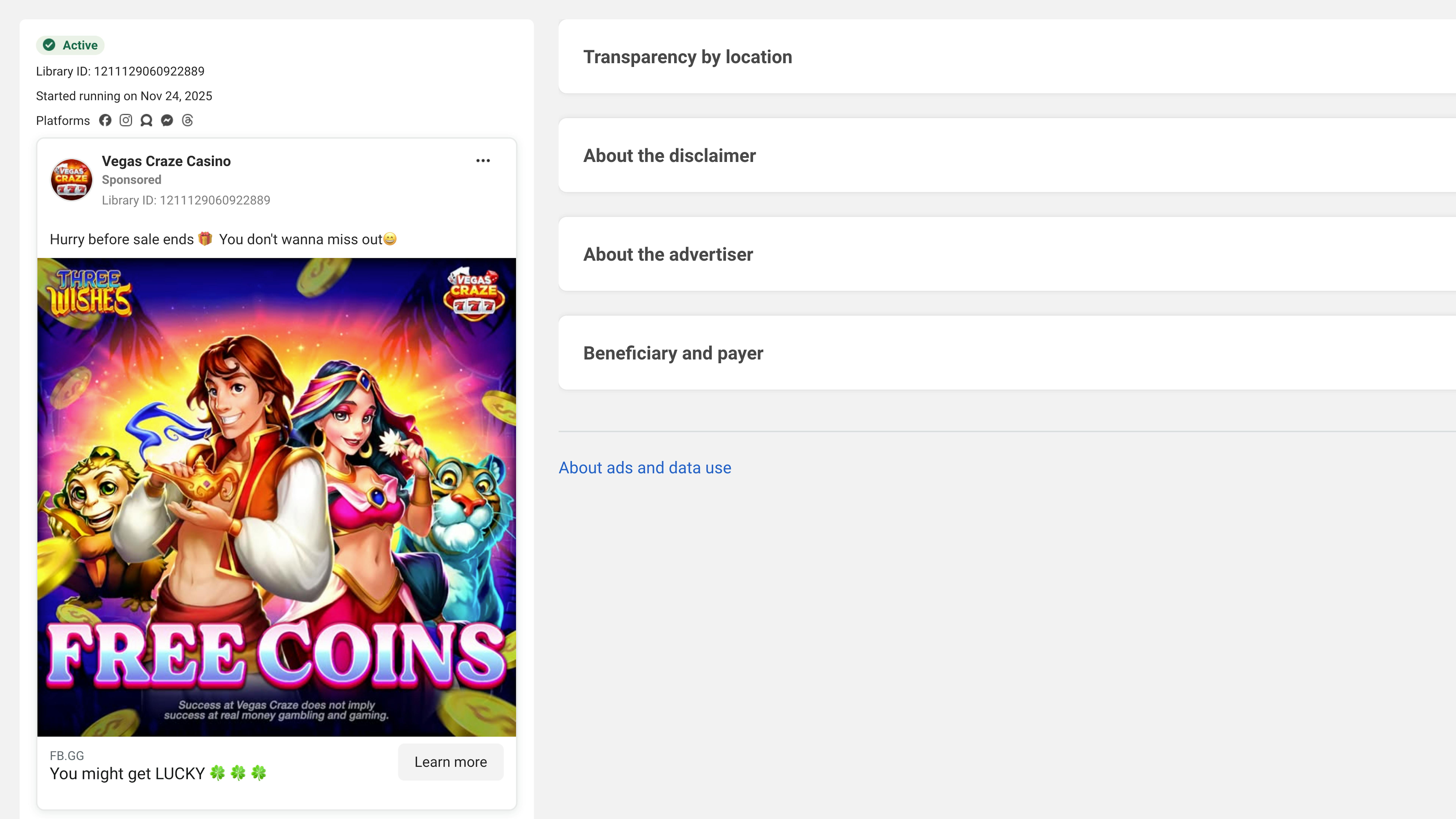
DoubleDown Casino is among the social casino apps running ads on Facebook.
DoubleDown Casino is among the social casino apps running ads on Facebook.
The class action lawsuit brought in federal court in California accuses Facebook of “ongoing participation in an illegal internet gambling enterprise,” in violation of an array of state gambling and consumer protection laws, as well as federal racketeering law.
According to the lawsuit, Facebook hosts, promotes, and profits from 50 illegal social casino apps. The apps have a "predatory design and business model," and through their partnership with Facebook and other platforms, they've "found a way to smuggle slot machines into the homes of consumers nationwide, twenty-four hours a day and three-hundred-sixty-five days a year," the suit alleges.
The case names 26 plaintiffs, living in 15 different states, who played the games and made purchases through Facebook, sometimes exceeding $200,000. The plaintiffs in the case include an Illinois woman who said she has spent about $240,000 playing DoubleDown Casino through Facebook. Her addiction cost the woman her retirement savings and forced her to find a job at age 70.
Similar suits have also been brought against Apple and Google, which also collect commissions from the games.
In September 2025, a federal judge rejected an attempt by the platforms to have the case dismissed. The platforms argued that Section 230 of the Communications Decency Act, which shields tech platforms from liability for user-generated content, protected them from the case. But the judge rejected that argument, ruling that the companies are not acting as publishers when they process payments for the games.
Apple and Google did not respond to requests for comment.
Sweepstakes casinos
Facebook is also profiting from advertising the company runs for so-called sweepstakes casinos. Facebook runs a steady stream of ads for the online games—and uses its data to help operators target their pitches—even as a growing number of states declare the games illegal.
Sweepstakes casinos offer traditional games such as poker, blackjack, and slot machines. Like social casinos, they provide free-to-play options, and they give players the chance to spend real money for extended play and other features. But they also offer the chance to collect real prizes and cash payouts.
For example, one popular sweepstakes casino, Chumba Casino, lets players use real money to purchase “gold coins” to continue playing when their free chips run out. Chumba also offers “sweeps coins,” which come as a bonus for certain activities—like signing up, or logging in on every day—that can be exchanged for real prizes.
Sweepstakes casino operators have used this dual currency system to argue that, because betting on the games does not take place with real money, they don’t need a gambling license to operate.
Several states, including New Jersey, Connecticut and California, have enacted legislation banning the games. Attorneys general and state regulators have declared the games illegal in several more, issuing more than 100 cease-and-desist letters and warning consumers about the risks of playing the unregulated games.
A review by TTP found that at least 30 sweepstakes casinos are advertising on Facebook, with several running hundreds of ads in October-November 2025, according to Meta’s Ad Library. The Ad Library does not provide information on where the ads ran, so TTP could not determine if they ran in states where the sweepstakes casinos have been declared illegal.
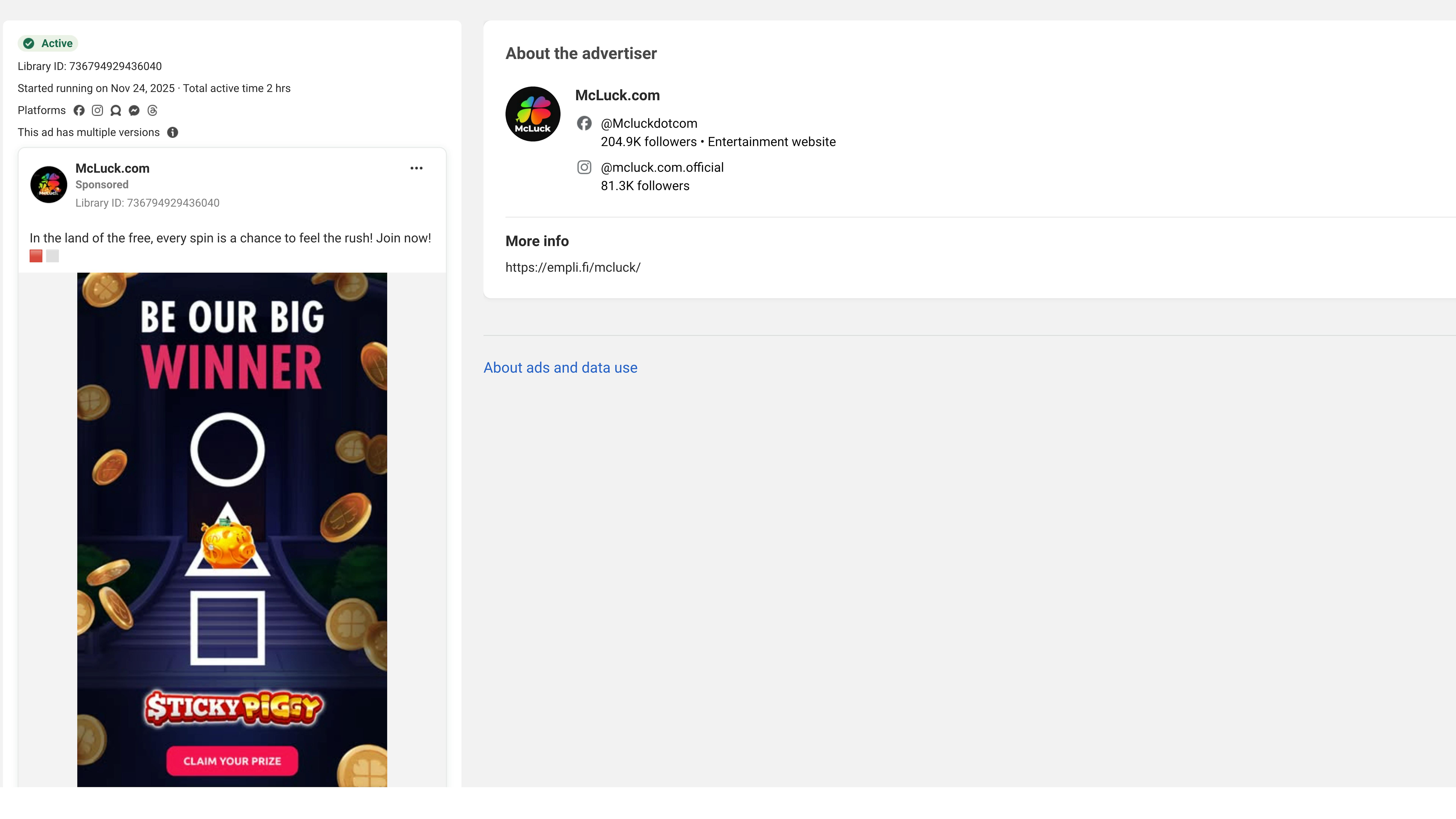
McLuck, which was recently shut down in Maryland and New York, had 110 active ads running on Meta platforms in early November 2025, according to the Meta Ad Library. Many were running on Facebook, Instagram, Threads and Messenger. And, as Facebook explains, many were using the platform’s data and other tools to help them reach players:
"This ad uses one of our dynamic products, where advertisers provide a combination of images, text and platform-specific preferences so our system can automatically create the right combination for the audience."
TTP reached to McLuck for comment. The company acknowledged receipt of TTP's email but did not immediately provide a comment.
Among the most prolific sweepstakes casino advertisers on Facebook is Virtual Gaming Worlds (VGW), an Australian company that owns and operates at least three active online casinos: the abovementioned Chumba Casino, Global Poker, and LuckyLand Slots.
Chumba Casino had about 1,000 active Facebook ads in early November, according to the Ad Library. Global Poker had about 440, and LuckyLand Slots had nearly 100. All were advertising on multiple Meta platforms.
State regulators and law enforcement officials around the country have recently shut down VGW and its sweepstakes casino games, saying they are illegal.
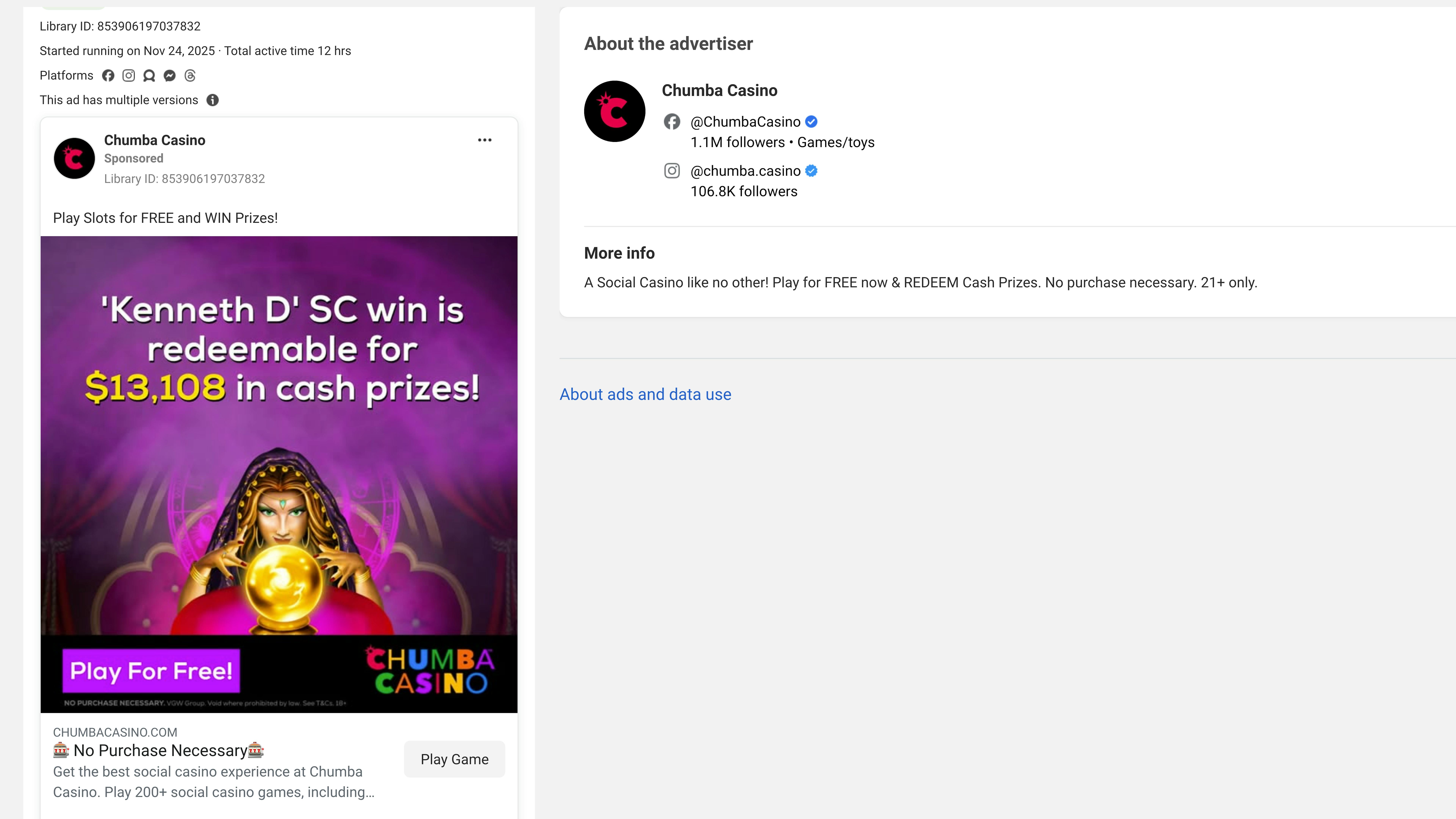
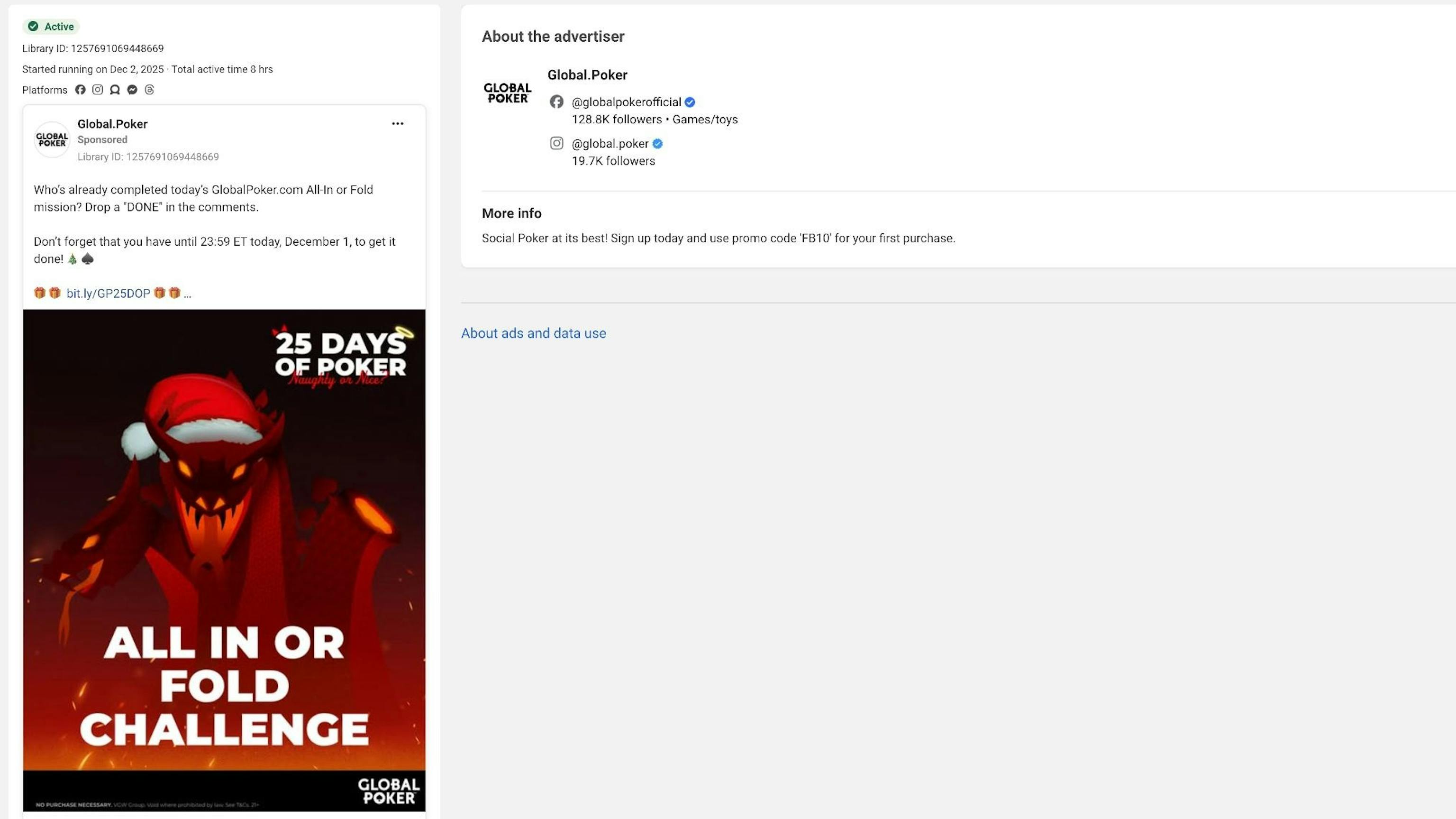
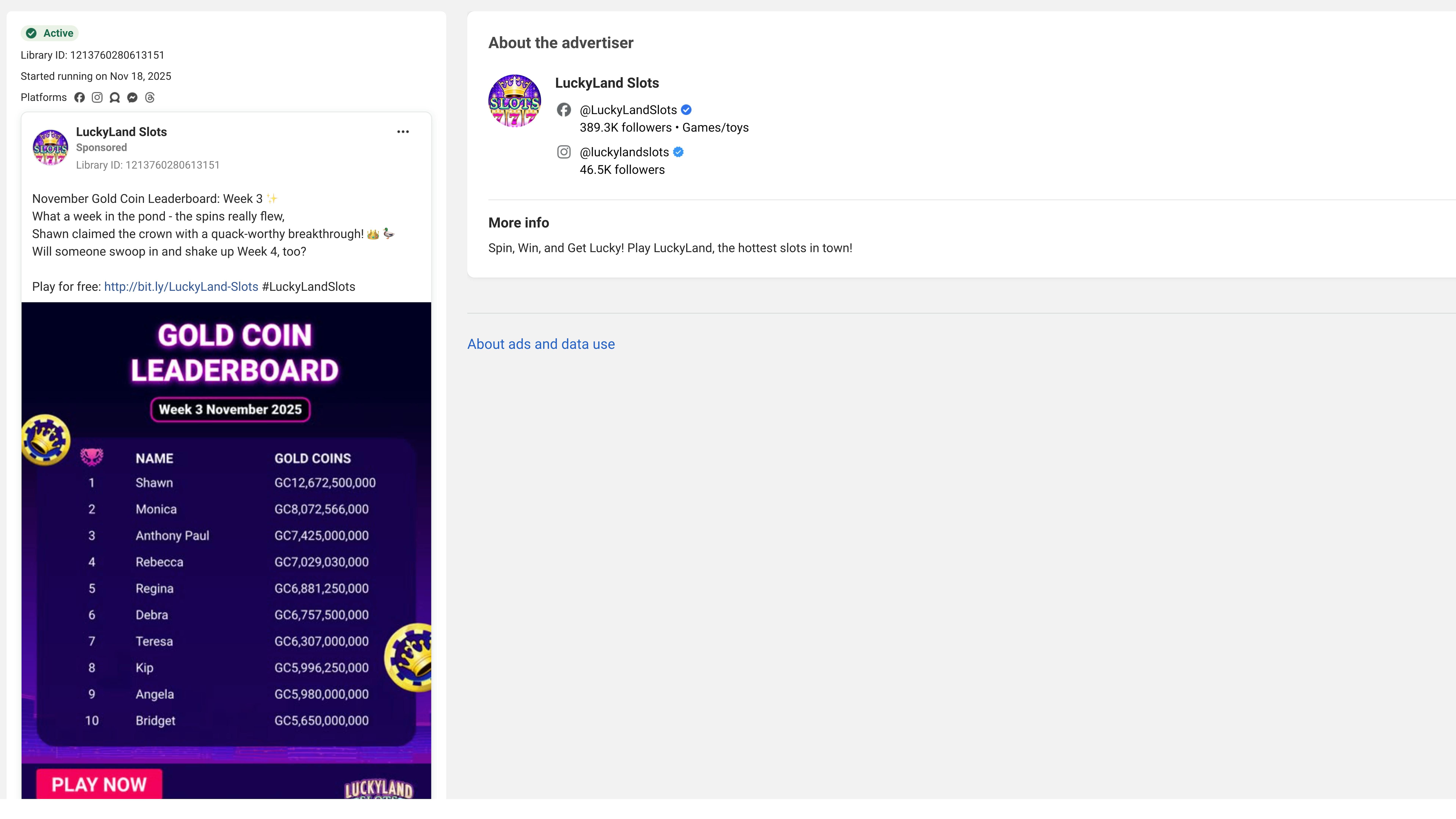
Among the most prolific sweepstakes casino advertisers on Meta is Chumba Casino from Virtual Gaming Worlds (VGW).
Among the most prolific sweepstakes casino advertisers on Meta is Chumba Casino from Virtual Gaming Worlds (VGW).
In New York, Attorney General Letitia James issued a cease and desist in June 2025 to 26 online platforms, including three VGW apps, saying, “Online sweepstakes casinos are illegal, dangerous, and can seriously ruin people’s finances.”
Amid the intensifying scrutiny, VGW now says it does not offer sweepstakes casinos in eight states, but does offer other games in those places.
VGW declined to comment.
It is unclear if Meta has taken any steps to modify its policies to adjust to the changing legal landscape. According to the company’s current advertising policy, online gambling apps must get an initial authorization to run ads in specific states, to ensure they are legally permitted to do so. Once the app receives this authorization, however, they can advertise in other states without getting additional approvals from Meta. According to Meta, the app is responsible for determining if it complies with any local laws.
“Advertisers are responsible for their compliance with local regulations and are expected to only run online gambling and gaming ads for which they are legally permitted,” the company’s ad policy states. “Meta is not responsible for how authorized ad accounts comply with local gambling laws and regulations.”
Google has made some changes in its approach to sweepstakes casinos. In October 2025, company modified its gambling and games policy to clarify that sweepstakes casinos are not considered social casinos. The change makes the games subject to the stricter rules that apply to gambling products.